Gold Price Forecast: Tempered hawkish Fed bets lift XAU/USD near $4,500
- Gold price holds onto Thursday’s gains at around $4,470 as traders trim Fed’s interest rate expectations.
- Hawkish Fed bets cool down after expression of confidence from Fed’s Waller that price pressures are decelerating.
- Investors keenly await the US NFP data for August.

Gold clings to its previous day’s gains on Friday ahead of the United States (US) Nonfarm Payrolls (NFP) data for August, which will be published at 12:30 GMT.
Soft US ADP data sets challenging stage for US NFP
Ahead of the US NFP data, weak US ADP Employment Change data for August has set an unfavorable backdrop. The data showed on Wednesday that US private payrolls rose by 38K, the weakest pace since February and were below market expectations of 46K.
Looking ahead to the official labour market report, TD Securities says, "We expect August NFP to rebound to 95k after July posted a decline of 23k," and stresses that "risks to our payrolls forecasts appear hawkish, and we would not rule out an outsized positive surprise." On the jobless rate, the bank expects limited movement, noting that "the UE rate likely went sideways at 4.1% with balanced risks." TD Securities concludes that "a modestly hawkish employment report will reaffirm the Fed's attention on inflation, but it will be by itself unlikely to push the Committee towards hikes."
The US official employment data is expected to have a significant influence on the Federal Reserve’s (Fed) monetary policy outlook, which could drive the next move in the Gold price.
Traders push back Fed interest rate hike bets
Currently, traders have trimmed hawkish Fed bets after comments from Fed Governor Christopher Waller at the Reuters NEXT Newsmaker event on Thursday, in which he appeared confident about price pressures deflating recently.
The CME FedWatch tool shows that the odds of the Fed hiking interest rates in the September meeting have diminished to 50% from 63.2% seen on Wednesday.
“Finally seeing some signs of disinflation in recent data," Fed’s Waller said, and added, “If August Consumer Price Index (CPI) data confirms inflation pressures are cooling off, he would incline to support holding the policy rate steady at the September policy meeting.”
Fed’s Waller didn’t rule out the possibility of a small adjustment in monetary policy "if August inflation data shows progress has reversed”.
On the geopolitical front, elevated oil prices due to interrupted global energy supply in the wake of Middle East tensions could limit the upside in the Gold price.
This week, military aggression between the US and Iran resumed, following weeks of relative calm, as the US Central Command (CENTCOM) struck Iranian rocket launchers that were preparing to send mines into the Strait of Hormuz, a critical passage to almost one-fifth of global energy supply.
Gold Technical Analysis
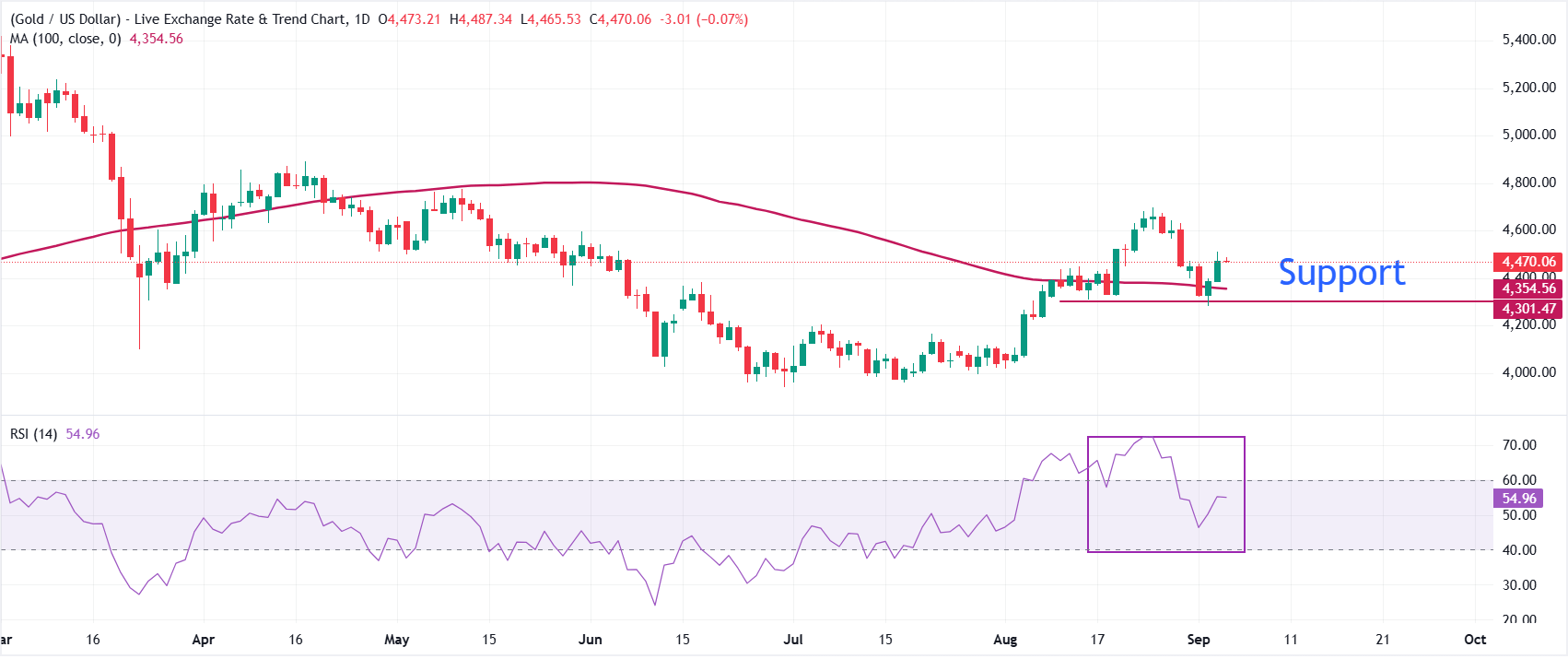
In the daily chart, XAU/USD trades at $4,469.86, retaining a bullish near-term bias as spot holds above the 100-day simple moving average (SMA) at roughly $4,354.56.
The price structure suggests buyers remain in control while the Relative Strength Index (RSI) near 55 hints at modest positive momentum without yet reaching overbought territory.
On the downside, immediate support is aligned with the 100-day SMA around $4,354.56, where a decisive break could expose deeper corrective pressure toward prior reaction lows at around $4,300. Looking up, the August high at around $4,697 seems the key hurdle for the precious metal.
(The technical analysis of this story was written with the help of an AI tool. Know more.)
Gold FAQs
Gold has played a key role in human’s history as it has been widely used as a store of value and medium of exchange. Currently, apart from its shine and usage for jewelry, the precious metal is widely seen as a safe-haven asset, meaning that it is considered a good investment during turbulent times. Gold is also widely seen as a hedge against inflation and against depreciating currencies as it doesn’t rely on any specific issuer or government.
Central banks are the biggest Gold holders. In their aim to support their currencies in turbulent times, central banks tend to diversify their reserves and buy Gold to improve the perceived strength of the economy and the currency. High Gold reserves can be a source of trust for a country’s solvency. Central banks added 1,136 tonnes of Gold worth around $70 billion to their reserves in 2022, according to data from the World Gold Council. This is the highest yearly purchase since records began. Central banks from emerging economies such as China, India and Turkey are quickly increasing their Gold reserves.
Gold has an inverse correlation with the US Dollar and US Treasuries, which are both major reserve and safe-haven assets. When the Dollar depreciates, Gold tends to rise, enabling investors and central banks to diversify their assets in turbulent times. Gold is also inversely correlated with risk assets. A rally in the stock market tends to weaken Gold price, while sell-offs in riskier markets tend to favor the precious metal.
The price can move due to a wide range of factors. Geopolitical instability or fears of a deep recession can quickly make Gold price escalate due to its safe-haven status. As a yield-less asset, Gold tends to rise with lower interest rates, while higher cost of money usually weighs down on the yellow metal. Still, most moves depend on how the US Dollar (USD) behaves as the asset is priced in dollars (XAU/USD). A strong Dollar tends to keep the price of Gold controlled, whereas a weaker Dollar is likely to push Gold prices up.
Author

Sagar Dua
FXStreet
Sagar Dua is associated with the financial markets from his college days. Along with pursuing post-graduation in Commerce in 2014, he started his markets training with chart analysis.