US Dollar at breaking point: China tariff clash risks collapse to 95 or even 92

Farmers, Boeing, and tech sectors brace for severe damage as USD threatens to break critical 10-year support amid escalating trade tensions.
Technical breakdown: Crucial USD zone under threat
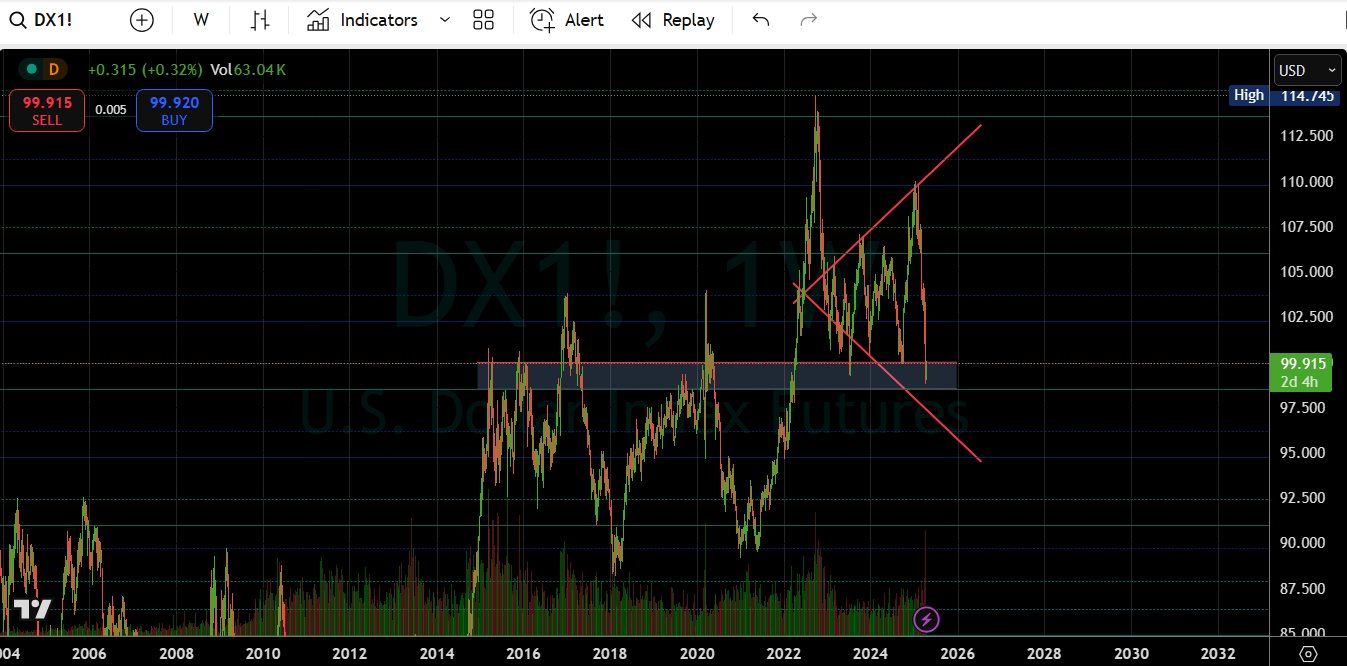
The US Dollar Index (DXY) currently sits precariously within a critical 10-year support and resistance zone between 100 and 98. Historically, this key price area has repeatedly served as a midpoint equilibrium, dictating significant directional shifts. A decisive breach below this support could unleash substantial downward momentum, targeting deeper psychological and technical levels at 95 or potentially 92.
Examining a 10-year price cycle reveals a consistent pattern: whenever the USD has broken below this midpoint zone, it has lingered and struggled to regain upward traction. Currently, the short-term reprieve provided by the temporary 90-day tariff halt may offer brief support—but the underlying macroeconomic stress signals growing vulnerability.
Fundamental factors: Tariff war's long-term damage
While the US administration's aggressive tariff strategy against China was intended to protect American industries, its effects are increasingly backfiring—posing significant long-term risks to the US dollar and economy.
Agriculture:
US farmers are already suffering substantial losses. China, a critical export destination for American meat, grain, and soybeans, has drastically reduced purchases in retaliation. The direct result is declining farm revenues, increased inventory buildup, and weakening regional economies dependent on agricultural exports.
Aviation (Boeing):
One of America's largest manufacturing exporters, Boeing has become a recent casualty. Tariff escalations and strained diplomatic relations have severely affected aircraft sales to China—its biggest overseas market. With Boeing's market dominance already challenged by competitors like Airbus, prolonged tariffs could have dire financial implications, further pressuring USD sentiment.
Technology and semiconductor industries:
The US tech sector, including semiconductor giants such as Intel, Nvidia, Qualcomm, and Apple, heavily relies on Chinese manufacturing and consumption markets. Tariffs imposed on Chinese components and retaliatory measures have led to significant supply chain disruptions, increased production costs, and lower profit margins. Extended trade tensions risk permanently damaging these companies' competitiveness and earnings potential.
Retail and consumer goods:
American retailers, from Walmart to Amazon, are also exposed to China's tariff retaliation. Rising import costs translate directly into higher consumer prices, diminished purchasing power, and potential slowdowns in consumer spending—key pillars underpinning US economic growth and, by extension, dollar strength.
Why the Dollar could sink further
As these vital sectors face prolonged pressure, broader economic fundamentals weaken. Reduced export revenues, rising domestic costs, and declining consumer confidence collectively undermine investor sentiment toward the US dollar. Moreover, sustained trade tensions might force the Federal Reserve into more accommodative monetary policies, potentially leading to rate cuts—a scenario traditionally bearish for the USD.
If the current trajectory persists, the US dollar could face intensified selling pressure, propelling it towards critical psychological and historical support levels at 95, with an even deeper potential retreat toward 92.
Bottom line
The dollar now stands at a pivotal crossroads. With crucial sectors like agriculture, aviation, technology, and retail deeply vulnerable to prolonged US-China trade conflict, a fall below the critical 10-year support at 98 would signal a significant bearish shift. Investors and policymakers alike must brace for volatility as the implications of this trade war continue to unfold.
Author
Denis Joeli Fatiaki
Independent Analyst
Denis Joeli Fatiaki possesses over a decade of extensive experience as a multi-asset trader and Market Strategist.