|

US Core PCE: Expect stock, USD, and Gold volatility

The CORE PCE print is the Fed’s preferred measure of inflation and for that reason, it is extremely important for the Fed as it assesses how well the fight against inflation is going. Remember, the key narrative at the moment is the Fed trying to balance banking fears with an inflation fight.

  • If banking fears become more pronounced the Fed will be more likely to cut rates.

  • If inflation data prints higher than expected then the Fed will be more likely to raise rates.

Current rate expectations

At the moment, short-term interest rate (STIR) markets see the Fed cutting rates twice this year. See the Financial Source’s interest rate tracker below. STIR markets see US Interest rates at 4.22% at the end of the year, down from the current 4.875% level.
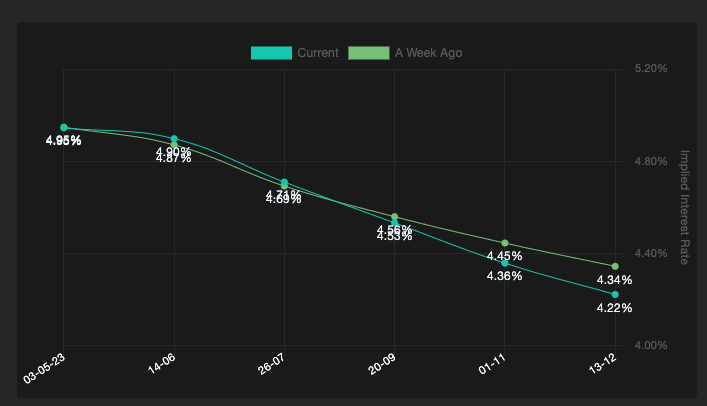
Chart

The probability of another 25bps rate hike or an on-hold decision is priced as 50/50 coin toss.

Core PCE

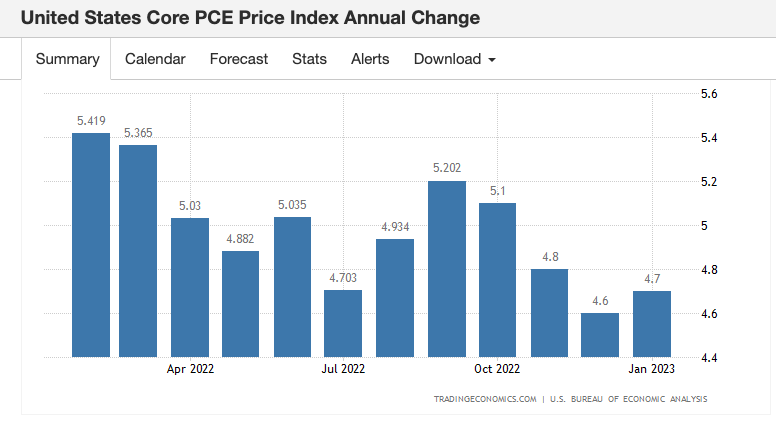
The PCE print is the personal consumption expenditures print that measures the spending on goods and services by the citizens of the United States. Around 2012 the PCE index became the main inflation index used by the Federal Reserve to inform its policy decisions. The core y/y print is expected to come in at 4.7%. January’s print came in higher than December’s and February’s print on Friday is expected to come in higher again. A rising core PCE print signals that the Fed still has to do more to tackle inflation.
Chart

If the print comes in below 4.5% on Friday that will take the pressure off the Fed to hike rates and should result in some S&P500 upside, USD weakness, and precious metal upside.

If the print comes in above the maximum expectations of 4.9% then that will increase the pressure on the Federal Reserve and should weigh on the S&P500, boost the USD, and weigh on precious metals. However, with real yields falling any deep dips in gold could be good buying opportunities.

XAUUSD

Learn more about HYCM

Author

Giles Coghlan LLB, Lth, MA

Giles is the chief market analyst for Financial Source. His goal is to help you find simple, high-conviction fundamental trade opportunities. He has regular media presentations being featured in National and International Press.


More from Giles Coghlan LLB, Lth, MA
Share:

Editor's Picks

GBP/USD hits multi-week tops around 1.3560

GBP/USD gathers fresh steam and advances to new three-month peaks near the 1.3560 zone on Friday. Cable’s sharp move higher comes after three daily drops in a row and follows the increasing selling pressure hurting the Greenback.

EUR/USD pops to fresh two-month highs, targets 1.1600

EUR/USD advances markedly, revisiting the upper 1.1500s for the first time since mid-June. The pair’s sharp uptick comes on the back of a strong retracement in the US Dollar amid BoJ intervention chatter and despite steady uncertainty in the Middle East.

Gold picks up pace, approaches $4,400

Gold rebounds toward the $4,400 mark per troy ounce on Friday, reversing the previous day’s pullback. The precious metal’s recovery comes as fresh and intense weakness keep weighing on the US Dollar, while traders keep assessing easing expectations of an imminent Fed interest rate hike and the situation from the Middle East.

Pi Network Price Forecast: PI extends consolidation as bulls eye $0.10
Pi Network (PI) price holds steady on Friday, maintaining a consolidating tone for three consecutive days. Mild retail strength in the PI token remains stable, with Open Interest above $9 million, while social buzz eases. PI token’s technical outlook is mixed, as bearish momentum wanes to neutral, with bulls eyeing the $0.1000 psychological level.
 Weekly focus: Some relief in US inflation concerns

Actual inflation data for July came out as expected with a 0.1% m/m increase in headline CPI and 0.2% excluding food and energy. Annual headline inflation remains too high at 3.4% and means that wage earners are experiencing stagnating spending power at best, and core inflation is a bit higher than the inflation target of two percent would suggest.

Why is Crude Oil priced for a reopening the ships haven't made?
Fourteen vessels crossed the Strait of Hormuz on Tuesday. Before the war, the count ran near 120 a day. In the sessions since the waterway was publicly declared open, Brent has drifted back to $87 and West Texas Intermediate (WTI) to $81, both a little lower again on Wednesday, with daily momentum on each unwound from the top of its range in late July to the low twenties now.