United States suspends Iran Oil sanctions while Trump hints at winding down Middle East operations
- Treasury issues thirty day waiver authorizing Iranian oil sales until April nineteenth
- Administration brings four hundred forty million more barrels to global energy markets
- President Trump hints at winding down military operations in Middle East soon
The U.S. government issued a 30-day waiver permitting sale and delivery of Iranian crude already loaded on tankers, an action expected to release approximately 140 million barrels into global markets and reduce pressure on energy prices. The Treasury Department's Office of Foreign Assets Control (OFAC) published the temporary license Friday after market close, valid until April 19.
The measure authorizes relevant transactions, including importation into the United States when necessary, although the U.S. has not imported Iranian oil since the Islamic Revolution more than four decades ago.
Timing of the waiver coincides with intensified conflict in the Middle East. Oil surged approximately 50% since the U.S. and Israel began joint airstrikes against Iran in late February, pushing prices above $100 per barrel. The surprise attack and Iranian retaliation effectively closed the Strait of Hormuz, which handles roughly 20% of global oil traffic. Treasury officials stated supplies will reach Asian ports within days, though uncertainty remains whether the U.S. will directly import Iranian crude.
China has exploited the situation by purchasing sanctioned Iranian oil at discounted rates. European nations where fuel prices have soared—including Italy and Greece—were major Iranian oil buyers before U.S. sanctions took effect in 2018. Now, the new waiver permits those markets to access supply again, potentially alleviating price pressure affecting European economies.
Trump proposes reducing military operations while administration adds 440 million barrels to global markets
President Trump suggested on Truth Social that the government is "very close" to accomplishing its objectives in the Gulf and is "considering winding down" military operations regarding the Iranian regime. Signal suggests the administration seeks de-escalation as midterm elections approach in November. Trump listed objectives as: degrading Iran's missile capability, preventing its approach to nuclear capacity, and protecting U.S. allies in the region.
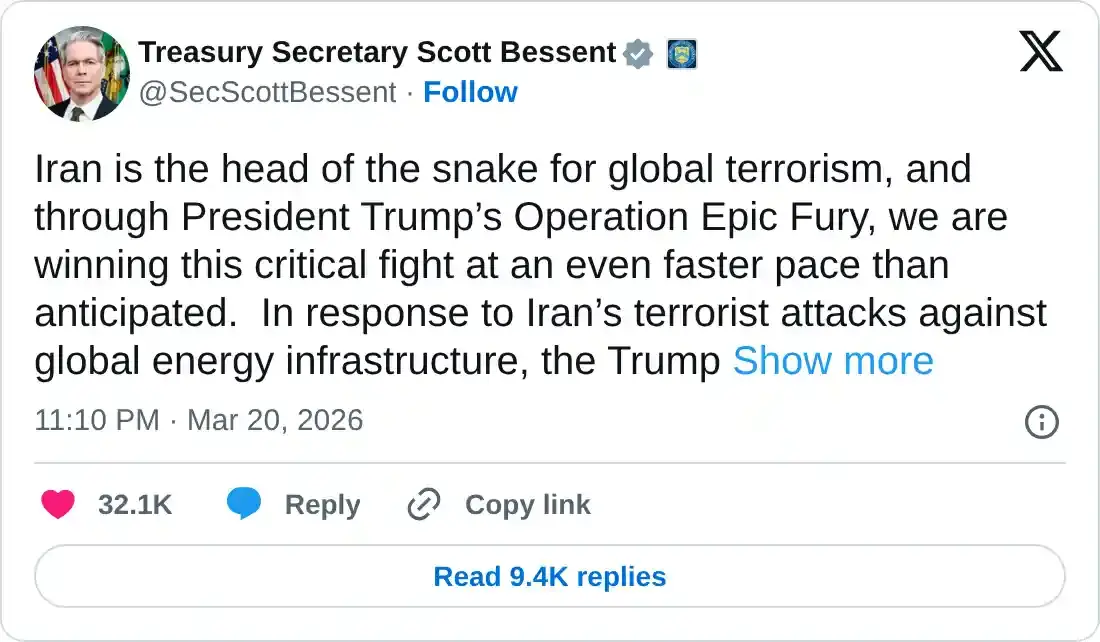
Separately, Washington already permitted India to purchase Russian oil in transit despite earlier threatening sanctions. The administration subsequently authorized other nations to buy Russian crude as well, with waiver valid until April 11. On March 19, OFAC replaced it with new license. Treasury Secretary Scott Bessent announced on social media that "so far, the Trump Administration has been working to bring around 440 million additional barrels of oil to the global market."
Both waivers—Iranian and Russian—exclude transactions involving North Korea, Cuba, and Crimea annexed by Russia. Trump's approach balances messaging of toughness against Iran (characterizing the regime as "the head of the snake of global terrorism") with pragmatic actions increasing supply to stabilize prices.
Combination suggests political calculation: demonstrate strength before retreat, reducing economic damage affecting American voters. Recent escalation of attacks on energy infrastructure in the region has intensified conflict, making de-escalation politically attractive to avoid additional retaliation destabilizing global energy markets.
Author

Isai Alexei
Independent Analyst
I am Isai Alexei. I work as a journalist and financial analyst covering cryptocurrency markets and traditional securities. I have spent ten years analyzing digital assets, trading activity, and market structure.