UK tax U-turn triggers bond market turmoil
- UK yields surge as bond market weighs up unfunded spending pledges.
- Bad politics weighs on pound.
- Budget now a high stakes event for UK fiscal stability.
- Risk sentiment remains sour.
- US tech stocks test key level that could determine further downside.


The UK Gilt market is under pressure this morning, and yields have surged at the open, after reports suggest that Rachel Reeves will scrap plans to raise income tax. We do not know if this will mean all bands of income tax will be left unchanged, or if it will only mean the basic rate of tax will be unchanged, however, either way, the Chancellor is now faced with finding an alternative plug to fill the estimated £30bn fiscal hole in less than 2-weeks.
Unfunded spending pledges sends yields soaring
This also means that the Chancellor has signaled billions of unfunded spending pledges, which the bond market is not fond of. Hence why yields are rising sharply across the curve. The 10-year yield is higher by 10bps, while the 2-year yield is higher by 9bps at the open. 30-year yields are taking an even bigger hit and are higher by 12bps.
Bond market volatility is not what the Chancellor wants to see with less than two weeks to go before the budget. Essentially, the bond market is warning the chancellor that she cannot merely tax the ‘rich’ to fund her lavish spending pledges. Either she broadens the tax base, or she cuts spending.
Market desperately seeking clarity from government
In the past, the chancellor has reversed course based on the bond market reaction, will she reverse the reversal on income tax this time? Either way, someone needs to give the market clarity on what this Budget will deliver, otherwise it could be a bloodbath for the Gilt market. Is the Starmer government New Labour or Old Labour? At the election they positioned themselves as New Labour, but now it increasingly feels like they are Old Labour, which comes with a fiscal cost and higher borrowing rates for the UK.
The u-turn on income tax rises, while better for growth in a service-based economy, does leave markets scratching their heads about how to fund scrapping the two child benefit cap, the ballooning benefits bill and Britain’s defense commitments.
Instead, the Budget is likely to be death by a thousand cuts, in the form of hundreds of tax rises announced on the 26th, which one source called a smorgasbord of fiscal choices for the chancellor.
Bad politics weighs on Gilt and pound
The pound is slumping today and is the weakest currency in the G10 FX space, however it still remains above the lows from earlier this week. GBP/USD fell to $1.3080 on Wednesday and is currently trying to hold onto $1.3100. However, sentiment remains weak, and it is hard to see a meaningful recovery in the pound ahead of this Budget. But, it is worth noting that GBP/USD has been able to stay above $1.30 even with budget speculation that has been brewing for months, this is largely because the USD is also under pressure.
Bad politics is what is weighing on the pound and the Gilt market on Friday. The positioning of this Budget is farcical. Drip feeding the media potential tax rises for months, a strange press conference all but announcing an income tax rise, scrapping benefit reform, and hints that the two-child benefit cap will be reversed, gives the impression that there are no adults in the room capable of getting a grip on the UK’s fiscal challenges. The bond market may have been kind to the Chancellor in the past few months, but it increasingly looks like she has used up all of its goodwill.
Risk sentiment sours as investors doubt Fed’s pre-Christmas rate cut
Elsewhere, the overall market mood is grim as we end the week. Concerns about high tech stock valuations, and fears that the Fed won’t cut rates next month sent US stocks tanking on Thursday. The sell-off was led by the consumer discretionary and tech sectors, which both fell by more than 2%. The biggest decliners in the US included Robinhood, Walt Disney, Coinbase and Tesla.
European stocks have followed Asian stocks lower today, with a 0.8% decline for the FTSE 100, after a sharp drop in the oil price on Thursday. However, the oil price is higher by more than 1% on Friday morning, and the price of Brent is back above $63.80, after a Russian oil depot and tanker were damaged by a Ukrainian drone attack.
Likewise, US equity market futures are in the red, but are pointing to milder losses on Friday. Expectations of a Fed interest rate cut next month have slumped to 50%, a month ago a rate cut was a near certainty. This could limit any chance of a stock market recovery until we see the latest US economic data now that the government shutdown has ended.
US tech stocks test key level
The US tech sector continues to get slammed by valuation concerns and fears about AI bets not paying off. The Bloomberg Magnificent 7 tech stock index is testing its 50-day moving average, as you can see below. If it breaches this level, then it would suggest that short-term momentum is to the downside and further declines in tech stocks, and major US indices, are possible.
Magnificent seven, with moving averages
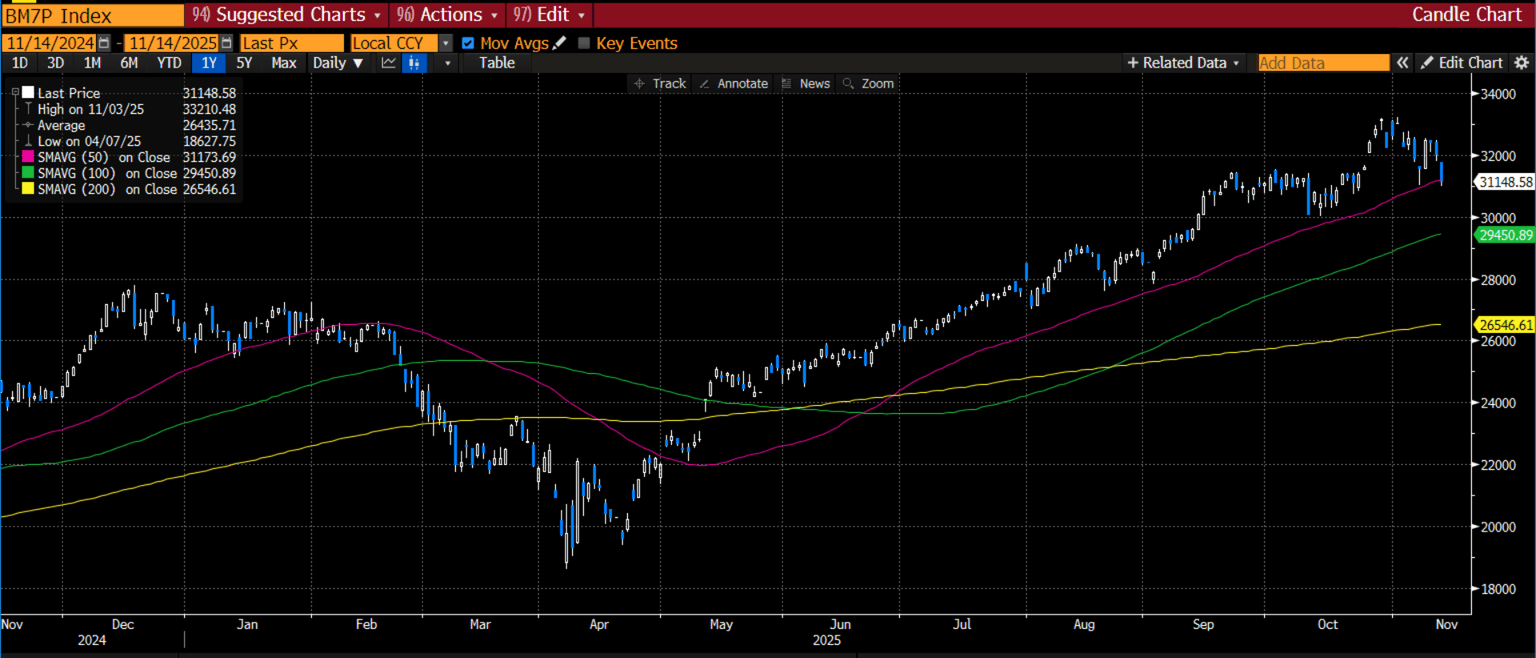
Source: XTB and Bloomberg
Author
Kathleen Brooks
XTB UK
Kathleen has nearly 15 years’ experience working with some of the leading retail trading and investment companies in the City of London.