UK Employment Preview: Impact of unemployment rate falling to multi-decade low is limited in the UK

The UK labor market is set to deliver another proof of strength in November. While the number of people claiming the unemployment benefits is set to increase by 3.4K in November, the unemployment rate is expected to fall further marking another multi-decade low of 4.2% in three months to October period.
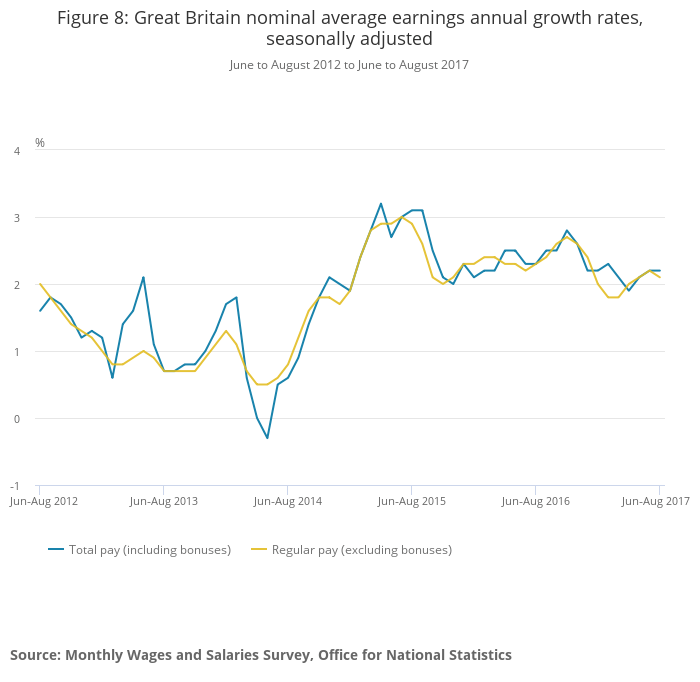
With inflation rising to the highest level since January 2012, the policymakers at the Bank of England and the market participants elsewhere are going to closely monitor the earnings development. Average earnings excluding bonuses are expected to rise 2.2% over the year in October, while earnings with bonuses are set to show 2.5% increase over the year.
With inflation surpassing the earnings growth by 0.9%, the real, inflation-adjusted wage growth is expected to remain negative, adding pressure on the Bank of England with its inflation vs. growth dilemma.
During November Inflation Report press conference the Bank of England Governor Mark Carney advocated the first interest rate hike in a decade by the need of removal of extra monetary accommodation. At the same time the Bank of England November Inflation report said that the labor market is tight and the past tightening in the labor market is likely to lead to greater upward pressure on wage growth.
As documented by the unemployment rate falling to the lowest levels in more than four decades, the impact of the tighter UK labor market on wage growth has been very limited so far with the possible explanation being the general Brexit related uncertainty. With company managers unsure about the shape of future trading relationships with EU, investment of corporations is falling and lowering future economic prospects as well as keeping current employees on the edge of uncertainty willing to accept current pay.
Wage growth of above expectations should, therefore, be seen as a sign of stability of companies or at least a removal of part of the Brexit related uncertainty. And greater the stability, the more predictable economic environment, including monetary policy.
Following are the most important UK labor market characteristics, the unemployment rate falling to multi-decade lows and the earnings growth rate, both in charts from October labor market report of the Office for National Statistics.
, seasonally adjusted-636486905309466805.png)
Author
Mario Blascak, PhD
Independent Analyst
Dr. Mário Blaščák worked in professional finance and banking for 15 years before moving to journalism. While working for Austrian and German banks, he specialized in covering markets and macroeconomics.