Turkish inflation undershoots expectations in July

CPI inflation in July came in at 2.06% month-on-month, falling short of both the consensus forecast and our projection of 2.5%.
Turkish CPI inflation in July stood at 2.06% month-on-month, coming in lower than the consensus estimate and our call of 2.5%. This was largely due to moderate price increases across both food and non-food categories. As a result, annual inflation, which has been on a downward trend for the past year, saw a sharp drop to 33.2%, down from 35.05% in the previous month. While inflation rose by 3.23% in July 2024, the five-year average for July in the 2003-based index was just 3.5%. This suggests a favourable base effect, reinforcing the continued decline in annual inflation.
However, it remains above the Central Bank of Turkey’s (CBT's) year-end forecast of 24%, which falls within the projected range of 19-29% according to the latest inflation report announced in May. The bank will release its third inflation report of the year on 14 August, which will shed more light on the inflation outlook and likely monetary policy moves for the rest of 2025.
The PPI increased by 1.7% MoM, driven mainly by utilities, refined petroleum products, fabricated metals and textiles. Annual producer inflation inched down to 24.2% YoY, after increases in two consecutive months. This indicates that cost pressures remain moderate due to the CBT’s continuing control on the exchange rate, with the FX basket rising by around 26% YoY as of July, showing an acceleration in the pace recently.
Core inflation (CPI-C) rose by 1.7% MoM, bringing the annual rate down to 34.7%. Preliminary seasonally adjusted data, set to be published by TurkStat and closely monitored by the CBT, indicate a less-than-expected monthly increase in July, and hence limited deterioration in the underlying trend.
Inflation outlook (%)

Source: TurkStat, ING
A closer look at the data shows:
-
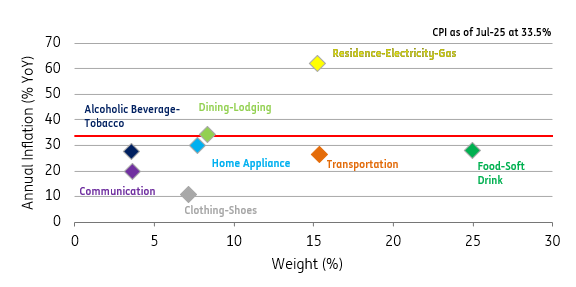
The housing group made the largest contribution to inflation (0.95ppt), driven by adjustments in natural gas prices and persistently high rents.
-
The transportation group added 0.45ppt due to car price adjustments following currency depreciation and gasoline prices.
-
On the other hand, clothing reduced inflation by 0.36ppt, driven by seasonal price reductions that exceeded the typical July average in recent years.
-
The food sector index remained practically unchanged, with price drops in the unprocessed food group almost offset by pressures in the processed food group. This was one of the factors contributing to the benign inflation headline last month.
As a result:
-
Goods inflation dropped to 27.0% YoY, while core goods inflation stood at 20.7% YoY.
-
Services inflation, which is more influenced by domestic demand and wage increases than currency fluctuations, continued to decline, reaching 48.5% YoY, its lowest level since mid-2022.
Annual inflation in expenditure groups
Source: TurkStat, ING
Read the original analysis: Turkish inflation undershoots expectations in July
Author
ING Global Economics Team
ING Economic and Financial Analysis
From Trump to trade, FX to Brexit, ING’s global economists have it covered. Go to ING.com/THINK to stay a step ahead.

















