Trump's inauguration day
In focus today
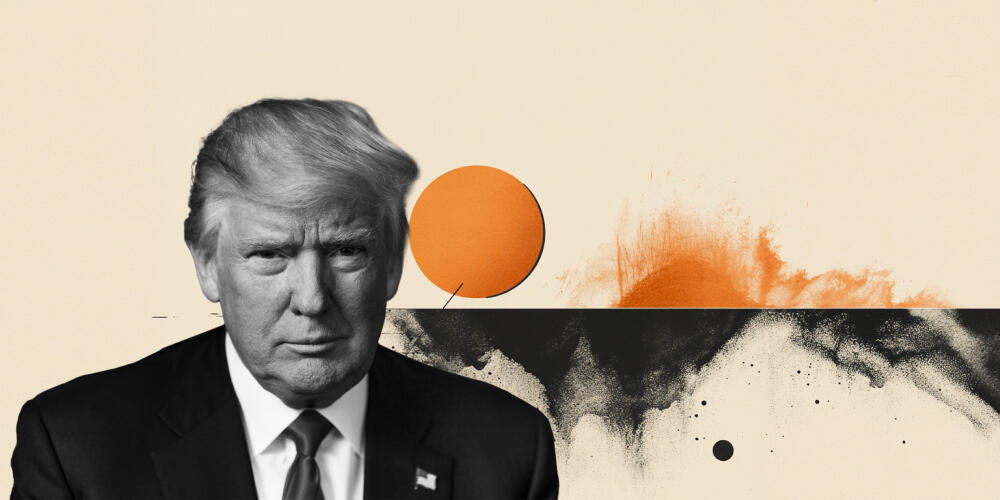
The main focus of the week is Donald Trump's 2nd Inauguration which takes place today at 18:00 CET. He will be officially sworn in as the President of the US and markets will closely follow his first executive orders and remarks to the public in the evening with special focus on possible tariff announcements and cuts to regulation.
Otherwise, the week ahead will be relatively quiet on the data front, with the exception of Friday when flash PMIs for both the euro area and the US are released. Financial markets have been particularly attentive to this indicator as focus has shifted to growth following the continued lower inflation momentum movements observed recently in especially the euro Aaea.
Economic and market news
What happened overnight
In the US, President Trump reiterated his pledge to initiate the largest deportation effort in US history on day one, aiming to remove millions of immigrants and implement stricter immigration limits.
What happened over the weekend
In the euro area, final HICP data came in at expected levels with 0.4% m/m and 2.4% y/y for December on Friday. In the details, momentum continued lower for the eighth consecutive month, now standing at 3.5% in the 3m/3m SAAR measure. The easing momentum will cause the yearly inflation rate to also decline significantly this year, which was acknowledged by the ECB at the December meeting. Hence, underlying inflation clearly continued to give green light for further rate cuts by the ECB.
In the US, industrial production for December overshot expectations at 0.9% (cons: 0.3%, prior: -0.1%) and data for November was revised up to 0.2% from -0.1%. The increase was supported by a rise in factory output, suggesting that manufacturing is stabilizing after two years of weakness.
In China, USD/CNH dropped from 7.355 to below 7.34 following Trump writing on Truth Social that he had a very good call with Xi Jinping. The message by Trump eased concerns over a trade war, saying he expects they will solve many problems together. Read more in China Flash - GDP surprises upwards but housing stabilisation more important, 17 January.
In the Middle East, a ceasefire deal took effect between Isreal and Hamas following 15 months of war between the two. The ceasefire was postponed by three hours due to a holdup in the release of three Israeli hostages. The deal acts as the first of three potential phases set to follow further negotiations in the weeks ahead. With the second phase including a complete withdrawal of Israeli troops from Gaza and the third phase including Gaza's reconstruction.
Equities: Global equities rose on Friday and for the week, following what we consider an almost full complement of support for equities last week. We saw a soft US inflation print, which sent yields lower, generally strong demand data, a very strong start to the earnings season, and finally, geopolitical improvement with the ceasefire in Gaza. Therefore, in our opinion, it should not be surprising to see global equities up by 2.5% last week, led by cyclical stocks, bringing the MSCI back to just 1% shy of its all-time high. In the US on Friday, the Dow rose by 0.8%, the S&P 500 by 1.0%, the Nasdaq by 1.5%, and the Russell 2000 by 0.4%. This morning, most Asian markets are in the green, led by Chinese shares in Hong Kong, while South Korean equities are underperforming. US and European futures are fluctuating around Friday's close.
FI: The bond market recovered modestly last week on the back soft US inflation data and comments from Federal Reserve's Waller. However, the 10Y US treasury yield has risen some 100bp since September, and with the inauguration of Trump today sentiment can change quickly.
FX: USD rose against the rest of the G10 on Friday ahead of President Trump's inauguration today. NOK in particular was under pressure, but JPY, CAD and GBP also felt the heat. EUR/USD traded around the 1.03 level and EUR/NOK rose firmly above 11.70.
Author

Danske Research Team
Danske Bank A/S
Research is part of Danske Bank Markets and operate as Danske Bank's research department. The department monitors financial markets and economic trends of relevance to Danske Bank Markets and its clients.