Trade Deficit Steepens Led by China: Top Six Offenders

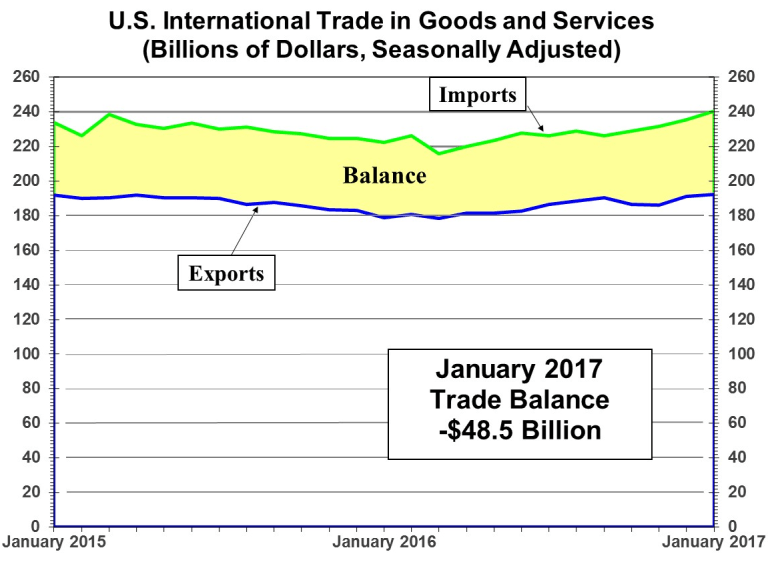
The International trade deficit widened to $48.5 billion matching the Econoday consensus. Don’t give the economists too much credit because the preliminary numbers on goods gave a big tip on what was going to happen. Today’s numbers reflect goods and service.
January’s trade deficit came in very deep but at least right on expectations, at $48.5 billion and reflecting a surge in foreign consumer and vehicle imports and higher prices for imported oil.
January imports rose 2.3 percent from December to $197.6 billion with imports of consumer goods jumping 2.4 percent to $52.1 billion and with vehicle imports up 1.3 percent to $13.6 billion. Petroleum imports totaled $15.3 billion in the month, up 19 percent and reflecting both higher prices, at $43.94 per barrel vs December’s $41.45, and a rise in volumes, at 8.4 million barrels per day vs 7.7 million.
Though dwarfed by imports, exports did rise 0.6 percent to $128.0 billion led by industrial supplies (where higher oil prices are at play) and also a 1.3 percent gain for vehicle exports to $13.6 billion as well as a $0.6 billion gain for foods. Exports of capital goods fell a sharp 1.9 percent to $43.5 billion in a decline that only partially reflected aircraft. Exports of services, usually the strength for the U.S., were unchanged in the month at $64.1 billion.
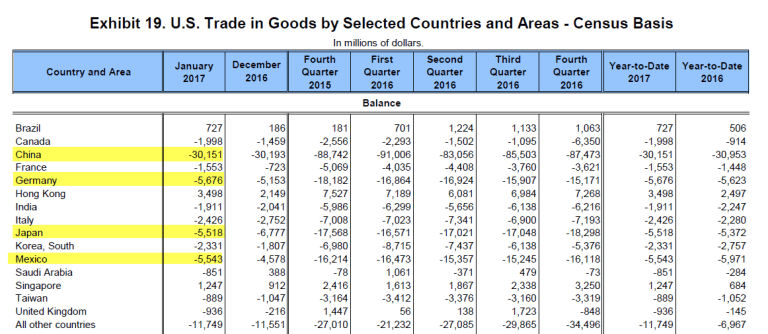
Unadjusted country data show a monthly widening with China, to a monthly deficit of $31.3 billion, and a widening with Canada, at $3.6 billion. Deficits narrowed with the EU, to $11.5 billion, with Japan, to $5.5 billion, and with Mexico, to $4.0 billion.
Strong demand for foreign goods and light demand for U.S. services and capital goods is not a favorable mix for GDP. This report puts first-quarter GDP on the defensive.
International Trade Goods and Services
Goods Trade Select Countries
Goods and Services Trade Select Countries
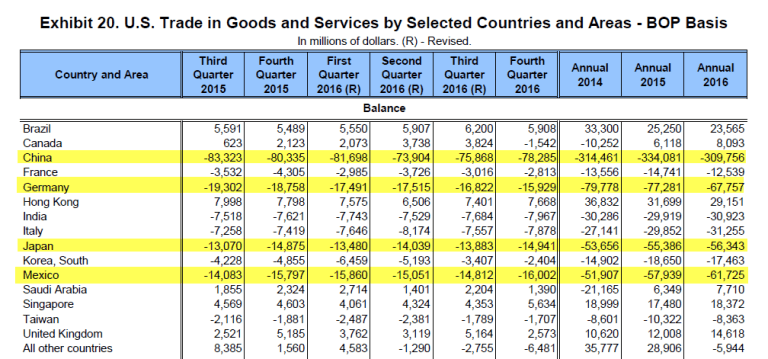
The above charts from the Census Report on International Trade.
2016 Top Six Trade Deficit Countries in Order
China: -309,756 Million
Germany:-67,757 Million
Mexico: -61,725 Million
Japan: -56,343 Million
Italy: -31,255 Million
India: -30,923 Million
The Trump team led by trade czar Peter Navarro is already howling. Expect more screams with the recent widening of the deficit.
Author
Mike “Mish” Shedlock's
Sitka Pacific Capital Management,Llc