This Thanksgiving Goes to Corporations: Thanks for the Greatest Free Gift in History

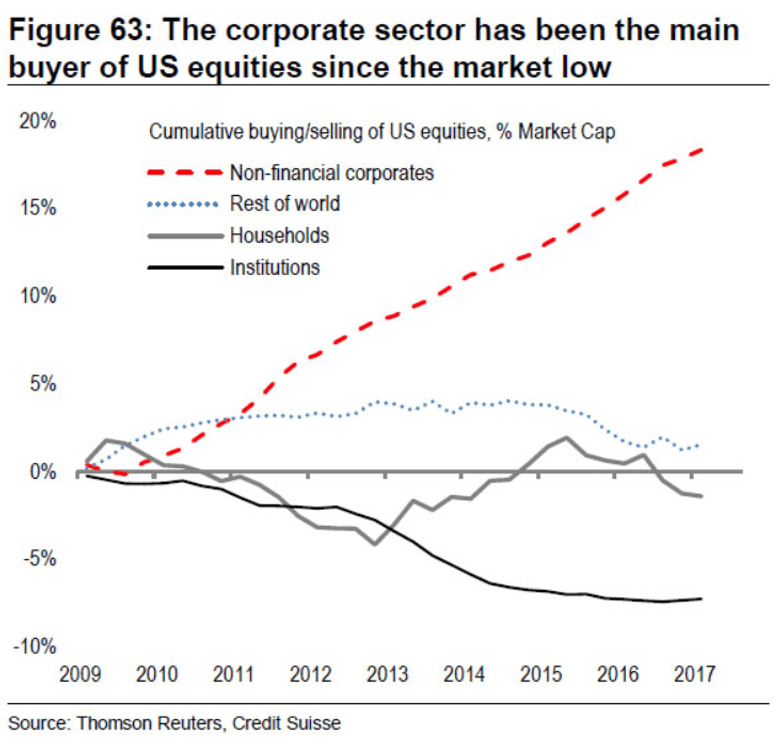
It’s no f’ing wonder!” I yelled to no one in particular the other day when my researcher, Dave Okenquist, shared with me a chart he’d just come across!
“We’ve died and gone to heaven thanks to these guys! They’ve given us the greatest free gift in history!”
The dog tucked its tail between its legs and made a hasty retreat.
“Thank you so much you a-holes! Now we’re going to pay an even bigger price when the wheels come off this f’ing bus and everyone realizes we’re not in heaven after all!”
The chart proved that this rally since 2009 is built on a whole lot of nothing! There are no fundamentals behind it. All that’s happened is corporations have been buying back their own stocks with the near-free money the Fed and other central banks put on the table.
So, on this Thanksgiving Day, let’s give thanks to the Fed and those corporations for this unprecedented bubble!
They’ve gotten the biggest “free lunch” in history.
And now they’re eyeing Trump’s tax cuts like cannibals at a human meat market, despite their corporate profits having hit as high as 11% of GDP. Those profits have been just 6%, on average, since the 1950s!
“Oh, if these companies that have been buying back their own stocks with free money only got MORE free money,” I continued raving to no one, “then they’d expand their capacity and create new jobs!”
I was being sarcastic, of course!
We’re at 4.1% unemployment. That’s about as low as it gets.
We’ve hired back all of the lost jobs from the great recession. Our workforce will actually decline for several years ahead and then only grow, at best, at 0.2% for decades to come.
Our productivity has dropped from 3% in the past to 0.5% now; and it’s still falling… because we’re aging as a society.
How many old people do you know who get more productive and innovative as they age past 50 or 60?
“Why didn’t we realize earlier that we could just grow our economy by printing free money?” I was still yelling at the wall. I could hear the dog trying to bury itself under something in a room nearby.
“Why should we have to innovate or work?! What idiots we were until John Maynard Keynes came along in the 1930s. Thank God for him! When there are downturns, the government can just run deficits or print money to offset them. We just grow without recessions and then retire and go to heaven! Couldn’t get better!
“Damn, why did I even make the investment to go to college and business school?!
“And the next step in the endless something-for-nothing stimulus scheme is to just stop fooling around. Let’s just start sending $10,000 or $20,000 checks to every household!”
At which point I’d finally wound myself down (although, as I typed this email to you, I did bang to keyboard harder than was entirely necessary).
Look at this chart that explains why the stock market has been so strong in a low growth economy. Dave found this on ZeroHedge.
So, here’s the new economy since demographics and debt tanked in most places from late 2007 forward:
Governments issue unprecedented amounts of debt – and buy their own bonds to keep interest rates low, to be able to issue more debt affordably.
Corporations use unprecedented low long-term interest rates – at near zero for risk-free rates adjusted for inflation – to buy their own stocks back and increase their earnings per share, even if their earnings are not growing.
Damn again!
We’ve been idiots for thousands of years to think we had to work and innovate and invest to create growth. All that suffering? When we just needed central banks!
Trouble is, it doesn’t work that way in the long run! Eventually it all heads south.
History is going to look back at this period as a time characterized by the worst financial policies in history… and possibly the worst stock market crash. And we’ll all be mortified, especially central bankers and economists!
History will show that the next several decades created the greatest political and financial revolution since democracy met free-market capitalism in the early 1700s.
That’s the new theme of my new book: Zero Hour.
In it, I prove that this dream world that the Fed and corporations have created won’t last for much longer… and I show what will bring it crashing to the ground.
Ultimately adversity creates innovation and progress!
Now that’s something we should truly be thankful for!
Happy Thanksgiving,
Author
Harry S. Dent, MBA
Dent Research
Harry S. Dent Jr. studied economics in college in the ’70s, but found it vague and inconclusive. He became so disillusioned by the state of his chosen profession that he turned his back on it.