The week ahead: Jackson Hole and Nvidia results to take focus away from Trump
- Bond vigilantes target the US.
- Tariffs risk resurface.
- USD is weighed down by fiscal concerns.
- A $40 trillion problem.
- Markets price in the ‘unknowability’ factor of Kevin Warsh.
- Precious metals back in focus.
- Oil price is key for markets as we move into Autumn.
- Investors get physical.
- What to watch: Jackson Hole and Nvidia.

We start the week with the focus squarely on the US. Rising Treasury yields, the Jackson Hole Symposium, inflation and GDP data, along with tariff risks, will dominate market action in the coming days.
Stock futures have slipped at the start of a new week, oil prices are lower as investors wait for the US to deliver a new package of economic sanctions against Iran, and the dollar index is up a touch, which is weighing on precious metals and crypto. This is set to be a pivotal week for asset markets, since there is still a chance the US Treasury sell off becomes a full-blown crisis.
Bond vigilantes target the US
The Treasury Secretary was given a harsh lesson in bond vigilantism last week; he tried to calm bond markets after the 30-year Treasury yield rose to its highest level since 2007. However, after doubling a bond buy-back programme, the Treasury Secretary found that his current methods to contain bond market volatility were not enough. US Treasuries were major global underperformers, the 2-year yield jumped 6bps, and the 30-year yield now stands at 5.27%.
To put US yields in context, Greece has a lower 20-year yield than the US right now. The rise in US yields put pressure on equities in the US and elsewhere. Japan’s Nikkei fell 4% last week, the Nasdaq dropped 2.5% the French Cac fell 2% and the S&P 500 dropped 1.69%.
Tariffs risks resurface
Anyone expecting a quiet August will be disappointed. Trump is back threatening his neighbours in Canada with 50%with tariffs, and the trade spat is ongoing as we start a new week. Canada has also threatened reciprocal tariffs.
USD is weighed down by fiscal concerns
The other big news from last week was the sharp drop in the dollar, which was the weakest performer out of the major currencies. The Kiwi dollar, the Aussie dollar, the euro and the pound all dominated, rising more than 1% vs. the USD, which was weighed down by fiscal concerns.
A $40 trillion problem
The were several drivers that triggered the bond market sell-off in the US. Investors are worried about high inflation, mounting federal debt and a deluge of tech debt issuance to fund the AI build out. The US Federal debt jumped to $40 trillion last week, this is hardly surprising due to the trajectory of rising US debt in recent years, but the speed of the debt build-up in the US has been astonishing. It has doubled in 10 years.
Markets price in the ‘unknowability’ factor of Kevin Warsh
There is also a concern about the ‘unknowability’ factor of the new Fed chair Kevin Warsh. He has scrapped forward guidance and does not seem keen to be led by financial market sentiment. Thus, if the bond market volatility continues, the ‘Fed Put’ may be conspicuous by its absence.
Precious Metals back in focus
The big winners last week were dollar alternatives. Precious metals surged, with big gains for platinum, silver and gold, which rose by 10%, 7% and 6% respectively. These gains may continue due to the current macro backdrop.
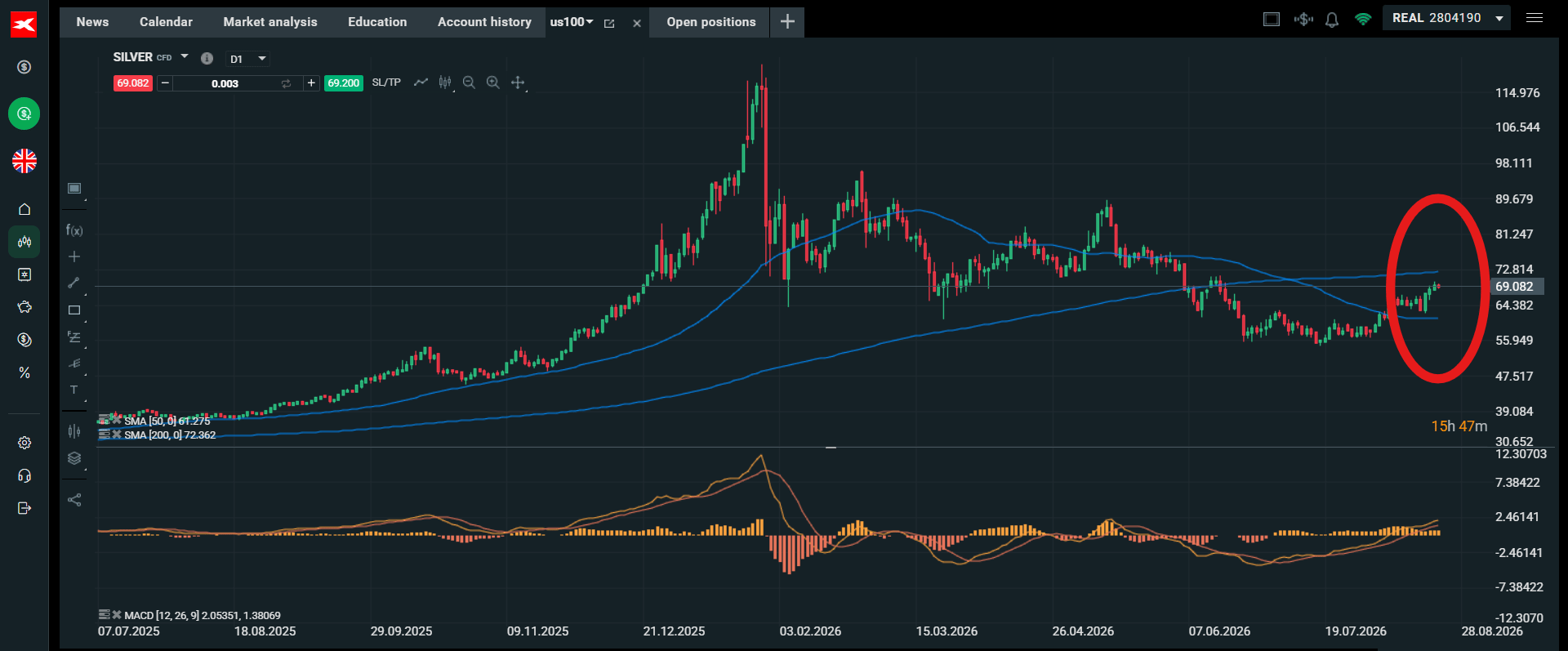
The silver price has dipped on Monday, after news that the US is preparing a package of new economic sanctions on Iran to force them into a deal on the Strait of Hormuz. This has helped to prop up the dollar at the start of the week, but we continue to think that precious metals will remain in demand. The silver price is a mere $3 away from its 200-day sma at $72.26, the 200-day sma crossing over the 50-day sma is also a bullish sign and suggests that further gains for silver could be on the horizon.
Silver daily chart
Source: XTB
Key questions to consider
This week, investors will be eager to see if Treasury yields jump further, will the US have to extend their intervention? What could this do to inflation, and will US authorities, including the Fed, have to accept that higher interest rates are necessary? The sharp drop in US stocks last week, including the fall in consumer linked names, is a keen reminder that rising yields have a real impact on Wall Street and Main Street. If rates keep on rising, then the US government may have to offer support for risk-sensitive areas of the economy also.
Oil price is key for markets as we move into Autumn
The oil price also rose last week, as traffic through the Strait of Hormuz slowed, and the peace talks between the US and Iran have been flatlining. The Brent crude price closed last week above $94 per barrel. It has dipped more than 1% today but remains above $93 per barrel.
Many investors had assumed that the November mid-terms would force the US President into finding a solution to the war in Iran at some point this summer. But, with the summer slipping away, there is no sign that a deal to permanently and safely reopen the Strait of Hormuz is forthcoming. This could keep oil prices elevated for the long term, keeping upward pressure on inflation and interest rates and Treasury yields, which increases the risks of general market volatility in the Autumn.
Investors get physical
As we move into a new week, investors are wary of US assets like bonds and stocks, and they have a clear preference for physical assets like gold and oil. Defensive sectors like healthcare are also doing well, as are UK stocks, which eked out a gain last week. Dollar alternatives like Bitcoin are also surging, Bitcoin rose by 22% last week and is above $77,000. This trend in financial markets will be hard to break, and there could be further pockets of volatility.
There are some major events for investors to digest in the coming days. The first is economic data, including US Core PCE, which is the Fed’s preferred inflation measure. US GDP, German IFO and CPI data are also released, along with inflation in Japan.
This is a huge week, as we have two major events that all traders should be watching.
1, Nvidia results
The first is Nvidia’s results, which are released after the market closes on Wednesday. The options market is already predicting a big swing in either direction on the back of these results, with options markets currently pricing in a 6% move.
Nvidia, the central bank of the tech world
Nvidia is the big kahuna of the AI world, and its chips are powering the global AI revolution. This means that their results are central for financial markets. Nvidia is now so powerful and cash-rich that it is almost like a central bank to the tech industry. It teamed up with 5 US financial institutions, including KKR and Blackrock, to establish an independent compute financing platform to mobilize $500bn in third party capital that will be deployed to the AI build out.
This is one reason why Nvidia’s results are so important. The market was not impressed by Nvidia’s pivot to the finance world, and its share price dipped by 5%.
News that Nvidia will increase costs by up to 15% for its largest customers could send waves through the AI trade as we start a new week, however, its stock price was calm overnight. Meta, which is offering to sell its excess compute, also saw its share price stabilize overnight, after dropping 7% last week.
Increasingly, the AI trade is being divided into winners and losers: the winners are those who supply the chips and the compute power, the losers are those who must buy it to build out their AI ambitions. Increasingly, it looks like full-stack AI providers, those who have their own chips, build compute and sell AI infused products will be the big winners from the AI race.
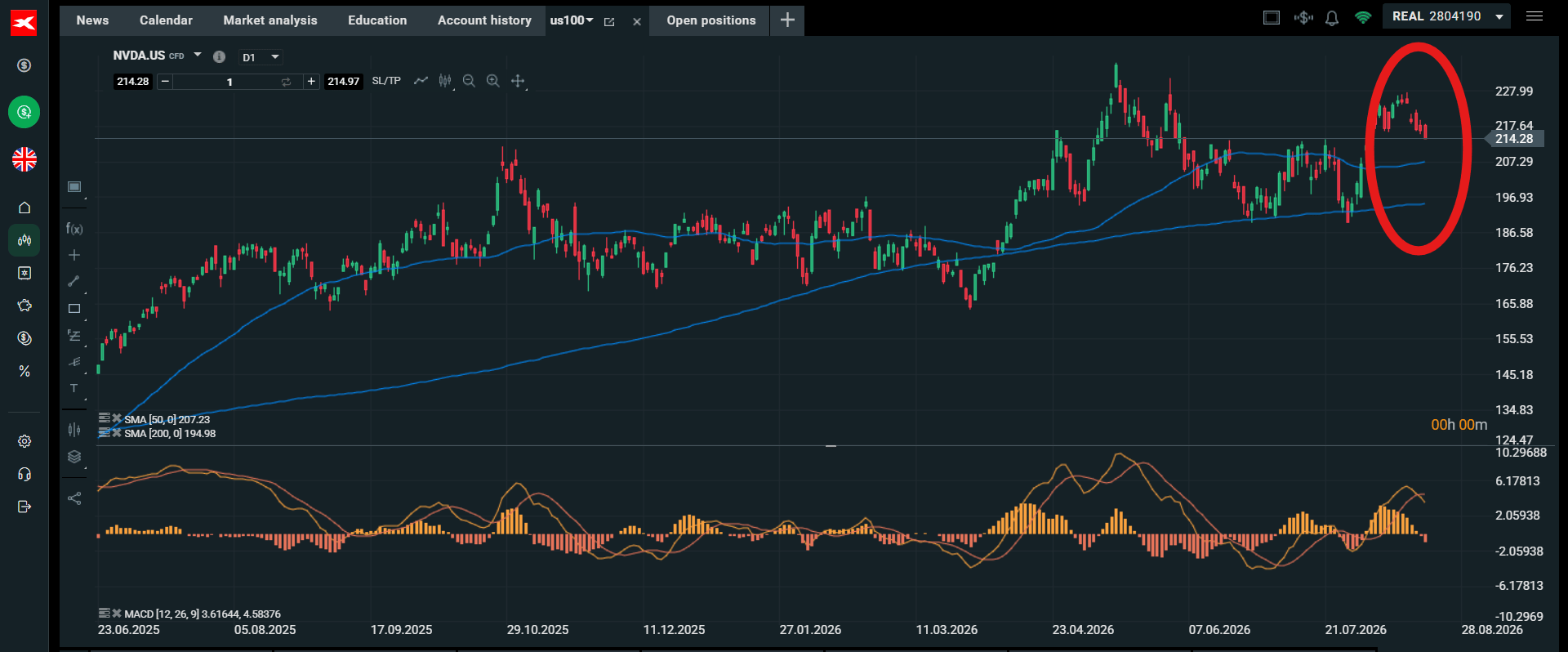
Nvidia is expected to deliver another monster revenue report, with over $92.05bn of revenue expected for last quarter. These results will also offer insight into demand for AI infrastructure, how Nvidia is managing Chinese competition and what the future holds. Investors are desperate to predict when we will hit peak AI, but Jensen Huang could keep them waiting for some time if the results are as good as expected.
Nvidia’s share price has backed away from its highs ahead of earnings
Source: XTB
2, Jackson Hole
As mentioned, Kevin Warsh is something of an enigma for financial markets, and his tenure at the Fed so far has triggered a sharp rise in bond yields, the 10-year Treasury yield is higher by 16bps in the last 3 months, the 30-year yield is higher by nearly 20 bps.
The new Fed chair almost relishes in the market figuring it out for themselves, but will this have a limit? If we see another surge in Treasury yields this week, will Kevin Warsh change his tune and offer soothing words to the bond markets? Analysts expect him to do this, but the question is what form will this take.
We doubt that he will backtrack on his move away from forward guidance, which could make it hard for him to offer any long-term comfort to fraught investors right now. If the stock market recovers this week, it could have more to do with Nvidia’s results than Kevin Warsh’s Jackson Hole speech on Friday.
The market has no idea what to expect from his speech, as he gives so little away. However, speculation is mounting that he will clarify some changes he plans to implement at the Fed. These include the future of the Dot Plot, the frequency of Fed press conferences, and how he plans to manage other Fed communications.
Right now, there is a 40% chance of a rate hike at the next Fed meeting in September. This is down from nearly 60% a month ago. A mixture of weak labour market data and cooler inflation is seen as reducing the near-term chance of a Fed rate hike. The new Fed chair will not want to say anything that gets in the way of the economic data and the direction that it suggests rates should go.
Overall, if Kevin Warsh is measured by his own yardstick, then his speech should not be market moving. It’s always worth listening to, but Nvidia is worth staying up for this week.
Author

Kathleen Brooks
XTB UK
Kathleen has nearly 15 years’ experience working with some of the leading retail trading and investment companies in the City of London.