The week ahead: Is the sell off over?


Markets are significantly calmer this morning, US equity futures are pointing to a stronger open later today, with a 2.8% bounce currently expected for the Nasdaq 100, after last week’s bloodbath pushed stocks into oversold territory.
Gold has jumped more than 3%, the dollar is also lower as safe havens lose their shine. On Friday, Nvidia, Anthropic and the neoclouds were the focus of negative attention. However, Nvidia is higher by more than 6% in the pre market at the start of trading this week, Anthropic is higher by more than 3% and neocloud provider CoreWeave is higher by 7%.
Asian authorities help to stabilise markets
The sell off in Asia earlier this morning was not as bad as feared. Japanese markets are closed for a holiday, Korea’s Kospi, which is closely linked to the AI trade, fell 3%, and China’s main index posted a gain, after authorities stepped in to limit the fallout from the rout in US stocks on Friday.
Last week’s stock market sell off was rapid, brutal and detached from fundamentals. The S&P 500 dropped nearly 10%, and is on track to have its second worst November performance in the index's history. The weakest November performance for the S&P 500 was in 1973, during the Opec oil embargo.
Real AI demand still there, for now
The question for investors is what changed to drive the sell off? We believe that investors got ahead of themselves last week. Although the cost of funding AI has changed, and risk appetite for AI stocks has also weakened, demand for compute power has not changed. Hyperscalers are still committed to their investment plans for the coming quarters, and there is no sign that demand for AI capabilities have diminished.
However, this has been a real shock for the market and we expect choppy conditions could persist in the coming weeks as the markets learn more about the inner dealings of Nvidia and its web of chip sales to China. Anthropic’s future earnings reports have gained even more significance after last week’s sell off as its demand profile will be used as a proxy for the future of AI, since it is unlikely that OpenAI will choose to IPO anytime soon.
Overall, last week’s sell off cemented a new era for AI, with more investor scrutiny guaranteed. However, the sell off went well beyond pricing in mere scrutiny of AI, so a pullback is to be expected. The question is, how long will aunty recovery last? If animal spirits persist, then this could be a dead cat bounce.
Counting the damage from last week’s sell-off
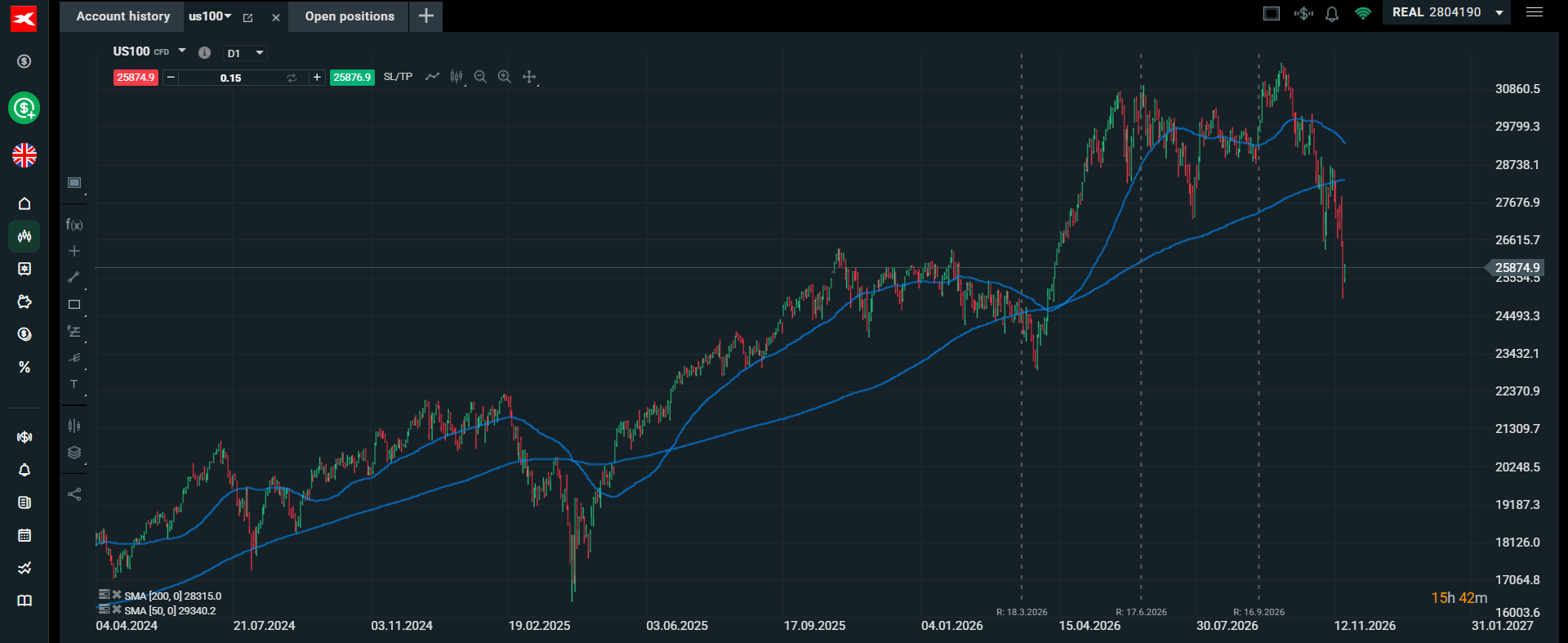
No wonder stocks are in recovery mode on Monday. The Nasdaq had a 7-day losing streak, and has lost 1.9% so far this year. It is also the first time in decades that the Dow Jones lost more than 1% on each day of the week. This is reminiscent of a 2000/2001 style sell off, and it has been a heavy week for stocks.
Chart 1: Freefall for the Nasdaq
The sell-off defies earnings strength
Fundamentals are secondary right now. As the S&P 500 sheds trillions of dollars in market capitalisation, the blended earnings growth rate for the S&P 500 is 34.7% if you exclude the Magnificent 7. The Magnificent 7 has a slightly lower earnings growth rate of 27% for last quarter.
Added to this, the sell off comes even though stocks are cheap, and the S&P 500 has the lowest forward price to earnings ratio for 3 years at 17.7, for some members like Nvidia, this is much lower. The chip giant’s 12-month forward P/E ratio is now a mere 7.5 times, and for the first time since the financial crisis, growth stocks now trade at a lower valuation than value stocks, which is a very rare market event.
Are we at the beginning of the end for the AI trade?
The outlook is incredibly cloudy.However, we are sure that every major economic and market theme does two things: 1, it attracts haters and cheerleaders, and 2, they don’t last forever. Could we be coming to the end of the AI theme that has driven markets for most of this decade?
The bear case
The AI bulls and bears have been tussling for airtime this weekend. The bears make a convincing case why the AI bubble is bursting and there could be more bad news for stocks ahead. There are growing concerns about Nvidia’s SEC investigation, which caused the stock price to drop 14% on Friday. It is worth noting that Nvidia’s stock price fell 26% the same week it reported $115bn in revenue for last quarter, and posted over $40bn in free cash flow.
Oracle spooks the market
Also, over the weekend Oracle posted on social media that it had secured full financing for its contracts with OpenAI. This is a $300bn arrangement whereby Oracle would finance a 5-year cloud computing arrangement for the maker of ChatGPT. This would provide large scale AI infrastructure and compute capacity to power OpenAI. Oracle then confirmed that it would post positive free cash flow in fiscal 2028.
This did not reassure all of the market, with some AI critics seizing on this statement as a sign that the lady doth protest too much, and Oracle must be in trouble. Some analysts are now convinced that Oracle relies on Nvidia to backstop this arrangement, and the risk is that without Jensen Huang at the helm, the deal could fall through. This would leave Oracle on the hook to finance $300bn in a rising interest rate environment, or face a costly break clause from its contract with OpenAI.
Neocloud businesses are also in the eye of the storm, and there is a real risk that some of them could collapse in the near term, as companies like CoreWeave have seen their share prices drop more than 60% in the last 6 months. Neoclouds are also reliant on Nvidia’s generous financing model, and have come under pressure as the market has taken a sceptical view of the circular funding model for many smaller AI companies and compute providers.
AI hopes rest on OpenAI and Anthropic
Added to this, Anthropic and OpenAI are approx. 40-50% of compute demand. A large chunk of the AI ecosystem is built upon the fortunes of these two companies. If they don’t perform as well as expected, then the whole ecosystem is at risk of collapse because it is reliant on such a narrow base. For example, banks and funds have helped to finance the AI build out, and some analysts believe that the recent sell off in tech stocks is the equivalent for tech venture capital funds what the GFC was for banks and hedge funds back in 2008.
For some AI critics, the Anthropic IPO was an exit strategy for early investors, and is not a sign of confidence in the AI boom. This pokes holes in the argument that Anthropic will be the next Windows.
Thanksgiving: A chance to press pause
The market is likely going to be extremely grateful we are coming into Thanksgiving week, and this could give investors a much-needed pause after a brutal few weeks. At first, the sell off was about individual companies, now it is at the index level, and that is when it gets more dangerous. If the market sell off weighs on business or consumer confidence, then the impact could hit economic growth and earnings growth, which may lead to a recession, and a deeper sell off.
Traders scale back Fed rate hike bets
The market is not discounting the sell off in the AI trade triggering an economic event and there are signs that investors are scaling back expectations for a Fed rate hike next month. There is now no chance of a 50 bp hike, and there is an 11% chance that the Fed remains on hold, according to the CME Fedwatch tool.
The bulls keep faith with the AI trade
However, the bears might have control of the price action, but they don’t control the market narrative completely. There is another, more optimistic angle that the AI cheerleaders are espousing. The bulk of their argument is that the sell off has been triggered by vibes and is detached from reality. For example, there is no actual credit event, default or recession risk that has caused this sell off.
Anthropic IPO added temporary market downside pressure
While the pressure of funding the AI boom is starting to show, there is still strong earnings growth, and the AI investment boom could last well into 2028. The AI bulls also argue that part of the reason for the sell off on Friday was indigestion from the Anthropic IPO. Although the stock price fell 8% on Friday, it was a successful IPO that values Anthropic at well over $1.5 trillion. This means that fund managers around the world need to make space for it in their portfolios, and may have sold other positions, which exacerbated the market decline. Overall, this is temporary, and should not lead to a prolonged period of market capitulation.
They also argue that the market is ignoring strong earnings growth, a solid economic performance and the lower oil prices. Brent crude is down 15% in the past month, which usually boosts market sentiment. The fact that the market was oblivious to these positive signals, could be a sign that bearish animal spirits have taken over, and the markets are overcorrecting.
Data watch
Over the next couple of days we will find out if battered financial markets will stabilize into Thanksgiving. For now, fundamentals do not seem to matter, as technicals take over. However, we think it is still worth watching the first reading of November PMIs that will be released early this week. This survey data will give us a good read on whether lower oil prices are feeding into stronger business sentiment. Upside surprises in global PMIs would be a stabilizing force for markets, however, the bears would point out that PMI disappointments could have the opposite effect.
PCE, especially core PCE, will be important as the market starts to question the wisdom of further Fed rate hikes into a stock market downturn. We will also get the second estimate of US GDP.
Overall, all eyes will be on where stock markets go next.
Author
Kathleen Brooks
XTB UK
Kathleen has nearly 15 years’ experience working with some of the leading retail trading and investment companies in the City of London.