The week ahead: Gold within touching distance of record high
- A full docket for a busy week.
- Delayed US economic data to tell us if Fed cuts were the right decision.
- Stocks sold off, but the Vix remained stable.
- Time Magazine, the ultimate contrarian indicator?
- The Great Rotation back into the US 493.
- Will the market fall in line behind the Fed?
- Dollar weakness ahead of Trump’s Fed announcement.
- US economic data dump.
- UK rate cut expected, even as inflation remains elevated.
- The Bank of Japan to hike and trim balance sheet.

As we enter a new week, stock market futures are pointing to a higher open and risk sentiment has stabilized, after a selloff in US tech stocks in the second half of last week. European and US futures look like they will open higher later today, and the gold price is on a tear at the start of the week. The gold price is higher by more than $40 per ounce early on Monday, and is within striking distance of a new record high. Strong fundamentals remain in place for the gold price as we move to the end of the year. Central bank demand remains strong, and gold linked ETF sales are rising, as investors rush into gold ahead of this week’s torrent of US economic data. Thus, there could be further records for gold before the year is out.
A full docket for a busy week
Economic data is in focus this week, the highlights include a torrent of delayed US data releases and the last of this year’s central bank decisions. The market is pricing in an 87% chance of a Bank of England rate cut next week, after the UK economy contracted for the second consecutive month in October. The UK will also release CPI and labour market data in time for the Christmas holiday. There is also a full data docket in the US, including November payrolls on Tuesday, retail sales for October, and the November CPI reading. As if that was not enough, there are also rate decisions from the ECB and the BOJ. The ECB is expected to hold rates steady, and signal that a lengthy pause in rates is coming, while the Bank of Japan is expected to raise interest rates by 25bps to 0.75%, as it embarks on its very slow normalization of monetary policy.
Delayed US economic data to tell us if Fed cuts were the right decision
As we start a new week, stock futures are little changed, however, it is a big week for financial markets, so a quiet start is to be expected. Most of the delayed economic data from the US government shutdown will be released this week. In that period, the Federal Reserve has cut US interest rates by 75bps. This week’s data releases are mostly backward-looking data, so these data releases will tell us if these rate cuts were the right decision, and not necessarily what the Fed will do next. A strong set of payrolls and a higher-than-expected CPI reading could spook financial markets and send the price of gold soaring to fresh record highs, as investors add another worry to their list: the Fed’s judgement.
Stocks sold off, but the VIX remained stable
Last week’s US interest rate cut did not stop US stocks from posting a loss for last week. The S&P 500 was lower by 0.6%, the Nasdaq sold off more sharply and lost 1.6%. There were milder losses for European stocks. Interestingly, although stocks made a loss for the week, the Vix index, Wall Street’s fear gauge, remained stable at 15.7, below the average for the year of 19.
Time magazine, the ultimate contrarian indicator?
The S&P 500 was led lower by Oracle, which slipped by 12%, after posting disappointing results, including for its main AI business units. This added to evidence that tech companies’ rush to boost capex spend is yet to bear meaningful fruit. We all know about the technology behind AI, now investors need to be persuaded for its utility and its ability to boost revenues and corporate profits. This theme is likely to run into 2026. Interestingly, Time Magazine announced its person of the year for 2025, and the accolade went to the architects of AI, including Jensen Huang, Mark Zuckerberg, Elon Musk, and Sam Altman. We shall have to see if this is a contrarian indicator!
The great rotation back into the US 493
The rotation away from AI linked stocks helped other sectors of the market play catch up. The Dow Jones, which is less exposed to tech, rose by more than 1%, As we move towards 2026, the Magnificent 7 are falling behind, allowing the other 493 members of the S&P 500 to play catch up. Last week, Warner Brothers, Southwest Airlines, and Royal Caribbean Cruises were some of the top performers on the main US index.
Cutting interest rates when the economy is resilient is undoubtedly good news for cyclical stocks, however, this week’s data will tell us if this was an economically sound idea from the Fed. If US CPI surprises on the upside later this week, then support for cyclicals could get hit regardless of their attractive valuations.
Will the market fall in line behind the Fed?
Bond yields were relatively stable last week, but this week’s central bank decisions along with major economic data releases could see a recalibration of rate cut bets for the major central banks in 2026. Currently, the Fed Fund Futures rate is expecting two cuts from the Fed next year, which is one more than what the FOMC is currently expecting. Treasuries can continue their strong run, but only if this week’s labour market data plays ball. Signs that the labour market is recovering could torpedo hopes for multiple rate cuts next year and see the Fed Fund Futures market fall in line with current FOMC thinking on future rate cuts.
So far in 2025, the US Treasury market is one of the top performers in the global bond market space, followed by the UK and Canada. If Treasury yields pop higher later this week, we could see UK and Canadian yields move in sympathy. European bonds have underperformed, and may continue to remain on the backfoot, with the prospect of higher yields also on the cards if the ECB announces a prolonged pause in its rate cutting cycle.
Dollar weakness ahead of Trump’s Fed announcement
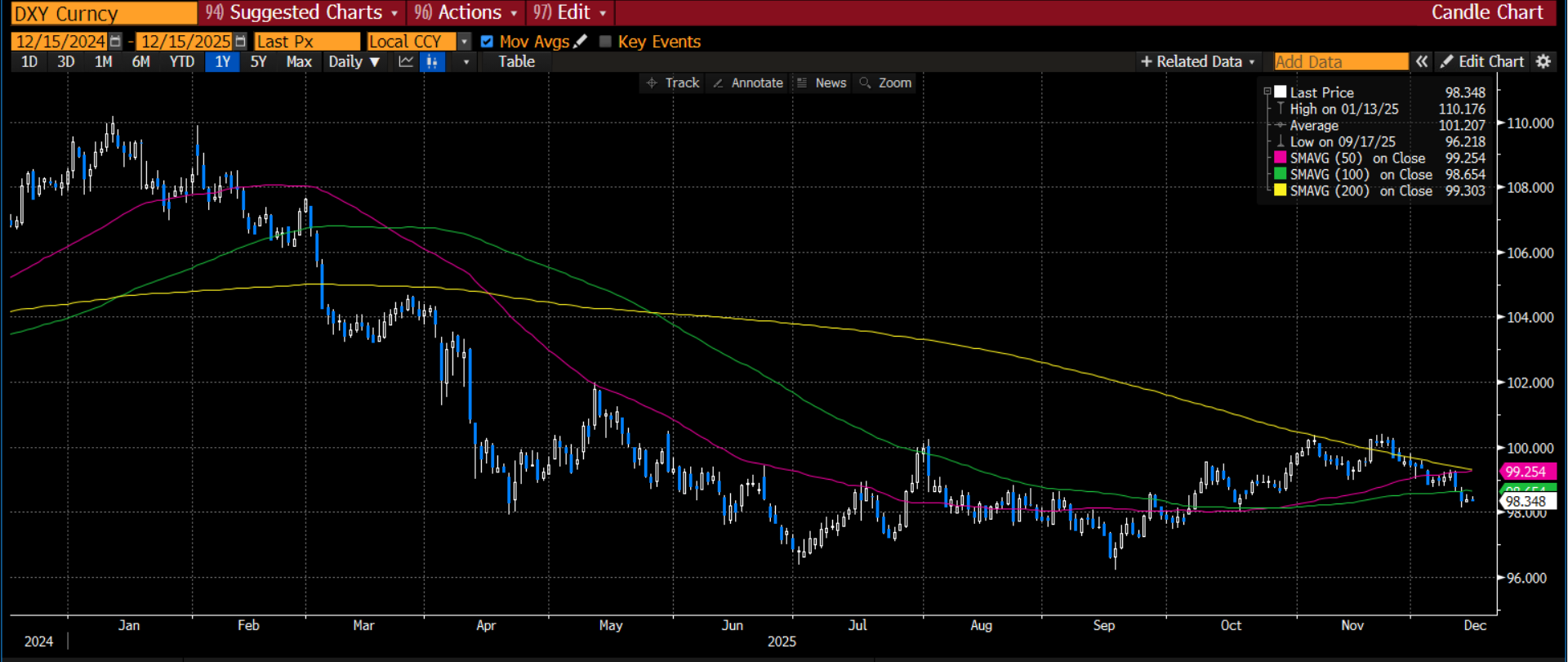
The dollar index was the second worst performer in the G10 FX space last week, and had a third straight week of declines, its longest losing streak in 3 months. It fell below its 200-day sma as you can see below, which is a negative sign and suggests that there could be further downside to come. Hopes of a dollar resurgence are fading, even though long end US bonds are falling/ yields are rising. This could suggest a lack of confidence in the currency. Perhaps investors are concerned about the next Fed chair, who could be announced this week, being too close to President Trump and White House interference at the Fed. Or perhaps there is some skepticism in the FX market that the US growth outlook will be as strong as the Fed expects next year, particularly if inflation starts to move north once more.
Chart 1: US Dollar Index breaks below its 200-day sma
Below, we take a look at the three main events for the week ahead.
1. US economic data dump
The delayed release of US economic data will be the main highlight of this week, including the November payrolls report and the CPI. The November payrolls report will also incorporate elements of October too and it is the first major look at the US non-farm payroll picture since before the government shutdown.
Analysts are not optimistic about this report, and expect a reading of 50k. The unemployment rate is expected to remain steady at 4.5% and average earnings growth is expected to be 3.6%, which is still inflationary.
The CPI report is also likely to suggest that the disinflationary trend in US price growth has slowed as we edge closer to the 2% target rate. The headline and core rate of CPI for October are both expected to remain above 3%.
2. UK rate cut expected, even as inflation remains elevated
There is a strong consensus that the BOE will cut rates this week, with all economists surveyed by Bloomberg expecting a cut to 3.75%. We think it will be a very close call, with a 5-4 split in favour of a cut. There are many who argue that the UK economy will not improve with a rate cut, and instead it’s loser fiscal policy that is needed to boost growth. However, that was put to bed by the recent budget and instead it’s up to the BOE to spur growth. We think the UK’s central bank will give the people what they want.
The next cut is expected by June. If the BOE shifts the prospect of another cut further into the future, potentially on the back of stubborn inflation growth, then the pound could benefit.
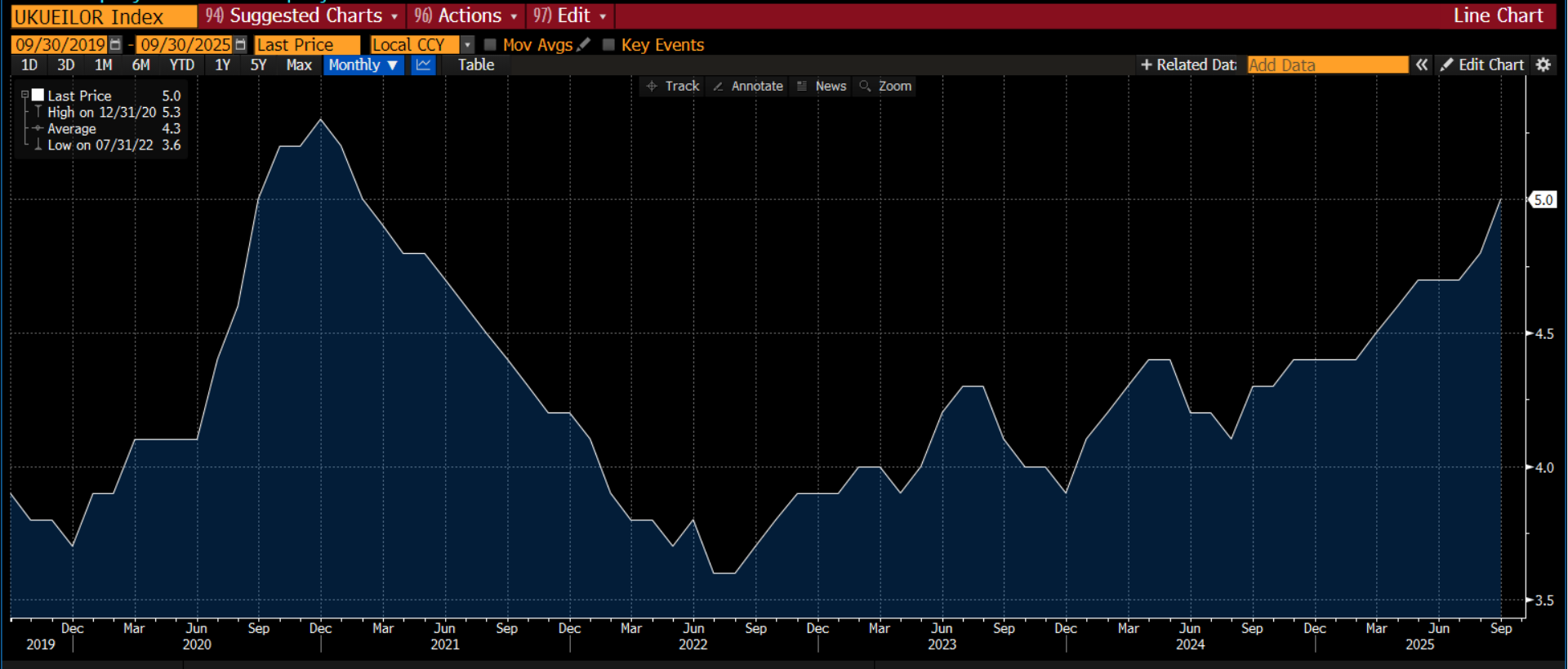
Inflation is expected to have moderated slightly for November, while the October unemployment rate is expected to have edged up to 5.1%, which would be the highest rate since 2021, but it would not necessarily signal deep stress in the labour market, even if the situation has deteriorated sharply during 2025.
Chart 1: UK Unemployment rate, expected to move above 5% in October
3. The Bank of Japan to hike and trim balance sheet
The BOJ is expected to hike interest rates to 0.75% at the end of this week. The economic data released earlier this week is expected to support this move, including a strong reading for business confidence and Japanese CPI hovering around the 3% mark.
This is likely to be enough evidence for the BOJ to embark on a much-anticipated hike, there is currently a 92% chance of a hike priced into the interest rate swaps market, which suggests that the financial markets are marginally more convinced about a BOJ hike this week, than a BOE rate cut.
A weak yen, along with concerns about inflation hitting the cost of living, has led the new PM to soften her stance on rate hikes in recent weeks, which also clears the path for a hike. USD/JPY has been trading sideways for most of the past month. The outcome for the yen could depend not on the rate hike, but what the BOJ says about the future path for policy. We expect them to take a cautious tone and to refuse to signal when or if future hikes are coming. Key downside support for USD/JPY comes in at 154.20, the 50-day sma.
The BOJ may also announce that it will begin selling its vast pile of stock market ETFs from early next year. It is expected to do so in an extremely gradual manner, and reports suggest that it wants the sales to have no market impact. The Japanese stock market has surged in the last two years, and the value of the ETFs has risen sharply. The BOJ could test the water with sales as early as January. If the sales go well and cause no volatility, then they may continue. However, we expect the BOJ to be very aware of market conditions and to halt sales if there is a major market event. Overall, this week should show that the Fed and the BOJ are moving in opposite paths, and this could weigh on USD/JPY.
Author

Kathleen Brooks
XTB UK
Kathleen has nearly 15 years’ experience working with some of the leading retail trading and investment companies in the City of London.