The week ahead: 3 events to watch

As we start a new week the market is still digesting the main events from recent days, including a weaker than expected payrolls reading for July, the unprecedented multi-lateral intervention to strengthen the yen, and the unresolved issues in the Middle East that pushed up energy prices on Friday.
Non-Farm payrolls fell last month, and the US lost 23k jobs. This unexpected loss, combined with a downwardly revised figure for June, which was revised to just 20,000, suggests that the US labour market is softening more rapidly than analysts forecast.
Healthcare posted an increase in jobs, but there were job losses In education, retail and financial services. This chimes with the ISM surveys, which reported a decline in the employment sub index of the service sector.
The US unemployment rate fell to 4.1%, its lowest level since June 2025, and the labour force participation rate fell further last month, to its lowest level since 2021, at 61.4%. This structural shift in the US labour market could keep downward pressure on the unemployment rate, even if the US economy is not producing jobs.
Low hire, low fire US economy
There is a low hire, low fire environment in the US right now, and hiring has slowed sharply as we have moved through 2026. This weakens the case for a rate hike in the near term. The CME Fedwatch tool sees a 43% probability of a hike next month, down from 57% before the payrolls report.
The market reaction was immediate, a sharp drop in the USD on a broad basis, and a decline in US Treasury yields. Stock indices rose, reversing some of Thursday’s losses for US stocks.
Overall, the sharp drop in education employment could be seasonal, especially since it has been one of the strongest sectors for employment this year. However, it certainly adds to asset price volatility at the start of August.
Unprecedented intervention to stem the yen weakness is too big to fail
The intervention to stem yen weakness was also a key theme last week. Japanese and US authorities sold USD and euro to strengthen the yen, and it worked. USD/JPY fell more than 2% in the past 7 trading sessions.
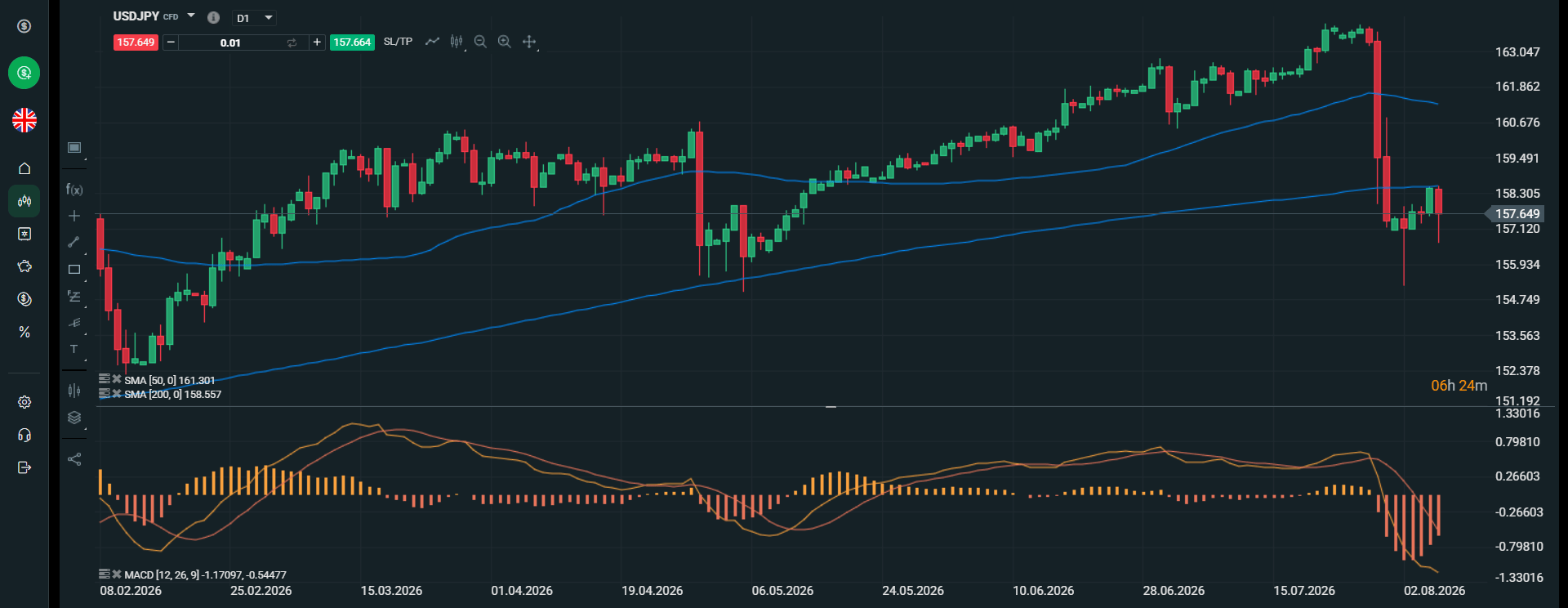
Usually when the US intervenes in the FX market it can mark a turning point in a currency pair. Although the yen is still stronger than it was before the intervention, it did drift lower over the course of last week, rising above the 200-day sma at one stage at 158.50. USD/JPY then fell back after the weaker payrolls report, but it remains above the intervention low around 155, above 157.50. If there is a move back towards 160.00 in the coming days then this could be a major issue for financial markets. If this intervention does not work at strengthening the yen, it could trigger volatility in global bond markets, as investors get worried that Japan will sell its stock of Treasuries to boost its FX reserves. This is one reason that is being discussed as to why the US made the unusual decision to spend its own FX reserves and prop up the yen last week.
Middle East developments worth watching as Brent rises back above $80 per barrel
The market is also going to watch developments in the Middle East. There was a breakthrough to reopen the Strait of Hormuz, which included Iran charging tolls to commercial cargo ships. The US has been tight lipped about this deal, and so far the President has sounded optimistic that the escalation in the conflict will end soon and talks are ongoing. There have been no new attacks, aside from Houthi attacks on Saudi Arabia at the end of last week, which so far have not derailed the alleged talks to get back to the MoU and finally agree a long-lasting peace deal.
The Brent crude oil price closed last week above $80 per barrel, even though there was no new direct attacks between Iran and the US. This suggests that the market is getting impatient at the lack of progress to find a deal, especially as we get closer to the autumn months in the northern hemisphere.
AI trade roars back to life
The increase in the oil price did not disrupt a major recovery rally for the AI trade. Chip stocks led the pack, and South Korea’s Kospi index rose more than 11%, followed by Japan’s Nikkei up 5.8%. US stocks outperformed their European counterparts; however, European banking stocks had another strong week and rose 3.58%.
This backdrop will collide with some big macro releases next week; we delve into three can’t miss events in the coming days.
1, US CPI
The market is expecting a small moderation in both headline and core US CPI for July. The headline rate is expected to come in at 3.4%; the core rate is expected to moderate a notch to 2.5%. The most notable thing about this data: both core and headline inflation remain above the Fed’s 2% target rate, something the new Fed governor has said is unacceptable.
Inflation data is arguably more important than payrolls right now, because of the laser focus on the Fed’s 2% target. If we get a hotter than expected CPI report for July then we could see Fed rate hike expectations for September reverse course and march higher.
The CPI report will also be crucial for USD/JPY. A hotter reading could keep downward pressure on the yen, and push USD/JPY back towards 160.00, which could put US and Japanese authorities in a difficult position. Alternatively, a reading of 2.3% or below in the core CPI rate for July could help USD/JPY drop back to 156.60, the intra-day low after Friday’s weaker than expected payrolls report.
Chart 1: USD/JPY
Source: XTB
2, UK GDP for Q2
This is released on Thursday and will be a good test of the UK’s economic strength ahead of the new chancellor’s Budget in October. The market expects quarterly growth to rise 0.4%, down from the 0.6% rate in Q1. The UK economy has a bias towards stronger first half growth, before weakening in the second half of the year, so the chancellor may not want to base his decisions for tax and spend on Q2 data alone.
The June GDP print is expected to be disappointing, a reading of -0.1% is expected, suggesting that there was no ‘World Cup’ effect at the start of the football tournament. It will be worth seeing how the intense heatwave in June impacted growth, especially since the heat has not eased significantly since then.
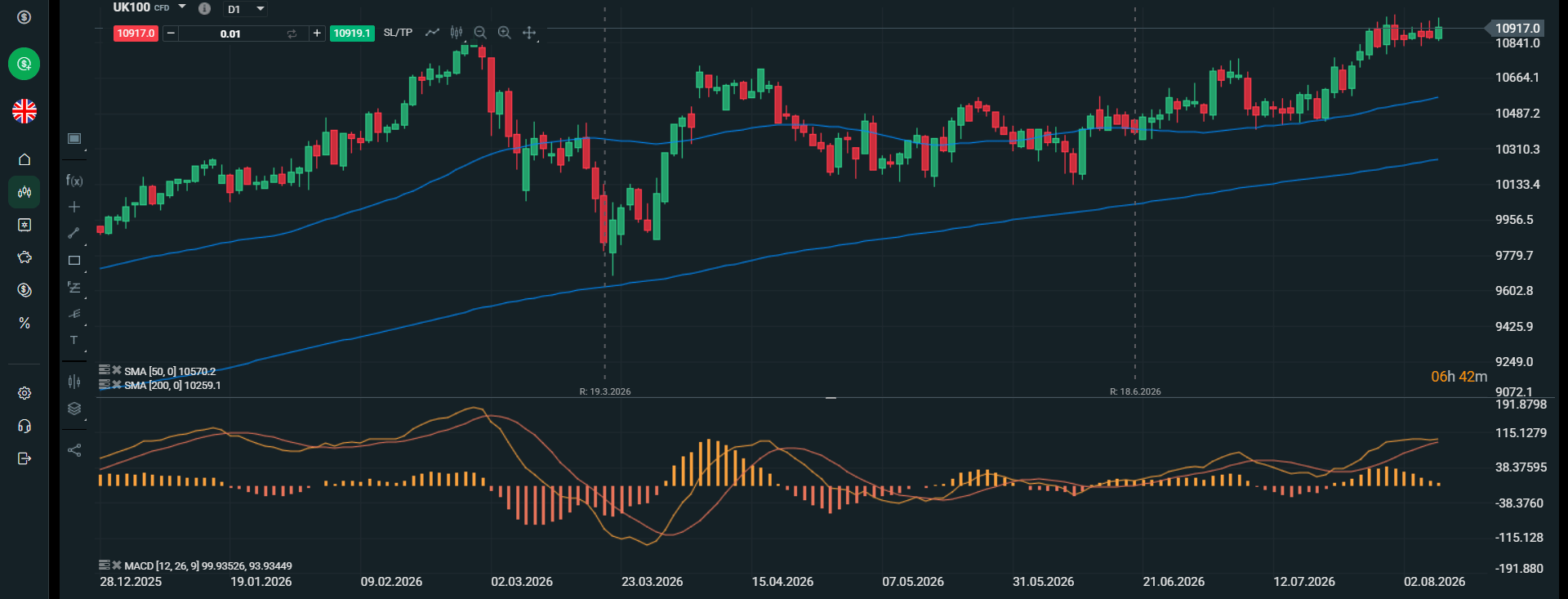
A lackluster economic backdrop has not thwarted UK stock indices from reaching fresh record highs in recent days. The FSTE 100 made an intra-day record on July 31st, while the FTSE 250 reached a new record high on August 6th.
The FTSE 100 was one of the weaker indices last week, rising only 0.2%, but it is higher by more than 2% in the past month, and by 6% in the last 3 months, suggesting that an uninspiring economic backdrop is not impacting interest in UK shares.
Chart 2: FTSE 100
Source: XTB
3, Eurozone GDP for Q2
It’s a big week for growth data. The Eurozone’s second reading of Q2 GDP is released at the end of this week, and it is expected to confirm that the economy expanded by 0.4% last quarter, with the annual rate hitting 1%. This is a significant change from the 0.2% decline in Q1, and the fastest pace of growth for nearly 2 years.
This would make another rate hike from the ECB extremely likely. There is already an 83% chance of a rate hike priced in for the ECB’s September meeting, with 2 rate hikes expected between September and July 2027. A strong reading for European GDP may see a third rate hike get priced in, and it could lend more support to the euro, which was the third best-performing currency in the G10 last week.
Author

Kathleen Brooks
XTB UK
Kathleen has nearly 15 years’ experience working with some of the leading retail trading and investment companies in the City of London.


![How Wall Street rigs the game [Video]](https://editorial.fxsstatic.com/images/i/market-chaos-01.jpg)