The US Dollar's September buyers are now underwater
Speculators rebuilt a $45 billion bet on the US Dollar in the four weeks after the Federal Reserve's September hike, and the Dollar Index is back at the average price they paid. A Democratic Congress, cheaper Oil and falling yields now work against that crowd.
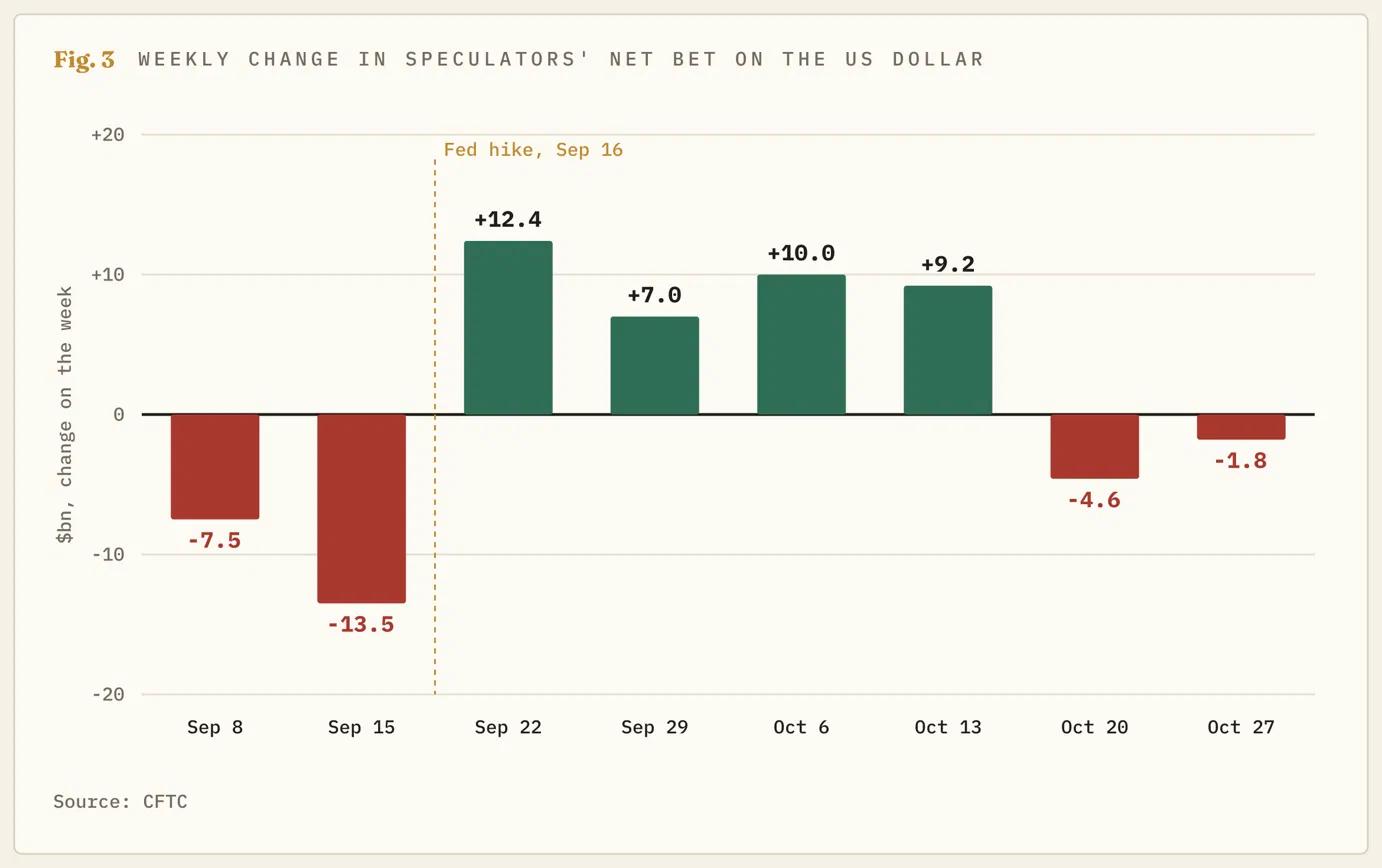
The US Dollar Index (DXY), which measures the Dollar against six currencies, rose about 4% from early September to its October 14 high and has given back about a third of that since, putting it back at late-September levels and below everything October paid. The Commodity Futures Trading Commission (CFTC), which counts futures bets every Tuesday, shows who did the buying on the way up. A crowd of speculators cut its bet on the Dollar to $6 billion the day before the Federal Reserve (Fed) raised rates on September 16, the first hike since 2023. It rebuilt that bet to $45 billion over the next four weeks.
That bet was placed at index levels between about 100 and 103, and weighted by when the money arrived, the average price paid was about 101, which is where the index is now. September's buyers, meaning the crowd that rebuilt the bet after the hike, are at breakeven as a group: everyone who bought in October is losing money and only the first week's buyers are clearly ahead. The rally they bought ran on the crowd rather than on rates, because the two-year Treasury yield peaked two weeks before the index did, and since the midterm elections the crowd has had three new reasons to leave.
A $6 billion bet became $45 billion in four weeks
The CFTC's weekly count separates futures traders hedging a business from those betting on price, and the second group moves with the news. Across the eight main currency futures, its net bet on the Dollar was $27 billion at the start of September, $6 billion on September 15, $25 billion two weeks after that and $44.5 billion on October 13. The crowd sold its Dollars the day before the Fed hiked and spent the next four weeks buying them back at higher prices.
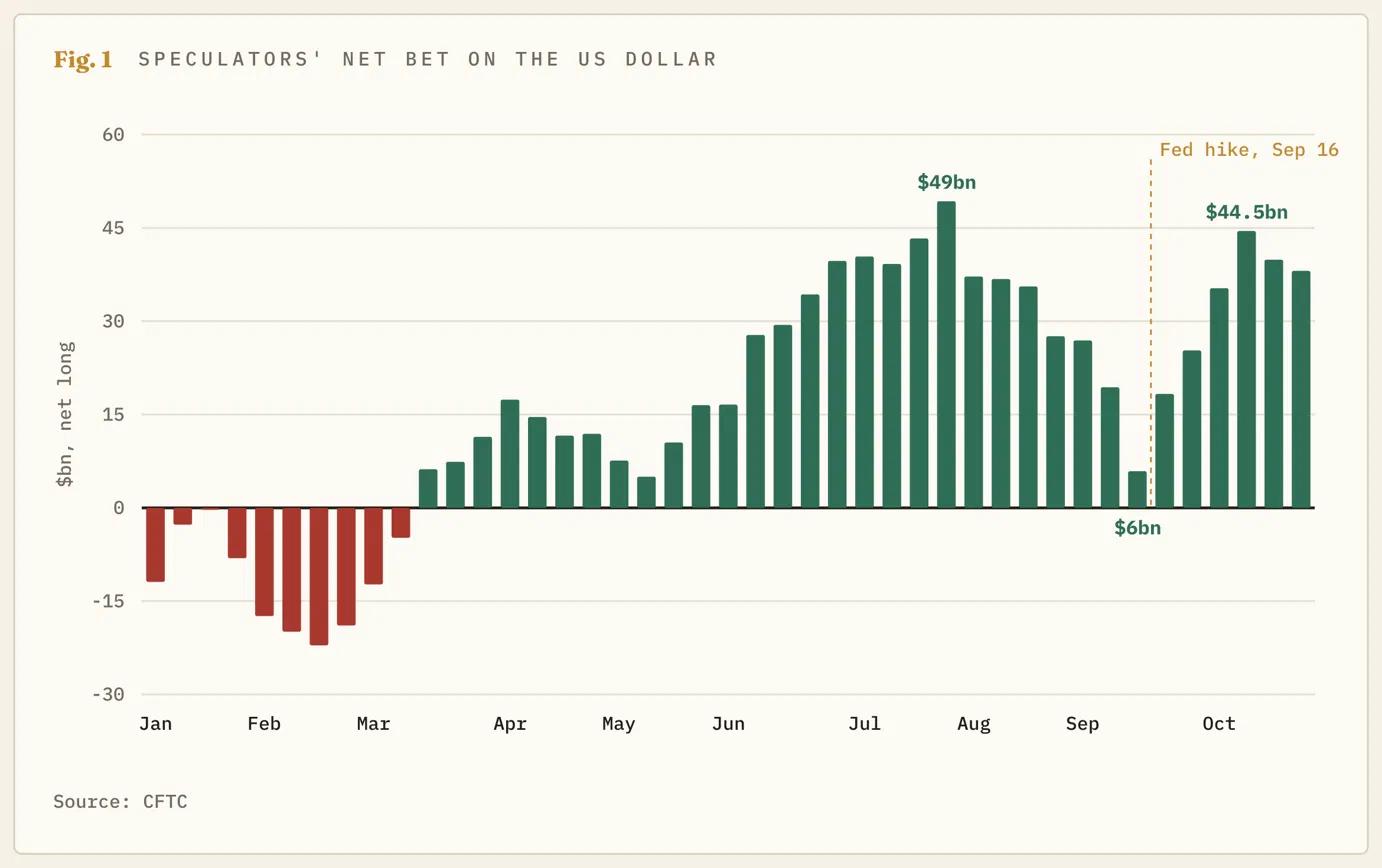
Most of that money went into one trade. Speculators sold 117K Euro contracts, about $16 billion, between September 15 and October 27, which took the bet against the Euro to its largest since early 2016. The bet against the Aussie Dollar is the largest on record, and the one against the Pound touched a nine-year high on October 13. The Euro is 57.6% of the Dollar Index, so the bet against the Euro and a bet on the index are the same trade under two names.
The two-year yield peaked two weeks before the Dollar did
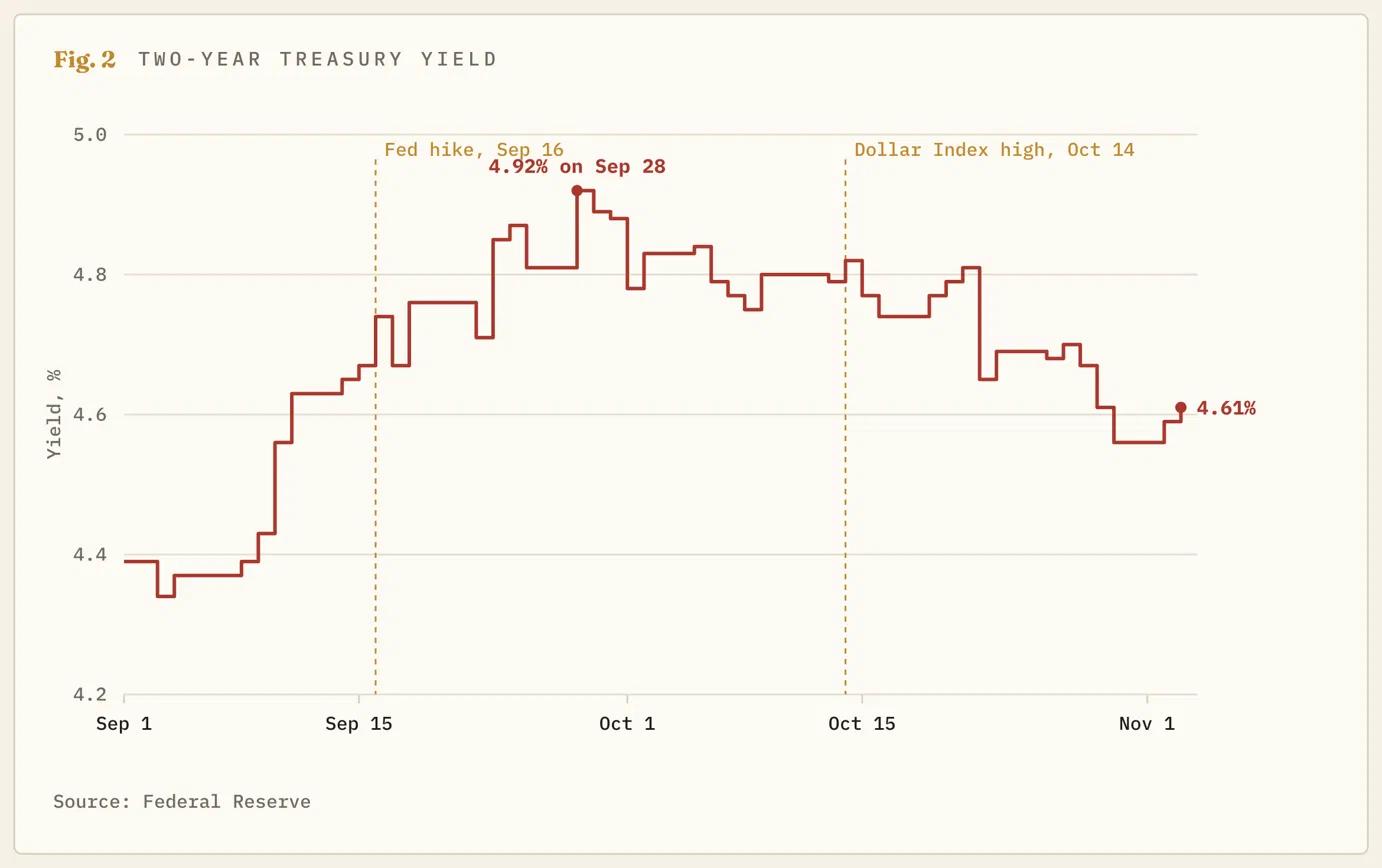
A currency usually follows the gap between its interest rates and everyone else's, because money moves to where it earns more. The two-year Treasury yield, the best gauge of where traders expect the Fed's rate to go, peaked at 4.92% on September 28 and has since fallen about a third of a point. The Dollar Index kept rising for two more weeks after that peak and made its high on October 14, the day the Consumer Price Index (CPI) came in at 3.7%, so the last leg of the rally ran on a rate gap that had already stopped widening.
The gap stopped widening because the other side of it was moving too. The Bank of England (BoE) raised its rate to 4% on Thursday by eight votes to one, the Reserve Bank of Australia (RBA) made its fifth hike of the year on Tuesday, to 4.85%, and the Bank of Japan (BoJ) and the European Central Bank (ECB) are expected to raise rates in December. Futures give the Fed's own December hike about four chances in five, so the Fed can confirm what is already priced in and can't add to it. A hike the whole market expects moves the gap by nothing.
The other two legs were Congress and Oil
Democrats won both chambers in the midterm elections, with CBS projecting 251-268 House seats and at least 54 in the Senate, and the Dollar Index fell to its lowest since September the day after the vote. A Congress unlikely to pass new tax cuts or stimulus means less borrowing, which means lower Treasury yields and a smaller rate gap. The 10-year yield peaked above 5.30% in early October and has fallen back below 5%.
Oil was the second leg. Brent traded near $118 at the end of October and fell close to 9% in the session after the result, to about $95, its lowest since early September. The drop followed President Donald Trump putting the Republican defeat down to gasoline prices and Vice President JD Vance writing that the war with Iran was behind the losses. Oil reaches the Dollar twice: dearer Oil pushes up US inflation, and the number of Fed hikes traders expect, and a war that threatens Gulf exports pulls money into Dollars as the place to wait it out. Both ran in reverse in one session, and the Dow Jones Industrial Average rose about 3% that day to within 3% of its August record, the same move seen on the other side.
Reuters published its monthly poll of currency strategists on the day of the vote. Seventeen of the 30 who answered the question said the bigger risk was a Dollar stronger than their forecasts, and 13 of 25 expected the speculators' bet to be about the same size at the end of November. The index fell to its lowest level since September the next day.
The hike was bought at 100 and the top at 103
The index was at about 100 on the day of the hike and about 103 at the October top, so the traders who bought the hike itself are still up about 1%, which after seven weeks and a change of Congress, counts as the good news, and the ones who bought the top are down about 1.5%. The crowd had started leaving before the vote: the bet was cut by $6 billion over the two weeks to October 27, and the count for the week of the vote is out on Friday.
Two banks' currency desks argued on Thursday that the slide isn't the start of a broad Dollar sell-off, because the US economy is still growing and the Fed has at least one more hike in it. Both were true on October 14 as well. A December hike that is already expected is not a reason to buy the Dollar, it is the reason the Dollar got to 103, and the people who bought it there have nothing left to wait for.
Payrolls and the Fed decide it
The crowd's position resolves on events rather than levels. Friday's Nonfarm Payrolls (NFP), with 65K forecast against 29K in September, the November 10 CPI and the Fed's December 9 meeting are the three things that can move the rate gap before year-end: the first two can take the December hike off the table, and the third can only deliver what is already expected. The CFTC counts that follow each one show whether the crowd is still leaving.
The case is for a lower index while the crowd is still long, because a bet built on a hike already priced in has no next catalyst, and every buyer who gives up becomes a seller. An index back at 100, where the hike was bought, puts the whole $45 billion underwater, which is where that selling tends to feed on itself. The case is wrong if the index is back above the October range, which would most likely take a payrolls number well above forecast and would mean the same crowd that bought October bought the election dip.
Author

Joshua Gibson
FXStreet
Joshua joins the FXStreet team as an Economics and Finance double major from Vancouver Island University with twelve years' experience as an independent trader focusing on technical analysis.