The US Dollar's new strength has a circular flaw built into it

Asian chip exporters supply much of the new foreign money that funds the United States, and they send it through the stock market. The shares they buy belong to their biggest customers, so a slowdown in AI spending would cut the US Dollar's support twice.
For half a century, the US Dollar's (USD) standing abroad has leaned on Oil. Exporters in the Gulf priced their Oil in Dollars and lent the proceeds to Washington by buying its bonds. That arrangement now has a rival. World trade in computer chips passed world trade in Oil and gas for the first time in the four quarters to mid-2026, according to a Deutsche Bank report published on Monday.
The chip money comes back to the US by a different route. It goes into shares, largely those issued by the artificial intelligence (AI) companies whose orders created the money in the first place. The Dollar's foreign funding now runs in a circle through the AI boom, and a circle has a weak point the old Oil arrangement didn't, because one event can cut it from both sides.
The Dollar's new backers buy shares, not bonds
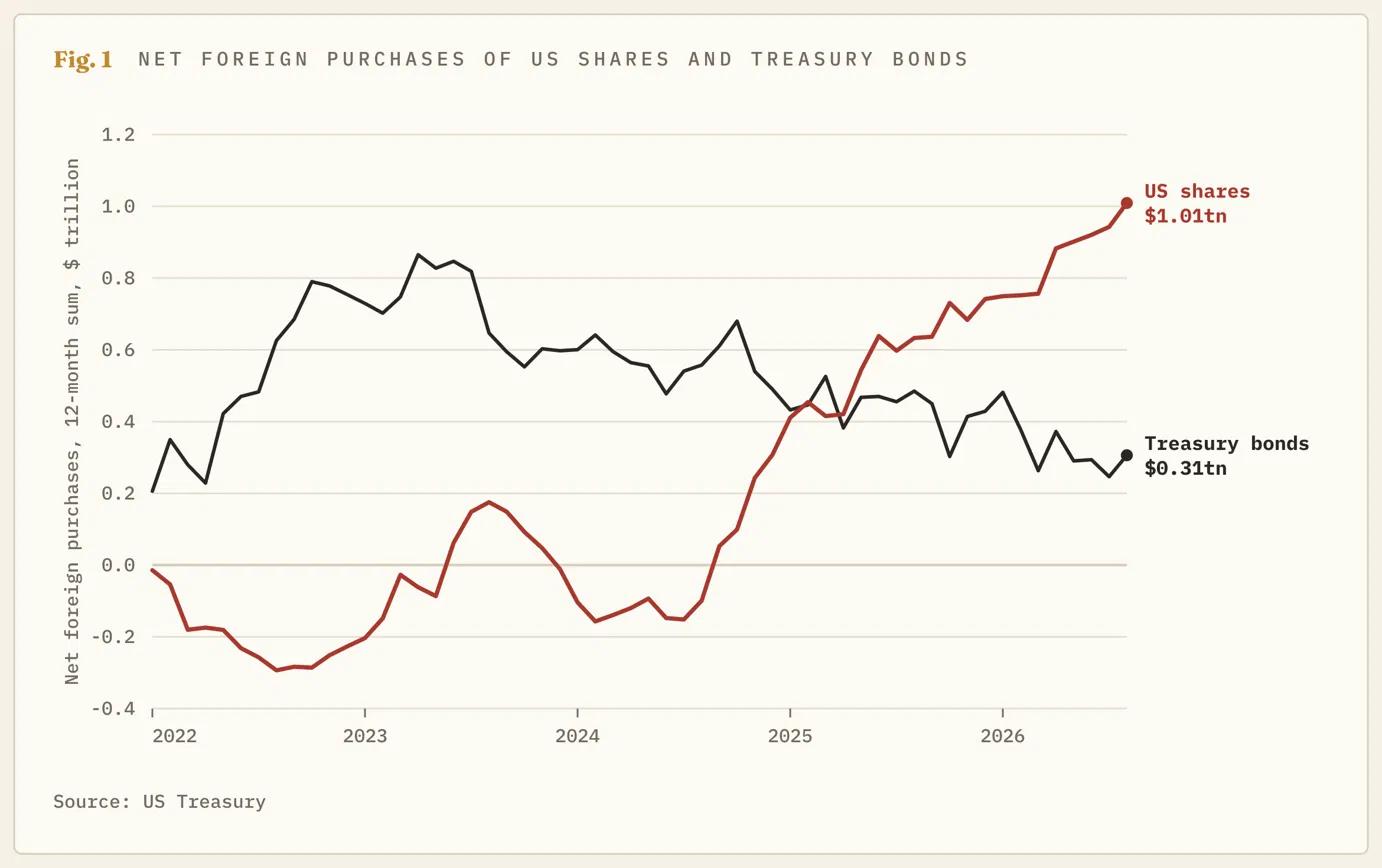
Foreign investors bought more than $1 trillion of US shares over the past year, according to Deutsche Bank's count of US Treasury data. That is more than double what they put into US government bonds, and most of the increase came from Asia. For a country that imports far more than it exports, that share-buying has become the main source of the foreign money that covers the gap.
Behind the Asian money are chip exports. South Korea's chip exports have more than tripled from a year earlier. Its chip trade surplus, the amount by which chip exports exceed chip imports, is close to $250 billion and accounts for all of the country's overall trade surplus. Across Korea, Taiwan, Japan and Southeast Asia, chip surpluses are now as large as the Gulf's surpluses in Oil and gas.
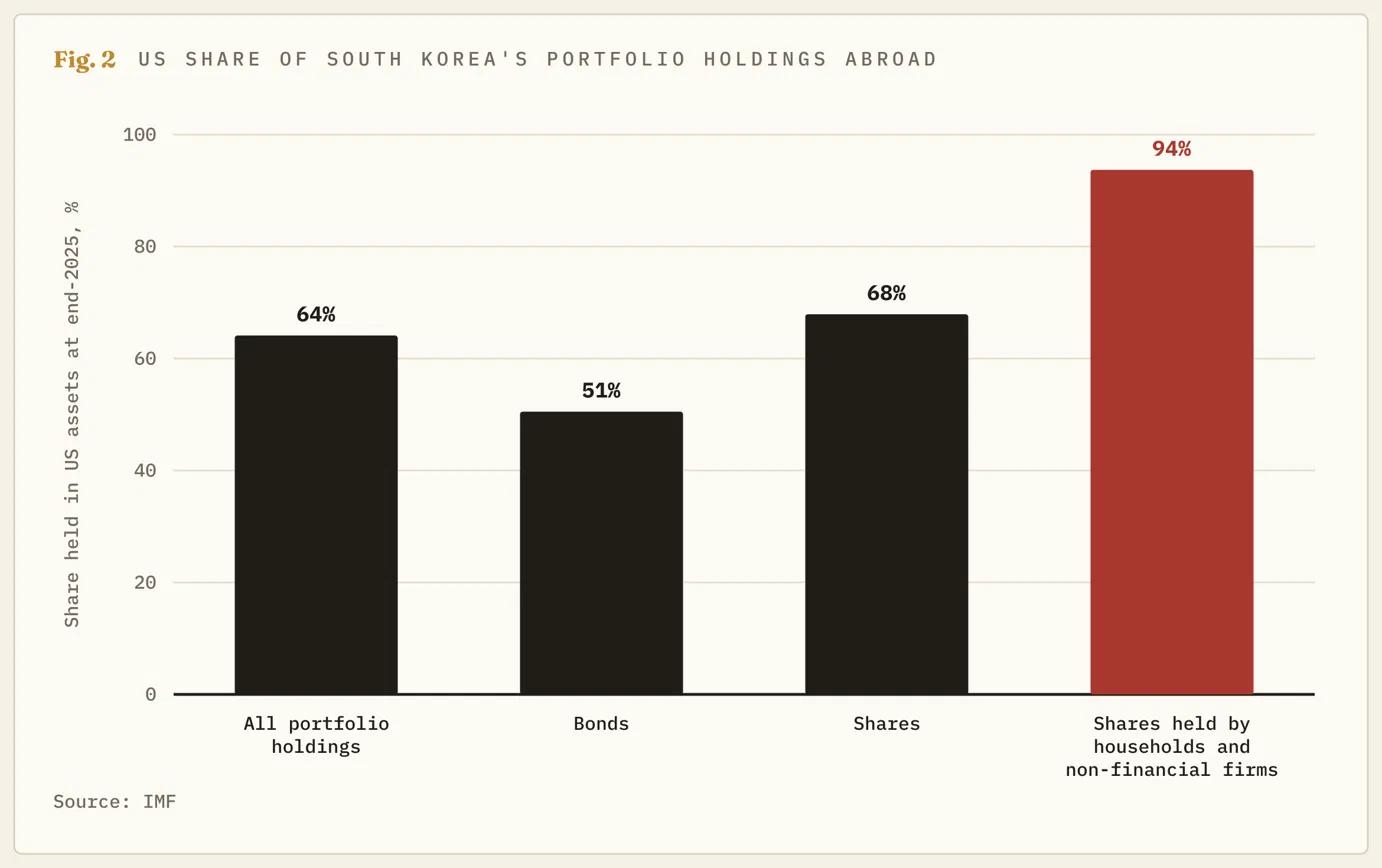
From there, the savings head overwhelmingly to one market. Korean investors have bought five times as much in foreign shares as in foreign bonds over the past two years, and 68% of their foreign shareholdings are American. The US makes up about half of the world's stock market by value and more than 90% of the foreign shares held by Korean households and non-financial companies.
How the money goes round
The loop runs in four steps. US technology companies order chips to fill AI data centres, and chips make up more than half the cost of building one. Asian factories make the chips and collect the export earnings. Savers and funds in those countries then buy US shares, especially in the technology companies that placed the orders, and higher share prices and cheaper funding help those companies order more.
At every step, somebody needs Dollars. The chips are sold in Dollars, and a Korean saver has to buy Dollars before buying a US share. Industry estimates cited by Deutsche Bank put planned spending by the big US cloud companies, which rent out computing power, near $8 trillion through 2031. That would imply about $4 trillion of chip orders still to come.
The weak point is that both halves of the loop depend on one thing. Under the Oil arrangement, a fall in the Oil price shrank the exporters' savings but did nothing to make US government bonds less attractive. In this one, a slowdown in AI spending would shrink the chip exporters' earnings and, in the same stroke, pull down the share prices that drew their savings to the US. Asian savers would have less to send and less reason to send it.
The Dollar rose in the selloff anyway
A first test of the loop arrived this month. The US midterm elections raised the prospect of closer oversight of AI, and on November 5, the S&P 500 fell 4.4% and the NASDAQ-100 fell 6.4%. It was the worst day for US shares since April 2025. Foreign investors had already sold a net $49.77 billion of Asian shares in October, including $30.68 billion in Taiwan, the most in any month since at least 2008.
Through all of that, the Dollar went up. The Dollar Index, which tracks the Dollar against six other major currencies, is at its highest since April 2025. Part of the reason is habit, because investors still buy Dollars when markets fall. The larger part is the Federal Reserve (Fed), which raised its rate to 3.75%-4.00% in September and is fully expected by traders to raise it again on December 9.
Nor did the share-buying stop. US share funds took in $63 billion in the week to November 11, weekly fund-flow data show, as buyers treated the fall as a discount. On that evidence, the flaw is a risk the Dollar carries and not a loss it has taken, and for now higher US interest rates are covering for it. In the first week of the selloff, investors left AI shares for the safety of the currency those shares help fund.
What breaks the loop, and where it would show first
The first place to look is the US Treasury's monthly count of foreign buying, the Treasury International Capital (TIC) data. September's figures are due on Wednesday, while October's, covering the month of the Asian selling, won't arrive until December. The Dollar's largest source of foreign funding is reported two months late, so traders will learn in December what foreign savers did in October.
Before then, the signals are the spending plans themselves. The loop keeps turning if the big US cloud companies keep their budgets and Korean chip exports keep growing, and the Dollar would then keep both of its supports. Chip orders and AI share prices would likely fall together if budgets are cut. That could come from tighter oversight in Congress, from narrower export rules, or from customers who don't pay enough for AI to justify the build.
For now, the lean stays with the Dollar while the Fed is raising rates and foreign share-buying continues. That view breaks if TIC data show foreign buying of US shares falling while rates keep rising. Higher rates would then replace money from shares rather than add to it.
Either way, Deutsche Bank's warning is about what kind of currency this produces. US shares have recently moved about three times as much as ten-year US government bonds, and chip shares more than three times as much again. A currency funded through the stock market would be expected to move more like a stock.
Author
Joshua Gibson
FXStreet
Joshua joins the FXStreet team as an Economics and Finance double major from Vancouver Island University with twelve years' experience as an independent trader focusing on technical analysis.