The US Dollar wobbles: Should you be worried about its biggest fall in 20 years?
The US Dollar (USD), as measured by the US Dollar Index (DXY), has lost almost 9% since the start of the year. This is its worst performance over the first five months of the year for almost two decades. This rapid, brutal and unusual fall raises the question of why such a fall, whether it can get worse, and what the consequences are.
Historic plunge for the US Dollar
It has been a particularly complicated year for the US Dollar, with the US Dollar Index, which measures the Greenback's performance against a basket of six foreign currencies, losing almost 9% of its value since the start of the year. The index began the year slightly above 108.00, and is now falling below the symbolic 100.00 mark.
April was a particularly bearish month, with the DXY index losing 4.5%, its worst monthly performance since 2009.
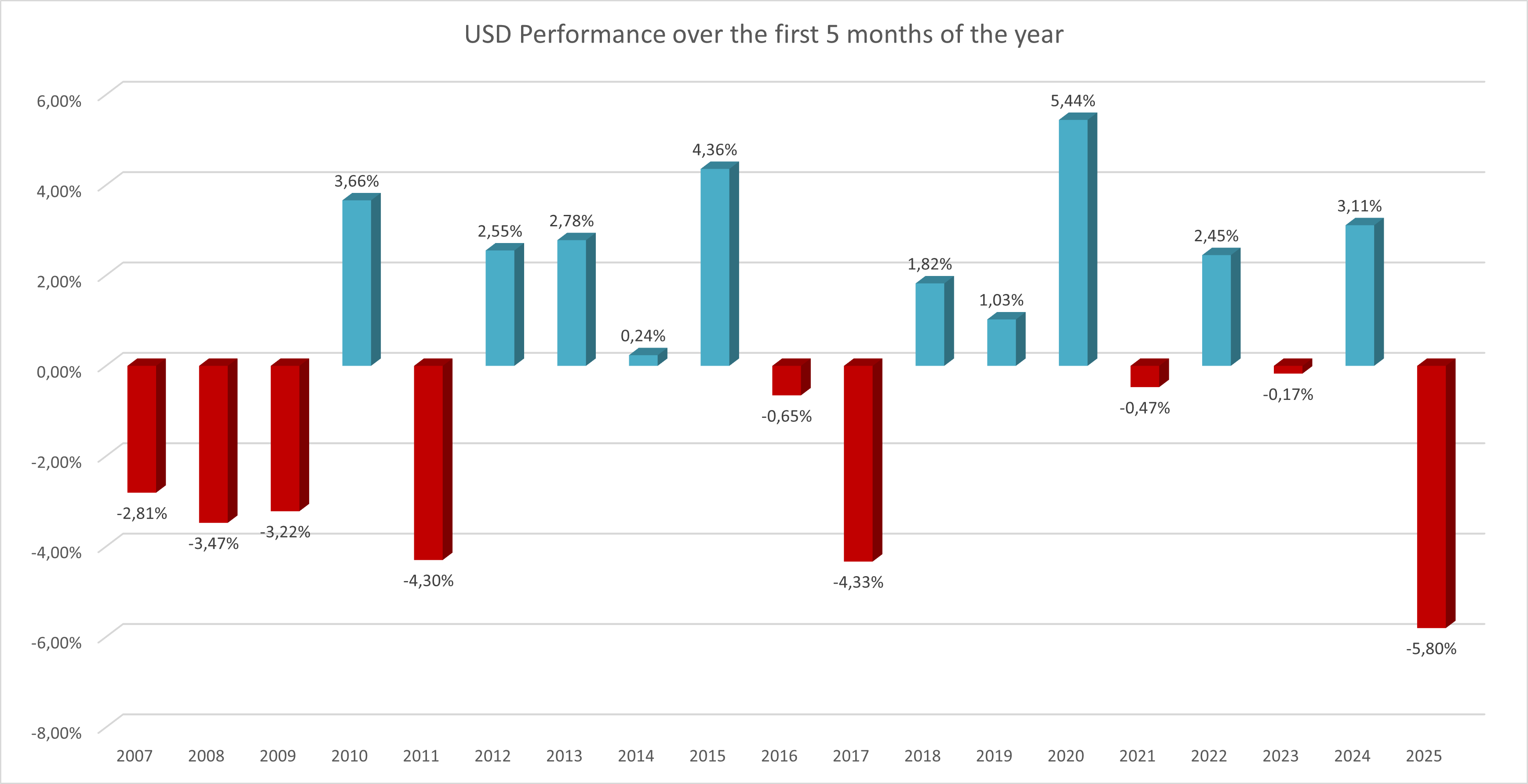
Source: FXStreet. Performance of the Nominal Broad US Dollar Index over the first five months of the year between 2007 and 2025. Data from the Board of Governors of the Federal Reserve System (USA) via FRED®.
A rapid correction in the US Dollar, but not a collapse
This spectacular fall needs to be put into perspective. Far from collapsing, the US Dollar remains historically strong. It had risen by more than 50% between 2011 and its peak in 2022, reaching levels rarely seen since the 1980s.
After its recent fall, the USD has returned to its levels of five years ago and remains 35% above its 2011 low, which puts the fall into perspective.
We therefore need to distinguish between a fall in the value of the US Dollar and a fall in the speed of its depreciation. While the US currency has indeed fallen at a rare and sharp pace, particularly in April, it still remains at a high level by historical standards.
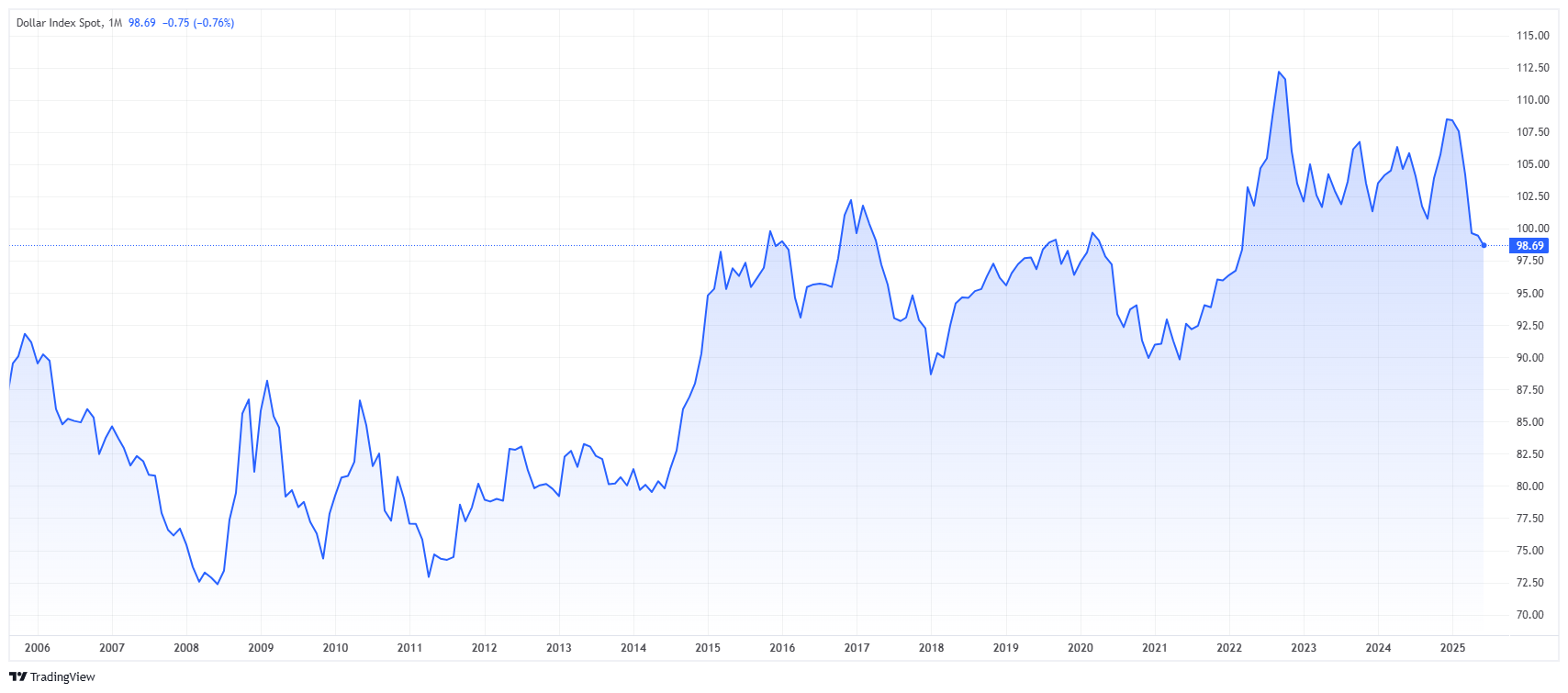
The sharp US Dollar climb between 2021 and 2022 was supported by aggressive interest rate hikes by the Fed and a US economy perceived as more robust than its competitors, in addition to its status as a safe haven during the COVID pandemic.
The currency is now back to levels close to those seen at the start of 2022. So, this is not a sharp fall in absolute terms, but a rapid correction after a long period of outperformance.
Why is the US Dollar falling so fast?
There are several combined reasons:
Aggressive trade policy
One of the main causes is the return of US President Donald Trump to the White House and his desire to relaunch a unilateral, protectionist trade strategy. The announcement on April 2 of a series of tariffs on imports from China, Europe and other trading partners has rekindled fears of a global economic slowdown.
So, instead of acting as usual as a safe haven in the face of uncertainty, the US Dollar was this time perceived as a source of risk.
Crisis of confidence in the Federal Reserve
The public pressure exerted by Donald Trump on Federal Reserve (Fed) Chairman Jerome Powell reinforced the idea that the independence of the US central bank could be called into question.
Twin deficits at record levels
The US budget deficit is now 6.8% of GDP, while the current account deficit is over 4%. According to research by the Bank for International Settlements, crossing this threshold is historically associated with pressure on currencies.
The country is increasingly dependent on foreign financing, which could become rarer, especially if the "revenge tax" sought by Donald Trump is applied.
Under this provision, certain foreign governments and international companies could be subject to an additional 20% tax, which would apply to non-US entities receiving US-source income, including interest, dividends and royalties.
Global repositioning: Europe is posting a stronger-than-expected recovery, China is stabilising its growth, and emerging markets are once again attracting capital. In short, the American exception is crumbling.
Towards a permanently weak US Dollar?
The question now is whether this fall is merely a correction or the start of a more lasting downward cycle. The answer will depend on a number of factors:
- Washington's economic policy: If trade tensions ease and Congress manages to avoid a fiscal cliff, the US Dollar could stabilise.
- Interest rates: The Fed could continue to cut rates. This would further weaken the US Dollar, unless the other central banks follow suit.
- Market confidence: This is the most difficult factor to measure. If the perception of an American decline takes hold, the fall could be self-perpetuating.
According to Deutsche Bank forecasts, the US Dollar could continue to fall in the second half of the year, driven by weaker fundamentals and a loss of relative attractiveness against the Euro (EUR) and the Chinese Yuan (CNY).
The bank cites the structural erosion of the "strong Dollar", fuelled by persistent deficits and the end of "American exceptionalism". The scenario of a downward cycle is now being taken seriously.
Rabobank, for its part, believes that the US Dollar is entering a phase of normalisation: "The greenback's performance over the past decade has been exceptional. What we are experiencing is, above all, a realignment with economic realities", comments the bank in a research report. Rabobank is still forecasting a short recession in the United States, despite a slight improvement on the trade front.
The Fed is expected to continue cutting rates this year, according to the consensus, which would keep up the downward pressure on the currency. For the time being, the markets are expecting at least one rate cut from the Fed between now and the end of the year.
Should inflation remain high, or should President Trump intensify political pressure, confidence in US monetary policy could continue to erode. This uncertain climate leaves the door open to a further fall in the US Dollar, even if no sudden collapse appears imminent.
What are the consequences of a weaker US Dollar?
A falling US Dollar has ambivalent effects:
- For US consumers, it's bad news. Travel abroad is more expensive, and so are imported goods, fuelling inflation.
- For American exporters, the opposite is true. Their products become more competitive internationally. This can benefit large groups, but also American agriculture.
- For emerging markets, repaying US Dollar-denominated debt becomes less expensive.
- For the global economy, in some countries, the desire to "de-Dollarise" could be rekindled.
Should we fear an end to the reign of the US Dollar?
Probably not in the short term. The US Dollar remains the world's main reserve currency, used in over 80% of foreign exchange transactions and nearly 60% of global reserves. No other currency has such a vast, liquid and reliable financial system.
But the trend towards diversification is real. The Euro, the Yuan, and even some digital currencies are starting to eat into the market.
What's more, signs of currency fragmentation are emerging: bilateral agreements in local currencies, BRICS currency projects, the rise of central bank digital currencies, etc.
Bottom line
The US Dollar is falling fast, but not to the point of collapse. It is correcting after years of outperformance, against a backdrop of economic and political uncertainty. What happens next will depend on the Fed, trade tensions and the United States' ability to win back market confidence. Because in the world of currencies, confidence is everything, and it can evaporate in the blink of an eye.
Author

Ghiles Guezout
FXStreet
Ghiles Guezout is a Market Analyst with a strong background in stock market investments, trading, and cryptocurrencies. He combines fundamental and technical analysis skills to identify market opportunities.