The US Dollar was recovering – then Trump and his tariffs came again

The US Dollar hasn’t taken well the tariff-related mess seen over the weekend. Renewed uncertainty over US President Donald Trump's trade policies led to a modest USD pullback, which extended through the early part of the new week. While markets seem to be more and more resilient to Trump’s woes, there is now a clear risk that investors reactivate the so-called “Sell America” trade – and that’s not good for the US Dollar in the short-to-medium term.
Trump's new global levy of 15% that followed a Supreme Court verdict against his sweeping tariffs fueled worries about retaliatory measures and disruptions to global supply chains. This leaves investors questioning whether trade tensions are returning, or at least highlights that these tensions never quite disappeared.
US Dollar recovery halts
The renewed US Dollar weakness comes after the Greenback posted much-needed gains of nearly 1% last week, its strongest performance since November, mainly due to a less dovish Federal Reserve (Fed) outlook.
The main tailwind came from the minutes from the January Fed meeting. which showed that a number of Fed officials judged that additional policy easing may not be warranted until there was a clear indication that the progress of disinflation was firmly back on track.
Geopolitics also gave a hand, as worries about a potential US strike on Iran also benefited the Greenback's safe-haven status.
“Sell-America” returns?
But markets seem to have forgotten all these USD-supportive factors in the wake of Trump’s umpteenth tariff threat. In this context, which favors the USD bears, it is likely that the recent recovery from the three-year low touched in January has run its course.
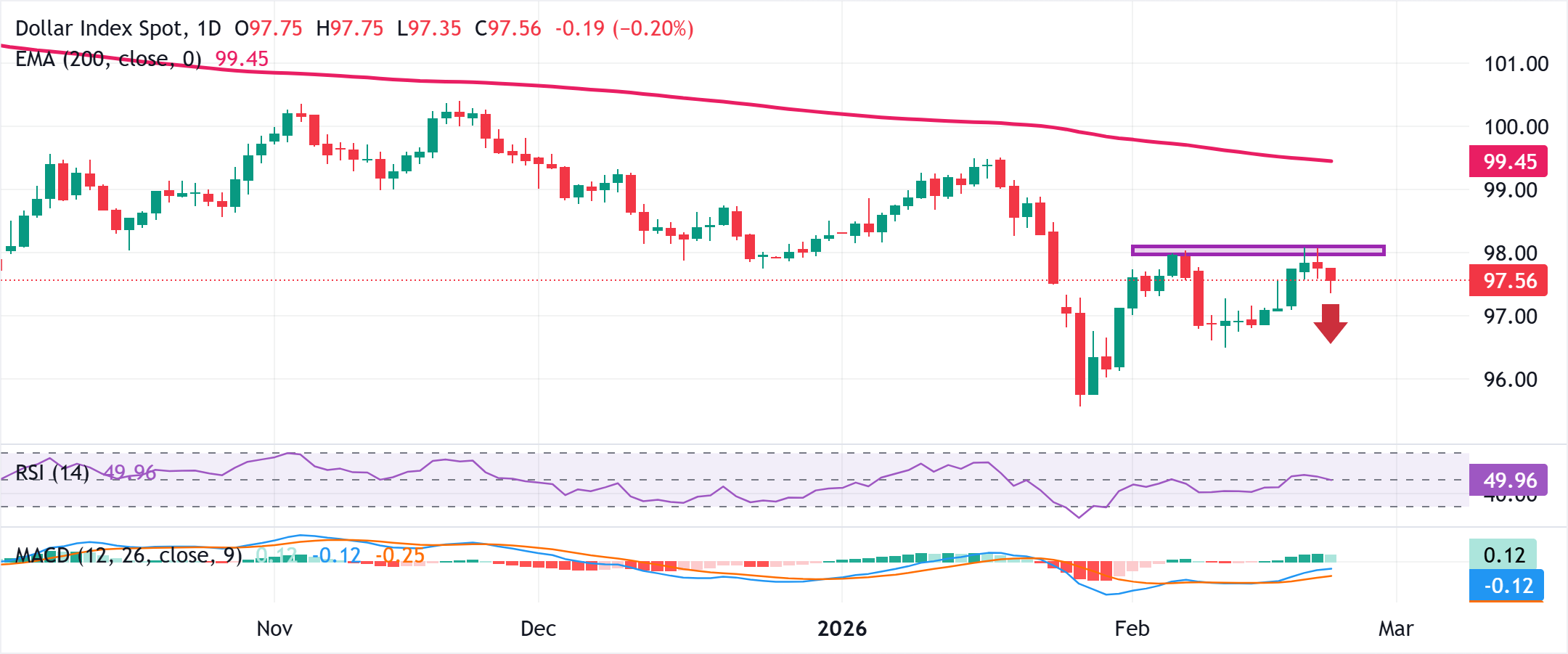
Looking at the technicals, last week's failure near the 98.00 mark constitutes the formation of a bearish double-top on the daily chart. This comes on top of the recent repeated failures near the 200-day Exponential Moving Average (SMA) and validates the negative outlook. However, bearish traders might opt to wait for a sustained break and acceptance below the 96.80-96.75 horizontal support before placing fresh bets.
US Dollar Index daily chart
US Dollar FAQs
The US Dollar (USD) is the official currency of the United States of America, and the ‘de facto’ currency of a significant number of other countries where it is found in circulation alongside local notes. It is the most heavily traded currency in the world, accounting for over 88% of all global foreign exchange turnover, or an average of $6.6 trillion in transactions per day, according to data from 2022. Following the second world war, the USD took over from the British Pound as the world’s reserve currency. For most of its history, the US Dollar was backed by Gold, until the Bretton Woods Agreement in 1971 when the Gold Standard went away.
The most important single factor impacting on the value of the US Dollar is monetary policy, which is shaped by the Federal Reserve (Fed). The Fed has two mandates: to achieve price stability (control inflation) and foster full employment. Its primary tool to achieve these two goals is by adjusting interest rates. When prices are rising too quickly and inflation is above the Fed’s 2% target, the Fed will raise rates, which helps the USD value. When inflation falls below 2% or the Unemployment Rate is too high, the Fed may lower interest rates, which weighs on the Greenback.
In extreme situations, the Federal Reserve can also print more Dollars and enact quantitative easing (QE). QE is the process by which the Fed substantially increases the flow of credit in a stuck financial system. It is a non-standard policy measure used when credit has dried up because banks will not lend to each other (out of the fear of counterparty default). It is a last resort when simply lowering interest rates is unlikely to achieve the necessary result. It was the Fed’s weapon of choice to combat the credit crunch that occurred during the Great Financial Crisis in 2008. It involves the Fed printing more Dollars and using them to buy US government bonds predominantly from financial institutions. QE usually leads to a weaker US Dollar.
Quantitative tightening (QT) is the reverse process whereby the Federal Reserve stops buying bonds from financial institutions and does not reinvest the principal from the bonds it holds maturing in new purchases. It is usually positive for the US Dollar.
Author

Haresh Menghani
FXStreet
Haresh Menghani is a detail-oriented professional with 10+ years of extensive experience in analysing the global financial markets.