|

The Sahm Rule signal: On the blink or flashing red?

Summary

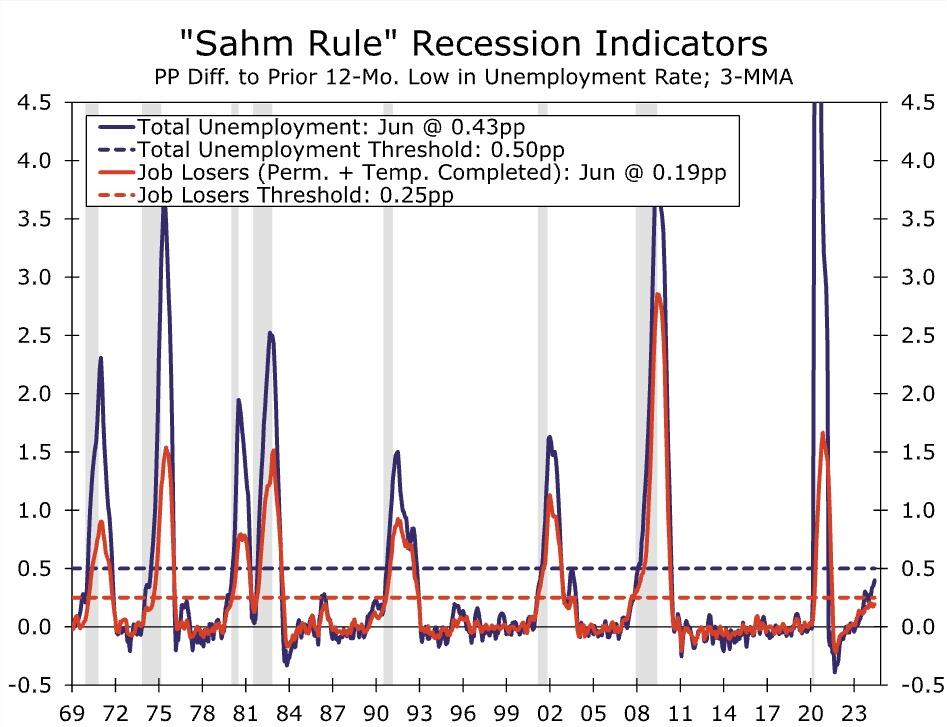
Rising unemployment over the past year has sent the clearest signal yet that the labor market is weakening. While the Sahm Rule indicator—which highlights the historical pattern that the unemployment rate has never risen 0.5 points above its prior 12-month low without a recession—has not crossed its recession threshold, the current rise would nonetheless be unique if a downturn in the labor market were to be avoided. Of course, this has been a unique labor market, with the pandemic initially delivering a massive shock to labor supply. Is the recovery in labor supply now interfering with the Sahm Rule signal?

At 0.43, the Sahm Rule indicator has already risen more than at the onset of any recession in the past 50 years. Yet entrants into the labor force, particularly re-entrants, have been an unprecedented driver of the increase. This should assuage some concern over the current rise as it comes in larger part for the “right” reason of more workers entering the jobs market, which ultimately makes it easier for businesses to grow.

Yet the increase in the unemployment rate for the “wrong” reasons is troubling in its own right. Looking at the rise in unemployment due to job loss on the same basis as the traditional Sahm Rule shows an increase similarly reminiscent of periods when the labor market was on the brink of a downturn.

Could this be the cycle where the Sahm Rule breaks? The larger lift from labor force entrants and more gradual ascent compared to the starting point of prior recessions raises the likelihood. That said, the negative feedback loop between rising unemployment and declining spending means that neither the current increase in the traditional Sahm Rule indicator nor the job loser version should be brushed aside. Recession thresholds crossed or not, the increase in both values shows an unequivocal deterioration in the labor market. With momentum in the jobs market difficult to shift, we see the risk of recession remaining unusually high at the moment.
Download The Full Special Commentary 

Author

More from Wells Fargo Research Team
Share:

Markets move fast. We move first.

Orange Juice Newsletter brings you expert driven insights - not headlines. Every day on your inbox.

By subscribing you agree to our Terms and conditions.

Editor's Picks

EUR/USD runs past 1.1730 after tepid US macroeconomic figures

EUR/USD extends its gains and trades above 1.1730 in the American session on Thursday. The US Dollar resumed its decline, following much weaker-than-expected Initial Jobless Claims. Market players bet for additional rate cuts despite a mildly hawkish Fed.

GBP/USD ticks north beyond 1.3400 after US employment data

GBP/USD ticks beyond 1.3400 in the American session on Thursday, as the US Dollar is back on the losing side, following worse-than-anticipated US employment-related figures. The US Federal Reserve delivered a rate cut at its December meeting, in line with the market’s expectations.

Gold on its way to retest record highs

Broad US Dollar weakness helps the bright metal to extend weekly gains. The XAU/USD pair trades above $4,250, its highest for the week and not far from its record high in the $4,380 region. The Greenback came under selling pressure on Wednesday following the Federal Reserve's monetary policy announcement, further pressured on Thursday by softer-than-anticipated United States employment data. 

Solana dips as hawkish Fed cuts dampen market sentiment

Solana price is trading below $130 on Thursday, after being rejected at the upper boundary of its falling wedge pattern. The broader market weakness following the Federal Reserve’s hawkish rate cut has added to downside momentum.

FOMC Summary: A split cut and a clear shift toward caution

The Federal Reserve (Fed) went ahead with a 25 basis points rate cut, taking the target range to 3.50–3.75%. But the tone around the decision mattered just as much as the move.

Solana dips as hawkish Fed cuts dampen market sentiment
Solana (SOL) price is trading below $130 at the time of writing on Thursday, after being rejected at the upper boundary of its falling wedge pattern. The broader market weakness following the Federal Reserve’s hawkish rate cut has added to downside momentum.