The ruble regains 100% of its loss after Russia invaded Ukraine, why?
Conventional wisdom on why the ruble has rallied is simply wrong. Let's discuss the theories and what is really happening.
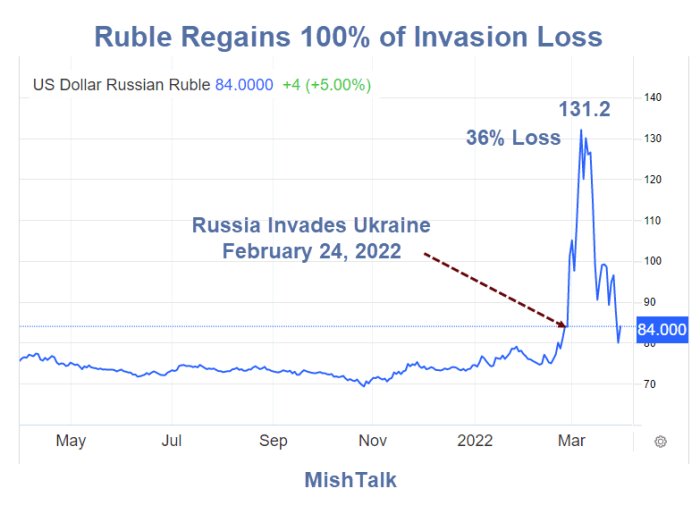
Source: Ruble chart courtesy of Trading Economics, annotations by Mish
Key points
-
When Russia invaded Ukraine on February 24, it took 84 rubles to buy 1 US dollar.
-
On March 7, it took 131.2 rubles to buy 1 US dollar.
-
That's a 36% decline in the rubble vs the US dollar.
-
The ruble is now back where it started on February 24.
Conventional wisdom
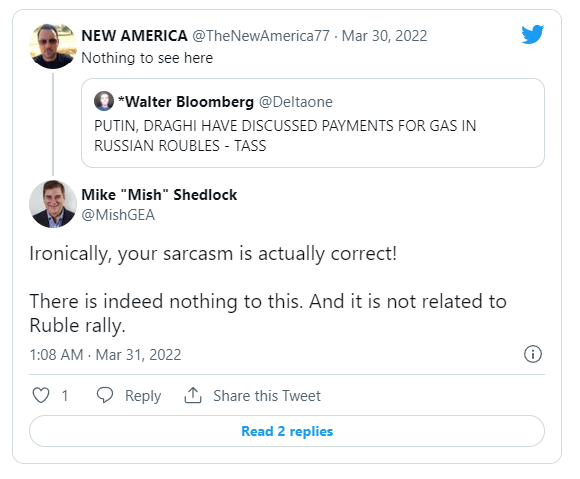
Putin and Italy's Prime Minister, Mario Draghi, have discussed payments for gas in Russian rubles.
What's the difference?
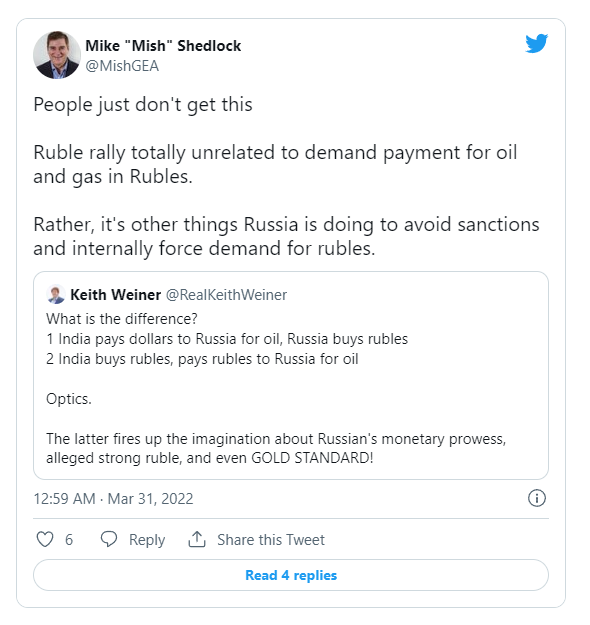
Weiner correctly notes the imagination.
Oil for rubles, who cares?
Case 1: To get rubles to buy oil, Europe sells Euros to Russia central bank. Europe immediately send the rubles it received straight back to Russia to pay for the the oil. Russia central bank accumulates euros.
Case 2: Russia sells oil for euros. Russia central bank accumulates the exact same number of Euros as in case number one.
The currency exchange takes place in seconds. Europe does not have to hold rubles to buy oil.
This is just more of the "oil priced in euros" stupidity. No one will have to hold rubles to buy Russian oil. Or gas. The Ruble does not become a reserve currency.
There is perhaps some small psychological impact, but there is no real impact unless Europe actually held ruble reserves, and here's a hint: Europe wouldn't.
What about European sanctions?
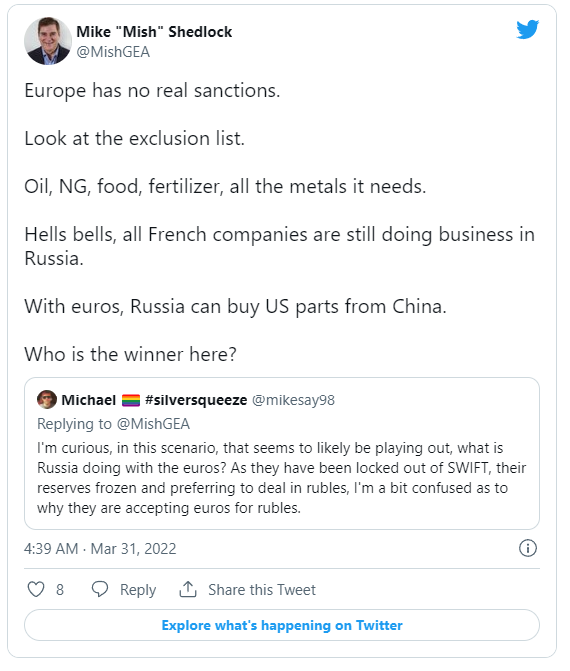
President Biden
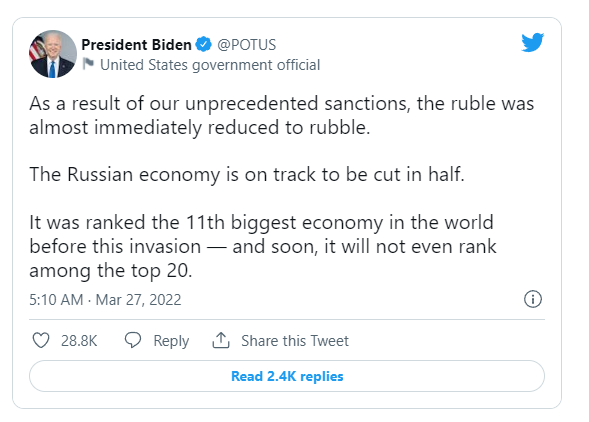
Biden says "Ruble reduced to Rubble because of sanctions."
It took another three days from that Tweet for the ruble to regain all of its losses. Why?
In three words: Sanctions Don't Work. Here are some examples.
Parallel credit card payment system
The Wall Street Journal reports Russia Built Parallel Payments System That Escaped Western Sanctions
Visa and Mastercard pulled the plug on Russia's credit cards. But following the 2014 war in which Visa and Mastercard did the same, Russia took measures to not let that happen again.
Instead, Putin implemented a National Payment Card System—known by its Russian initials NSPK. Visa and Mastercard went along with it.
In 2015 Russia then forced the use of Mir cards based on NSPK.
Those cards do not use the US payment system.
One irony is that instead of Visa and Mastercard getting the fees, Russia's central bank collected 8.2 billion rubles in net profit, or about $94 million at current exchange rates.
Russia actually profited from Visa and Mastercard sanctions.
Price of oil and natural gas
The price of oil and natural soared after the invasion.
The US banned Russian oil, and that influenced the price. But trading never totally stopped. Instead, Russia traded oil to China for a discount, but at a price higher than the pre-war price.
In the hoot of the “We are completely against any kind of blackmailing,” Germany’s Finance Minister Christian Lindner told CNBC Monday.
Gold-backed ruble?
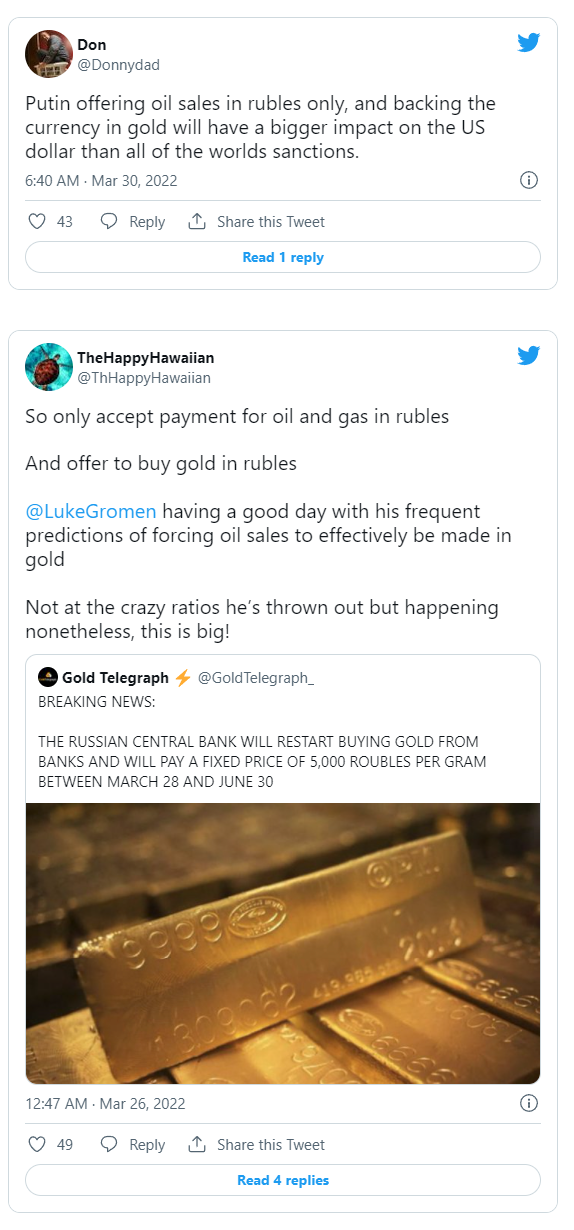
Those Tweets are nonsense. There is no gold-backed ruble.
Russia is offering to buy gold at a discount. It certainly is not selling gold at a discounts.
The amount of total nonsense generated over those Tweets and payment in rubles is staggering.
What does payment in rubles really mean?
Please consider What Would Paying for Natural Gas in Rubles Mean?
The article quotes Eswar Prasad, professor of trade policy at Cornell University and a former official at the International Monetary Fund.
In theory, requiring ruble payments could support demand for the currency and its exchange rate. But not by much, Prasad says. As it stands, euros and dollars are already being used to purchase rubles when Gazprom exchanges its foreign earnings.
Note that last sentence. This is what Weiner implied in his Tweet above.
What Russia actually did is force exporters to trade 80% of its euros and dollars into rubles at a discount. That creates a huge artificial demand for rubles.
Currency and stock market restrictions
Russia also restricted currency trades. People who wanted out of the ruble could not get out.
In addition, Russia Banned Foreigners From Selling Russia Stocks.
Russia's real power
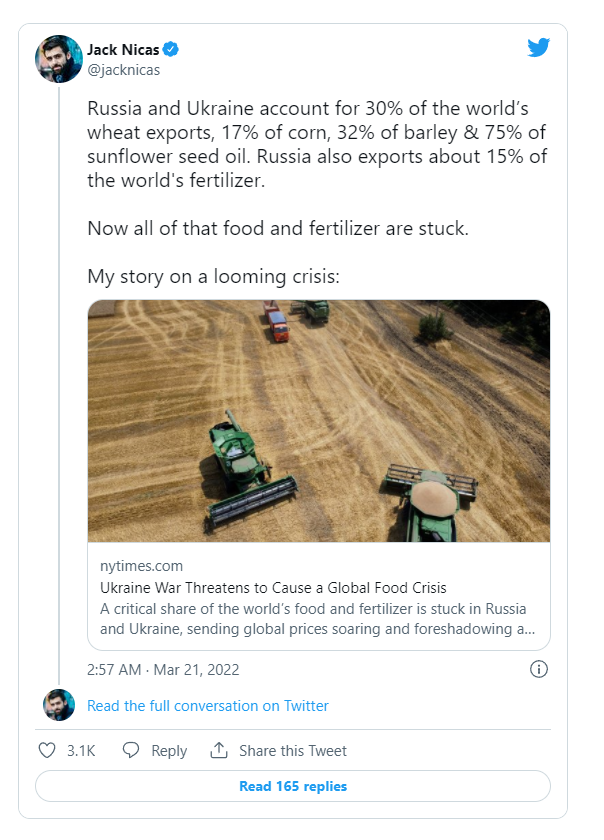
Russia's real power is to shut off the supply of natural gas, oil, fertilizer, and grain.
List of companies still doing business in Russia
The list of US companies still doing business in Russia is huge. We hear about meaningless reactions.
France would not go along, at all. "We are not at war with Russia," said French President Emanuel Macron.
For discussion, please see After McDonald’s Closed 847 Restaurants in Russia, Russian Government Renamed Them "Uncle Vanya"
Russia seized 847 McDonald's. Who did that hurt?
Eight reasons for ruble rebound
-
Russia escaped Visa and Mastercard
-
Russia still trades oil and gas with Europe
-
Russia halted currency trades
-
Russia enacted stock market restrictions
-
Of Russian exporters, Russia demanded 80% of euros and dollars be traded for rubles.
-
Russia threatens to stop exporting key commodities including aluminum, natural gas, fertilizer, rare earth minerals, etc., driving up prices and the need to stockpile.
-
Sanctions cannot take away Russia's natural resources.
-
The Fed can print dollars, it cannot print commodities. Likewise, the ECB can print euros, it cannot print commodities
Two false reasons people key on
-
Russia demands payment in rubles
-
Gold-backed ruble
I am surprised Robin Brooks messes this up so badly.
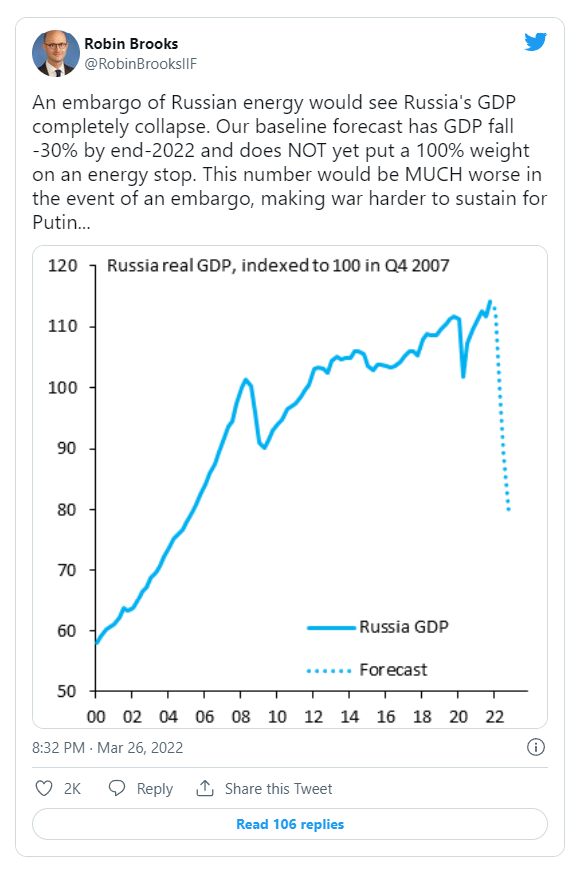
Understanding threats
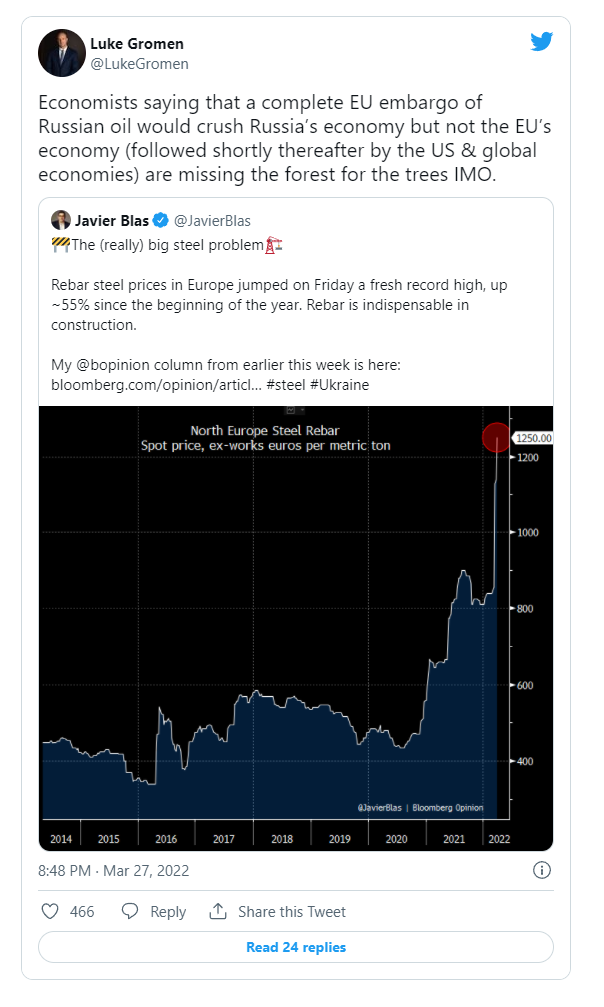
Luke Gromen gets that aspect correct, Robin Brooks doesn't.
Twelve and three-word summations
A twelve-word synopsis of the above is Misguided Souls Still Do Not Understand This Simple Truth: Sanctions Don't Work
The last three of those twelve words emphasize the key point.
Meanwhile, Biden Doing Everything Possible to Drive Up the Price of Oil, Some of It's Illegal
Finally, US Sanction Policy Drives China Into Russia's Loving Arms.
China is the big winner in global sanction policy.
There is one more key aspect: Weaponizing the US dollar has totally backfired on the US. War views aside, we should all cheer that aspect. Yet, misguided souls want to escalate what is proven not to work.
Author

Mike “Mish” Shedlock's
Sitka Pacific Capital Management,Llc
Mike “Mish” Shedlock is a registered investment advisor for SitkaPacific Capital Management.