The Oil spike is a problem that central banks can’t ignore anymore
Oil is suddenly back in the spotlight, and that matters more than it might initially appear. Energy markets often react before the broader macro narrative shifts, and a sustained rise in Oil prices could complicate the inflation outlook just as central banks prepare for a crucial round of policy meetings.
After months in which investors focused mainly on interest rates and Artificial Intelligence, Crude prices are beginning to climb again as the war intensifies in the Middle East.
Oil is once again becoming a key driver of the global macro conversation.
Geopolitics returns to the oil market
Energy markets are particularly sensitive to geopolitical shocks, and the current war involving Iran has revived concerns about supply risks in the Middle East.
Much of the world’s Oil still flows through fragile geopolitical corridors, including the Strait of Hormuz, one of the most critical chokepoints in global energy trade.
Even the perception of disruption can be enough to lift prices. Energy markets tend to price risk early, often before any actual supply shortage materialises. The current scenario goes beyond the mere perception, as the war has effectively closed the waterway.
That risk premium now appears to be returning.
-1773676900014-1773676900015.png)
Why central banks are watching
For policymakers, Oil matters more because of the expectations it shapes rather than because of its direct weight in consumer baskets.
Higher energy prices can quickly feed into transport costs, industrial inputs and household inflation expectations. If the move becomes large enough, it can slow the disinflation process that central banks have spent the past two years trying to achieve.
This creates a dilemma.
If Oil continues to climb, policymakers may need to remain cautious even as economic growth shows signs of softening.
That dynamic becomes particularly relevant as central banks gather for a series of policy meetings this week. From Australia to the US, the recent Oil shock will be in all policymakers’ tables.
Energy and inflation: a familiar story
The global inflation surge of recent years was not caused by energy alone, but Oil and Gas played an important role in amplifying price pressures across the economy.
When energy prices rise, inflation often follows with a lag. Fuel costs affect transportation, logistics and production, gradually filtering through supply chains before eventually appearing in consumer price indices.
This is why energy shocks often appear first in commodity markets before showing up in inflation data.
In that sense, Oil can act as an early warning signal for the broader macro environment.
Oil positioning: speculators are leaning bullish
Positioning data shows that more and more investors are betting on the rise in Oil prices.
The most recent numbers from the Commodity Futures Trading Commission (CFTC) reveal that speculative net long holdings in WTI Oil rose dramatically to around 228K contracts in the week ending March 10. This is up from about 172.1K contracts the week before.
The rise shows a big change in mood, with hedge funds and other big speculative traders boosting bullish exposure as tensions between countries rise.
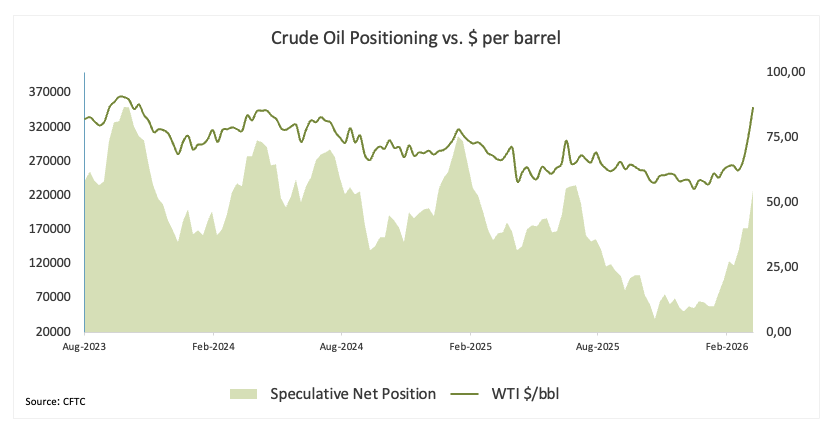
At the same time, open interest fell slightly from roughly 2.07 million contracts to about 2.05 million contracts. This suggests that some of the changes in posture may be due to short covering or portfolio rebalancing rather than a big wave of new involvement.
Still, the big rise in net longs shows that speculators are getting ready for Oil prices to go up much more.
In real life, the statistics show that the Oil market is starting to draw in more investors.
The US Dollar and macro spillovers
The swings of Oil also have a big effect on currency markets.
When there are geopolitical tensions and commodity prices go up, the US Dollar frequently becomes stronger as investors move their money to safe-haven assets like US Treasury markets.
-1773676925246-1773676925247.png)
At the same time, economies that rely significantly on imported fuel, like portions of Europe and Asia, might suffer when energy prices go up.
This combination may make the US Dollar stronger just when central banks are talking about whether or not to make monetary policy more flexible.
Bottom line
For now, the Oil price surge is little compared to the big changes that happened during past global crises. But the way you travel is important.
Energy markets usually move before the big picture changes. When Crude prices start to go up, they sometimes show dangers that other types of assets haven't completely factored in yet.
As central bank meetings loom and tensions across the world stay high, Oil may once again be a major factor in the economy's future.
If the rise keeps on, authorities may soon have to deal with a problem they know all too well: keeping inflation under control in a world where Oil costs are going up again.
Author

Pablo Piovano
FXStreet
Born and bred in Argentina, Pablo has been carrying on with his passion for FX markets and trading since his first college years.