The MoF likes to play tricky games with the traders

About the yen: We have lived through several rounds of Japanese intervention and learned one lesson: the MoF likes to play tricky games with the traders. They will hit you over the head with a baseball bat, then stand aside for a few days, then come back again or maybe just do a little jawboning. It’s not possible to forecast the yen once intervention becomes real and not just talk.
Reuters calls it a game of cat-and-mouse and that is accurate. Since the actual intervention Thursday night and Friday, we see the dollar/yen making a feeble effort to rise back up, but in baby steps. From the panic low Sunday night at 156.51, the dollar has regained only a little more than one yen to 157.94 at about 5 am today.
This time is different, too. Japan has the US on its side in a new, far more rigorous way, very good for propaganda purposes even if Mr. Bessent didn’t actually sell any dollars, just euros.
We need to ask where the Japanese would like to see the yen if they can get it. We guess 100-125, which is what prevailed in 2015-21. See the monthly chart. This seems unattainable at the moment but we wouldn’t bet against it. It would take some action from the BoJ and some careful repatriation by insurance companies and other big funds.
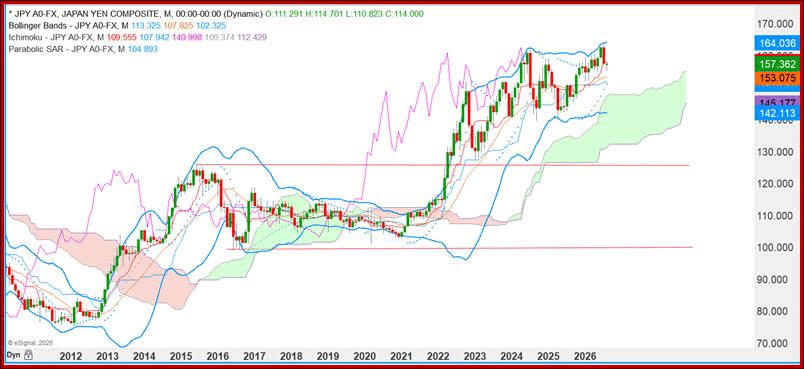
The WSJ got behind Warsh telling the bond market to do its own risk assessment and not rely on the Fed’s forward guidance. It has also gotten behind Bessent in his quest to control the FX market.
To intervene without actually selling dollars or having Japan sell Treasuries, Bessent wants to use a trick whereby the US lends the dollars to Japan under a Covid-era program. The 12-member Fed board has to agree, a new test for Warsh. Bessent and Warsh speak regularly. Oh, good, two multimillionaires running the show, exactly the opposite of what the Founders designed and tradition has shaped for 250 years to now. Stay tuned.
Outlook
Today we get the June JOLTS report, factory orders and trade balance. Jolts will be important now that we have employment higher in the ISM manufacturing PMI, in the face of handwringing over unemployment as an offset to inflation at the Fed. We also get earnings from SpaceX.
The US economy may be a bit lopsided to the high-tech side—data centers, chips, etc.—but it’s not weak, as the ISM PMI just demonstrated. It seems improbable that a rate hike or two would throw it into recession, as economist Zandi worried about. In fact, we might say that given the rise in input prices, the economy could be overheating, although that narrative is weakened by the manufacturing sector comprising only about 9.4% of the economy (and workforce) if $2.4—2.9 trillion in its own right.
Forecast
If the drop in the price of oil on the prospect of re-opening the Strait is the real deal, the dollar gets a slap in the face. What it does to Fed thinking about looming inflation is another matter. The Fed already sees inflation abating. An excuse not to hike in September?
Any kind of progress in the Iran war is probably going to drop the level of risk aversion, too, another black mark on the dollar’s book.
That leaves growth, still behind a strong dollar, but coming under increasing fire for being lopsided in favor of tech, with plenty of essays on how this is just like the railroads in the 19th century or the internet in the ‘90’s—or different this time.
In the end, we need to watch the 2 and 10-year yields. The 10-year is already dipping.
This is an excerpt from “The Rockefeller Morning Briefing,” which is far larger (about 10 pages). The Briefing has been published every day for over 25 years and represents experienced analysis and insight. The report offers deep background and is not intended to guide FX trading. Rockefeller produces other reports (in spot and futures) for trading purposes.
To get a two-week trial of the full reports plus traders advice for only $3.95. Click here!
Author

Barbara Rockefeller
Rockefeller Treasury Services, Inc.
Experience Before founding Rockefeller Treasury, Barbara worked at Citibank and other banks as a risk manager, new product developer (Cititrend), FX trader, advisor and loan officer. Miss Rockefeller is engaged to perform FX-relat