The looming recession so many predict is still not in evidence

Outlook: The calendar is stuffed full this week, with consumer sentiment a possible star in the US today–but remember that sentiment has been falling back while consumer spending remained robust, even at the expense of savings.
And not to sound like a broken record, but that looming recession so many predict is still not in evidence. Last week the Atlanta Fed GDPNow came in at 1.9% for Q2. We get another one tomorrow. And the US is not alone. We get GDP from Australia and Canada this week, likely more robust than earlier feared and in the case of Canada, a cattle prod for two more fat (50 bp) hikes. The BoC remarks tomorrow could be interesting.
The point: it ain’t necessarily so that relentless hikes and hawkishness–beating inflation at all costs–will crash economic activity and market sentiment at the same time. We are accustomed to the two things going together. Central bank hikes lead inexorably to the economy contracting and equities falling back, too. There is no law that says you can’t have hikes and hawkishness with the economy (meaning the consumer) fighting back with the same and nearly the same degree of activity, and the stock market seeing those higher earnings instead of seeing only economic contraction. This implies inflation lasting longer, and because capital spending will not necessarily be part of that push-back, recession can still be out there in the future–just not now.
For a clutch of reasons–Shanghai re-opening, the amazing foreign policy unity in Europe, acceptance of the Fed’s hawkishness, the S&P’s retreat from bear market territory–risk sentiment is swinging its needle from panic/fear to “oh, okay.” This is not the same thing as the embrace of risk, but it’s a hole in the wall of despair. Case in point: commodities are diverging from one another instead of acting like a single massive monster. It would be rare for a market about to get punched in the jaw with the end of QE–technically, tomorrow–and massive rate hikes to keep going on the same path. But not impossible. Can it last? Maybe not. That’s a version of the soft landing and it has low probability.
In FX, when in doubt about the dollar, look to the Other Dollars and also to the crossrates. If we are right about sentiment swinging to a less negative mode, the Other Dollars should be about to shine.
Foreign Affairs: A TV show last week polled viewers about whether Kissinger is right that Ukraine will have to give up some territory to Russia to make Russia go away. A whopping 90%+ said “Go to hell, Henry.” So did the Polish and Ukrainian top officials, who spoke eloquently about the principles they embrace. Nobody has forgotten Kissinger’s betrayal of the Kurds. It’s not only Americans in solidarity with Ukraine–Europe’s support for Ukraine is amazing and wonderful. Putin has done what Merkel could not. It may be foolish economically to ban Russian oil in any part, but never mind–the point is not the oil or the economy. It’s solidarity. How rare for a political principle to win.
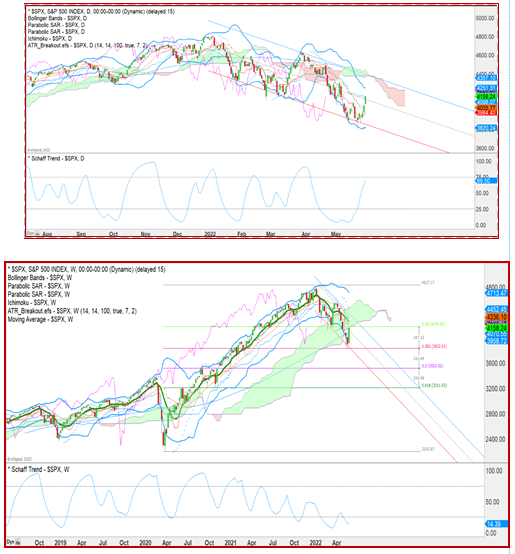
Musings on the S&P: Before our emergency hiatus, we wrote that the reason we may avoid a reversal in the stock market is a stubborn refusal to enter bear territory and stay there. That turned out to be correct, but recession fear still stalks the land. On the daily chart, we easily see the downward sloping channel, happily getting a robust pushback at the moment but likely ending at the Bollinger band top (4251.56) or the channel top itself (4376.07). The Average True Range breakout indicator lies in-between at 4354.30. Notice the whole shooting match is below the cloud, a sell signal.
There is only one question: what is the probability of the current rising wave continuing to break out above all these resistance levels to deliver a reversal? In FX, the answer would depend on current events, economic releases, central bank statements, etc.. We just saw it happen in dollar/yen.
In the S&P, the probability is nearly zero. See the weekly chart. The dark green line is the 200-day/40 week, a meaningless number over long periods of time but still a solid sell signal to many. If enough people believe, they cause it to happen. The Fibonacci retracement lines tell the same story. The probability is high that the S&P falls to the 50% retracement (3532.96) or the 62% retracement (3212.63). Again, Fib numbers and the secrets of the universe in some magic set of numbers is nonsense, but becomes a self-fulfilling prophecy all too often.
All these indicators are standard, conventional indicators that come packaged with every charting software. You can add fancier indicators but will get the same outcome–the probability of a deep dive is very, very high. The point is that is enough chartists are seeing the same prognosis, do they not all behave the same way? Well, maybe not. If risk sentiment is doing that weird tango of accepting hawkishness without giving up activity, the first place we will see it is the S&P.
That is going to bring out the pickers–energy, commodities and agriculture will be okay, right? Maybe not. An ebbing tide lowers all boats as traders and investment managers abandon ship. Even oil may be at risk (eek).
This is an excerpt from “The Rockefeller Morning Briefing,” which is far larger (about 10 pages). The Briefing has been published every day for over 25 years and represents experienced analysis and insight. The report offers deep background and is not intended to guide FX trading. Rockefeller produces other reports (in spot and futures) for trading purposes.
To get a two-week trial of the full reports plus traders advice for only $3.95. Click here!
This is an excerpt from “The Rockefeller Morning Briefing,” which is far larger (about 10 pages). The Briefing has been published every day for over 25 years and represents experienced analysis and insight. The report offers deep background and is not intended to guide FX trading. Rockefeller produces other reports (in spot and futures) for trading purposes.
To get a two-week trial of the full reports plus traders advice for only $3.95. Click here!
Author

Barbara Rockefeller
Rockefeller Treasury Services, Inc.
Experience Before founding Rockefeller Treasury, Barbara worked at Citibank and other banks as a risk manager, new product developer (Cititrend), FX trader, advisor and loan officer. Miss Rockefeller is engaged to perform FX-relat