The Japanese Yen gains as Japan's inflation hits its highest since November 2025


USD/JPY retreats on Friday as the Japanese Yen (JPY) gains ground against the US Dollar (USD) following the release of Japan's latest inflation figures. The pair pulls back after approaching the psychological 160.00 level last week, a level that has renewed concerns about possible intervention by Japanese authorities.
The Japanese Yen is benefiting from a combination of domestic and international developments. Rising inflation reinforces expectations of further monetary tightening by the Bank of Japan (BoJ), while a sharp sell-off in global equity markets encourages investors to seek refuge in the Japanese currency.
However, the US Dollar remains supported by increasingly hawkish expectations surrounding the Federal Reserve (Fed), creating competing forces that could determine whether USD/JPY extends its correction or makes another attempt to break above 160.00.
Japan's inflation reaches a one-year high, keeping BoJ tightening expectations alive
Japan's National Consumer Price Index (CPI) rose 2.3% YoY in October, accelerating from 2.1% in September and reaching its highest level since November 2025, according to data released by the Japan Statistics Bureau on Friday. Despite the acceleration, the headline figure fell short of market expectations of 2.5%. The National CPI excluding fresh food, Japan's preferred measure of core inflation, increased to 2.2% from 2.1%, also below the 2.3% consensus. Meanwhile, inflation excluding fresh food and energy eased to 2.2% from 2.4%.
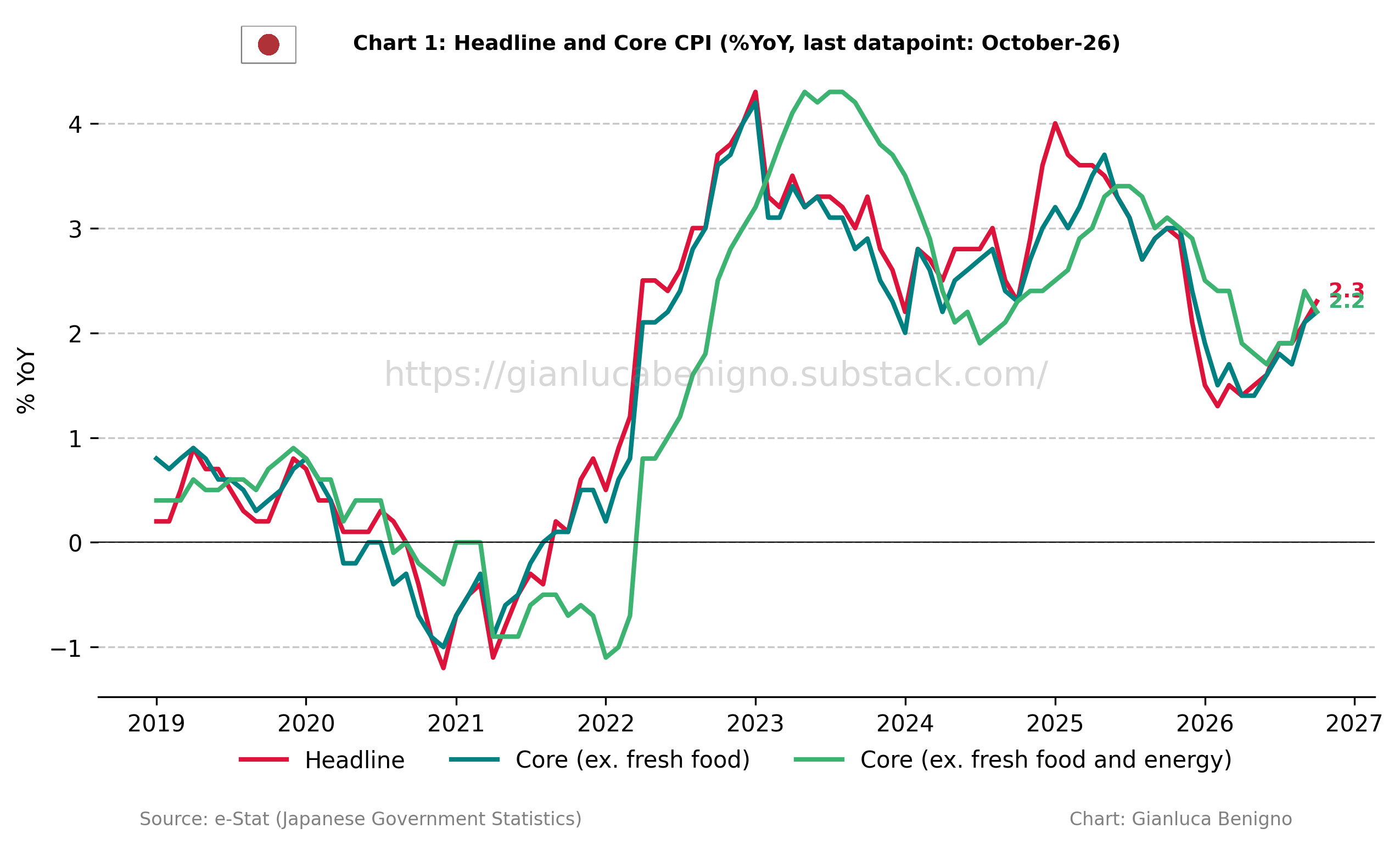
Although the figures were slightly softer than anticipated, inflation remains above the BoJ's 2% target, supporting expectations that the central bank will continue normalizing monetary policy.
Commerzbank highlights the persistence of underlying price pressures, particularly in industrial goods: "Industrial goods inflation, in particular, remains elevated at around 4% year-on-year, well above the Bank of Japan’s target." The bank also points to strong monthly inflation momentum, arguing that current price developments could justify further monetary tightening beyond December.
For the Japanese Yen, the key question is therefore not simply whether the BoJ raises interest rates at its next meeting, but how far the tightening cycle could extend into 2027.
Bank of Japan's December rate hike remains on the table
Expectations of another BoJ rate increase remain elevated despite the downside inflation surprise. According to Brown Brothers Harriman (BBH), the probability of a 25-basis-point interest rate hike in December declined to 77% from 87% following the inflation report. Nevertheless, markets continue to anticipate another tightening move, particularly after BoJ Governor Kazuo Ueda reiterated on Thursday that underlying inflation is broadly consistent with the central bank's target.
Ueda also emphasized that monetary conditions remain accommodative and that the BoJ intends to continue raising borrowing costs if its economic outlook materializes. Japan's Economy Minister Minoru Kiuchi reinforced this assessment on Friday, highlighting favorable signs in the economy as wages and prices continue rising together.
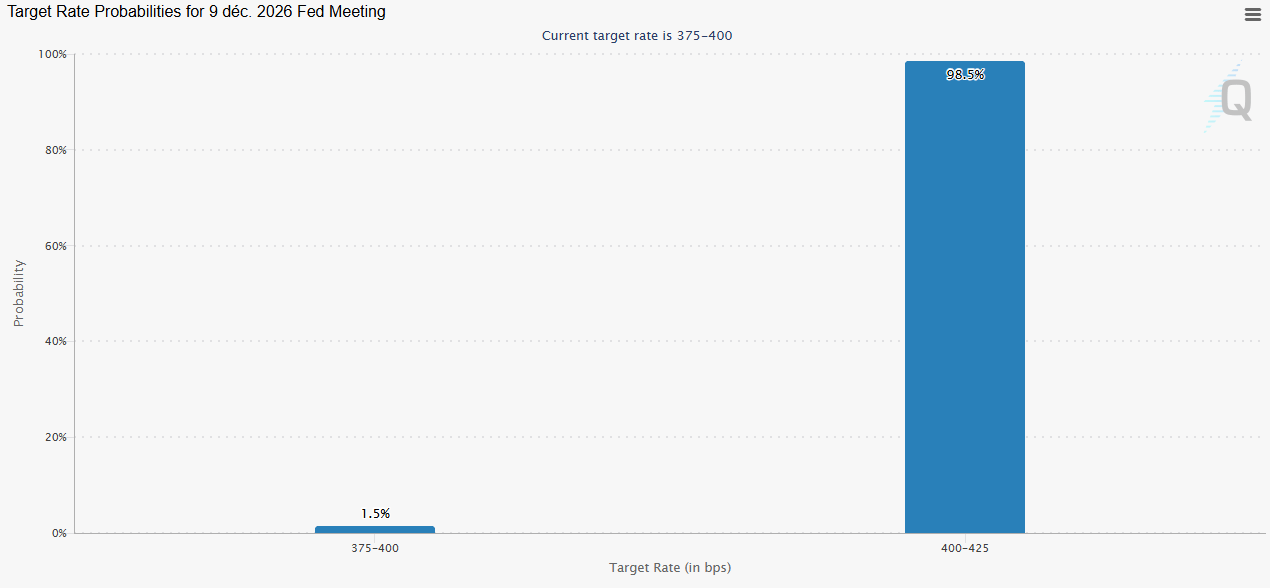
However, the contrast with US monetary policy remains significant. Markets are almost fully pricing in a 25-basis-point Fed rate hike in December, with additional tightening expected in January. This divergence in interest rate expectations continues to support the US Dollar and could limit the scope of a sustained Yen recovery.
Tokyo's intervention warnings make 160.00 a critical threshold
Beyond monetary policy, the risk of intervention in foreign exchange markets remains an important factor supporting the Japanese Yen. USD/JPY's recent approach toward 160.00 has revived speculation that Japanese authorities could intervene to prevent excessive currency depreciation.
Although Tokyo has not announced a specific exchange rate that would trigger intervention, repeated warnings against excessive currency movements have made investors increasingly cautious about pushing USD/JPY above this psychological threshold.
BBH emphasizes the risks associated with further upside: "Higher US yields keep USD/JPY biased upward, but intervention risk makes chasing gains beyond 160.00 a less attractive risk-reward trade."
The combination of potential intervention and expectations of a December BoJ rate hike creates a significant obstacle for US Dollar buyers. Nevertheless, verbal warnings alone may not be sufficient to reverse the broader trend if US Treasury yields continue rising and the Fed maintains its hawkish stance.
Global stock market turmoil gives the Japanese Yen another reason to strengthen
The Japanese Yen is also benefiting from renewed risk aversion as global equity markets face significant selling pressure. Concerns about stretched Artificial Intelligence (AI) valuations and the sustainability of technology investment spending have triggered a broad retreat from riskier assets. The resulting unwinding of carry trades, which typically involve borrowing in low-yielding currencies such as the Japanese Yen to invest in higher-yielding assets, is supporting demand for the Japanese currency.
MUFG considers the Japanese Yen particularly well-positioned if the sell-off intensifies. "We see the yen as best positioned and we are not surprised it is the best performing G10 currency after the dollar in November," notes the firm.
A deeper correction in technology stocks could also push US Treasury yields lower, reducing the interest rate advantage supporting the Greenback. However, the Fed's hawkish outlook remains a counterweight, suggesting that a sustained decline in USD/JPY may require a more pronounced deterioration in US financial conditions.
USD/JPY technical outlook: 160.00 remains the key resistance
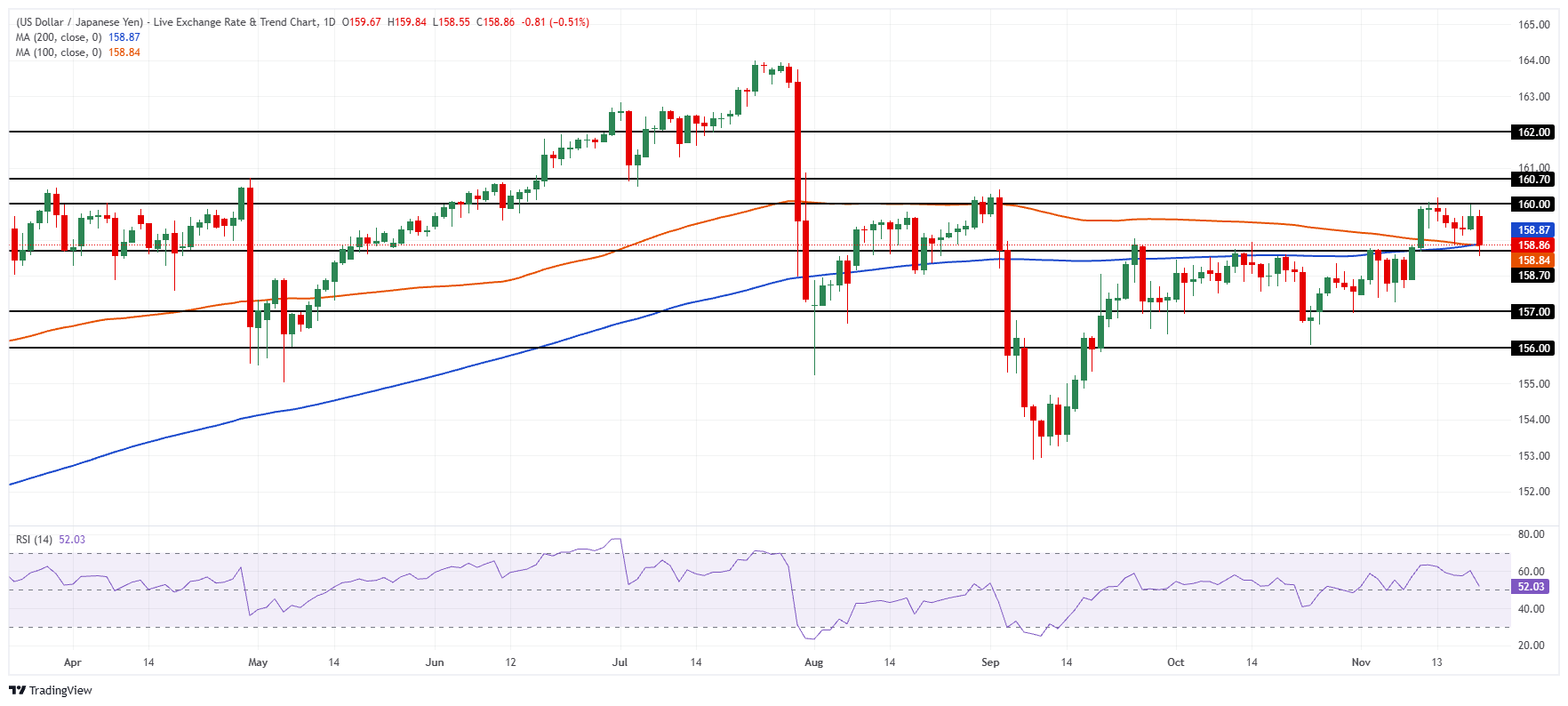
The daily chart shows USD/JPY retreating from the 160.00 resistance area after failing to sustain its recent bullish momentum. The pair currently trades around 158.86, almost exactly at its 200-day Simple Moving Average (SMA) of 158.87 and its 100-day SMA of 158.84. This convergence of moving averages creates an important technical pivot for the pair.
The Relative Strength Index (RSI) stands near 52, indicating broadly neutral momentum after the recent rejection from 160.00.
A sustained break below the 158.70 support level could encourage further selling pressure, exposing the psychological 157.00 level, followed by 156.00. Conversely, a recovery above 160.00 would be needed to revive bullish momentum, with subsequent resistance at 160.70 and 162.00.
For now, the Japanese Yen benefits from rising inflation, expectations of tighter BoJ policy and growing safe-haven demand. However, the Fed's hawkish stance could continue to limit its recovery. The battle around 160.00 therefore remains crucial. A sustained rejection would reinforce the JPY's recovery, while a decisive breakout could put Tokyo's willingness to intervene back into focus.
Author
Ghiles Guezout
FXStreet
Ghiles Guezout is a Market Analyst with a strong background in stock market investments, trading, and cryptocurrencies. He combines fundamental and technical analysis skills to identify market opportunities.