The Indian Rupee isn’t likely to find relief anytime soon

India is the world’s fastest-growing major economy. That alone should be enough for investors to support the currency. So what is holding back the Rupee?
The Indian Rupee entered 2026 after posting its largest annual fall in three years and fell to a fresh record low against the US Dollar in January. Regular intervention by the Reserve Bank of India has helped slow losses, but the Indian currency has failed to reverse the downtrend
Trade uncertainties add to the pressure
One of the main reasons behind the Rupee’s underperformance is hedging by importers and corporate firms as they anticipate further depreciation. Exporters have also played their role by slowing USD sales in the forward market, reducing supply and keeping the currency under pressure.
And, of course, we can’t forget about Trump’s erratic trade policies and continued tariff threats. Uncertainty remains a key variable for the outlook on the INR. Following the Supreme Court's verdict blocking Trump's tariffs imposed using emergency powers, India and the US rescheduled a meeting to finalise the legal text of the proposed interim bilateral trade agreement reached earlier this month.
-1772010771384-1772010771387.png)
Increasing Oil prices further complicate the outlook
Moreover, the current market environment for the INR is a complex interplay of the USD dynamics and Crude Oil prices. The USD Index (DXY), which tracks the Greenback against a basket of currencies, has shown signs of stabilization on the back of the Federal Reserve's (Fed) hawkish outlook.
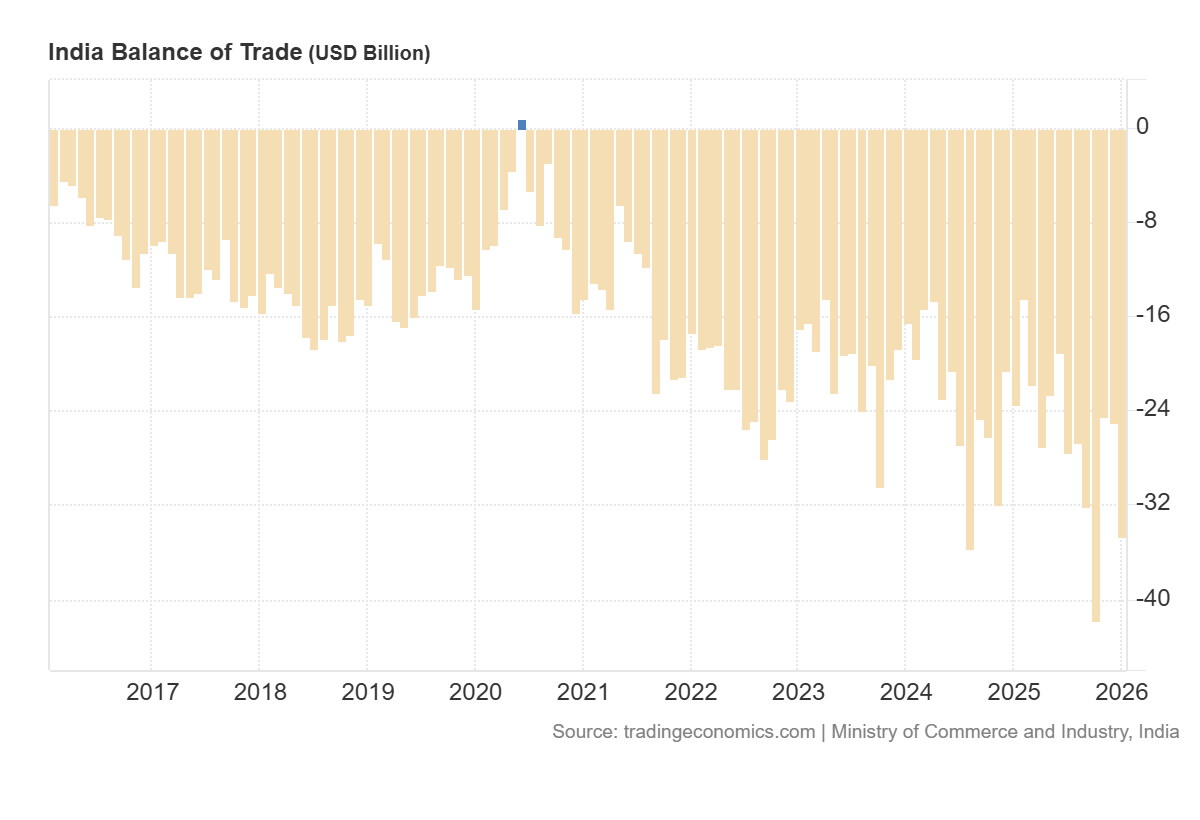
Adding to this, a surge in Crude Oil prices – a critical import for India – to the highest level since August 2025, directly increases the nation's import bill and broadens the trade deficit. This highlights the INR’s sensitivity to external pressures and could limit the scope for a sustained near-term recovery.
A difficult road to recovery for the Rupee
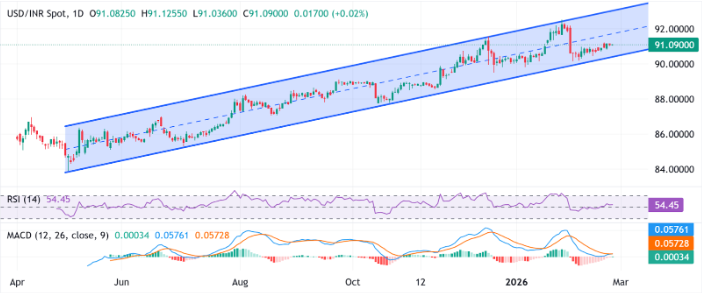
The USD/INR pair has been scaling higher from the 2025 yearly low, along an upward-sloping channel formation, which points to a well-established bullish trend. The lower boundary of the said channel now runs just below 90.50, keeping the broader structure biased to the upside despite recent moderation.
The Relative Strength Index stays above its midline and signals mild bullish momentum rather than overbought conditions. The Moving Average Convergence Divergence (MACD) line has turned slightly positive and edges above the signal line, hinting that downside pressure has faded and that buyers are regaining near-term control within the broader uptrend.
(This story was corrected on February 25 at 11:20 GMT to say that Crude Oil prices surged to the highest level since August 2025, not September.)
Author

Haresh Menghani
FXStreet
Haresh Menghani is a detail-oriented professional with 10+ years of extensive experience in analysing the global financial markets.