The FOMC is expected to leave rates in hold
Outlook
Today is Fed day and everyone will be glued to the TV to hear Powell’s final remarks. The FOMC is expected to leave rates in hold. Somewhat counter-intuitively, if the Fed speaks of wait-and-see, it’s favorable for the other currencies regardless of where yields go. This would be refusal to feed risk aversion and scare the horses. One Fed mandate is to maintain financial market stability, so a decent excuse to be mild.
Some will say the Fed is behind the curve as usual (and as it misjudged supply chain effects during covid), but to talk about hiking when it’s not expected could look panicky and not justified on current data. After all, the Fed shouldn’t make policy changes in future data, however realistic.
Again counter-intuitively at first, staying on hold benefits gold and bitcoin, too. They are non-yielding, so yields holding near current levels removes any fresh incentive to dump them. To the extent the rising US yields stalled the equity market, the Fed can put an end to that with staying on hold and justifying the wait-and-see. That means dialing back the hawkish warnings. The Fed doesn’t care about the stock market and its natural inclination would be a hawkish hold, but it’s also Mr. Powell’s last press conference, so he will be cautious. Tension is mounting already today.
As for the US yields rising on inflation fear, that stops offering support to the dollar when everyone else’s yields are rising, too. It’s the relative yield that counts. See the table from Trading Economics at the end of the report.
We have some fancy growth analysis from Mark Zandi via Jared Bernstein—see the table. If you add up the negatives—Iran (-0.30%) and deglobalization (-0.59%) you get a drag on GDP of 0.89%. Now add up the positives, 0.50% from AI and 0.40% from policy (including tax refunds), you get a push of 0.90%. In other words, GDP should be about the same in 2026 as in 2025 or even a bit higher by 0.01%.
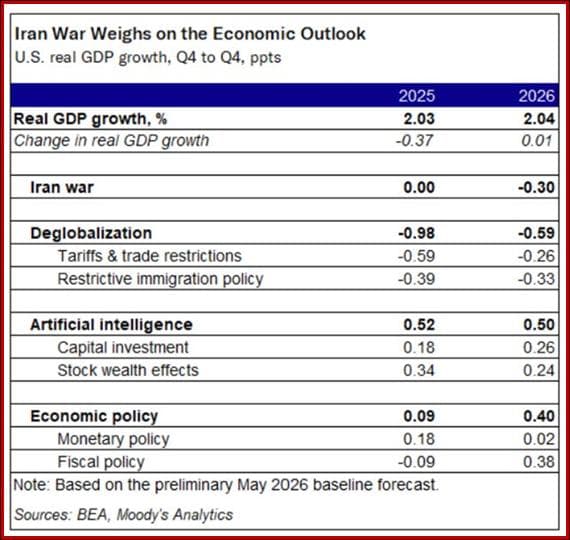
Keep this in mind as you contemplate the new Atlanta Fed GDPNow, which will be for Q1 only, not the whole year. The report is issued after the PCE data, including inflation, tomorrow.
Forecast
For once another figure is taking over from Trump as a determiner of the dollar’s near-term fate. An honest assessment of the economy would have to be worries about inflation, but since it’s not really at scary levels so far, Mr. Powell can be less hawkish than the expectations would call for. He is staying on the Board (we think) and has to work with these govs for another few years. He has time to express hawkish ideas later on. His term will end Jan 2028. He may not be chief but still a toppish dog, even after Warsh comes in.
If Mr. Powell (or the vote count) indicates more hawkishness, it’s dollar supportive. We give this a less than 50% probability, but you never know.
Food for thought
The AP reports the Iranian rial hit a record low today of 1.8 million to $1. The collapse started Monday. “Experts warn the fall of the rial is likely to further fuel inflation in a country where many imported goods, from food and medicine to electronics and raw materials, are affected by the dollar rate.”
Trading Economics has this: “The USD/IRR exchange rate rose to 1,315,483.0000 on April 28, 2026, up 0.06% from the previous session. Over the past month, the Iranian Toman has strengthened 0.01%, but it's down by 3,024.66% over the last 12 months.”
Remember what happened to the German mark in the 1930’s—devaluation in the same manner even before the war.
This is an excerpt from “The Rockefeller Morning Briefing,” which is far larger (about 10 pages). The Briefing has been published every day for over 25 years and represents experienced analysis and insight. The report offers deep background and is not intended to guide FX trading. Rockefeller produces other reports (in spot and futures) for trading purposes.
To get a two-week trial of the full reports plus traders advice for only $3.95. Click here!
Author

Barbara Rockefeller
Rockefeller Treasury Services, Inc.
Experience Before founding Rockefeller Treasury, Barbara worked at Citibank and other banks as a risk manager, new product developer (Cititrend), FX trader, advisor and loan officer. Miss Rockefeller is engaged to perform FX-relat