The Federal Debt Ceiling Outlook: An Update


At present, we still think the debt ceiling "X date" will fall in early October. However, there remains a risk that the "X date" will fall in late August/early September, a possibility complicated by the Congressional calendar.
Debt Ceiling Deadline Drawing Closer
On May 2, we published a report on the federal debt ceiling outlook. At the time, we wrote that our baseline assumption was for the U.S. Treasury's "extraordinary measures to be exhausted sometime early in October, though we think there is a risk they could run out in late August instead."
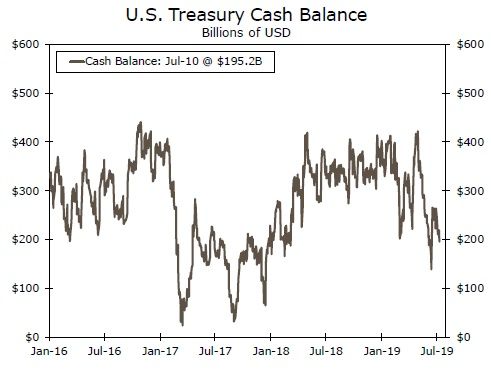
Our forecast has not changed since then. Our base case remains that the true "X date" will fall in the first week of October. But, the late August/early September period could bring the government very close to running out of cash. At present, the Treasury's cash balance is just shy of $200 billion (top chart). At the start of July, the remaining extraordinary measures available to the Treasury were probably another $100 billion or so. We project the budget deficit will total $262 billion over July and August, which if realized could leave the Treasury running very light on cash at the end of August.
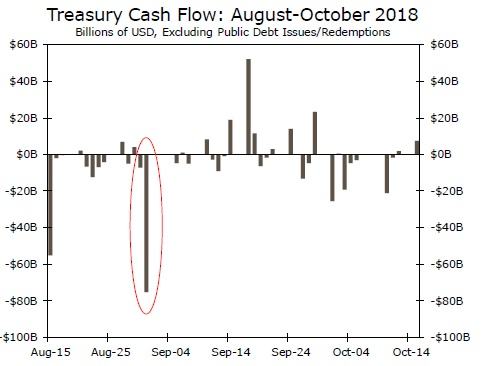
However, as we also discussed in our report from May, the monthly budget deficits do not tell the full story. The Treasury's actual daily cash flow is not evenly distributed over the course of a month. In order for the government to remain solvent into October, the key will be reaching the middle of September. Quarterly corporate tax payments are due on Sept. 15 and should provide an infusion of cash to the Treasury. Getting to Sept. 15, however, will require the Treasury to navigate a tricky period around Labor Day. The middle chart illustrates Treasury's daily cash flow from August-October 2018. As can be seen, there were large net outflows in late August, and when these outflows occur again this year, they could bring the Treasury's cash balance down to unusually low levels, probably sub-$100 billion (in "normal" times, the Treasury's cash balance is $300-$400 billion).
The Congressional calendar adds an additional wrinkle to this debt ceiling calculus. At present, the House of Representatives is scheduled to leave Washington, D.C. for its August recess on July 26, while the Senate is scheduled to finish up on August 2. Neither chamber is scheduled to return until Sept. 9, making it much more difficult for policymakers to react quickly if the "X date" ends up being closer than analysts currently expect.
Given the uncertainty, why not lift the debt ceiling before leaving town? Indeed, politicians on both sides of the aisle have stated that they do not want to put the full faith and credit of the U.S. government at risk. The challenge is that policymakers in both parties have a strong preference to tie a debt ceiling vote to a broader budget deal. As we have discussed previously, if the federal government does not have a budget in place past Sept. 30, and if no deal is reached by then, the government would enter a partial shutdown on Oct. 1, and large spending cuts would automatically take place a couple months later (bottom chart). The uncertain fiscal outlook is one more factor likely to tilt the Fed towards a 25 bps rate cut at its meeting later this month.

Author
Wells Fargo Research Team
Wells Fargo