The Fed preview: Crucial meeting is key test for markets

The Fed meeting later this evening is one of the most hotly anticipated for the year so far. The consequences of this meeting will be felt in two ways, the immediate decision and the longer-term consequences.
The market is expecting the Fed to cut interest rates by 25bps, with a small 4% chance of a larger 50bp rate cut. We think that a 25bp cut is expected as the slowdown in the labour market justifies Fed action to support the economy to full employment. However, the market is likely to be more sensitive to what the Fed signals will happen in the future, and if they are embarking on a prolonged rate cutting cycle.
This meeting will also see the updated Dot Plot, where Fed members give their views on where interest rates will be in the coming months. This was last updated in June, and back then, the median estimate of FOMC members were for interest rates to be 3.87% in 2025, 3.6% in 2026, and 3.37% further out the curve.
What will the Fed do next?
Since then, there has been a massive recalibration of interest rate expectations. The Federal Funds Futures market is predicting that rates will fall to 3.6% by December this year, and for rates to end 2026 at 2.88%. The key question that the market wants to answer at this evening’s meeting: will the Fed ratify this narrative and support a rapid pace of rate cuts, or will it push back on it?
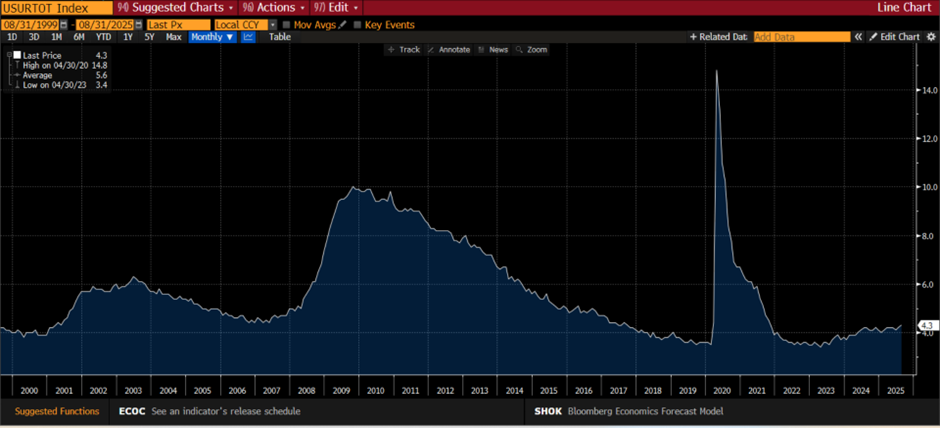
There are pros and cons to rate cuts at this stage. Looking at the pros first: the labour market is weakening in the US. The Fed has a dual mandate and is responsible for maintaining full employment. Although the unemployment rate has picked up from low levels since 2023, there are concerns that once the labour market weakens, the unemployment rate can spiral higher very quickly, as you can see in the chart below. If the Fed wants to get ahead of the curve when it comes to unemployment, then they may want to cut rates over the coming months, to avoid worse to come for jobs growth down the line.
Chart 1: US unemployment rate, 1999- 2025
Source: XTB and Bloomberg
However, just under 6 rate cuts in the next 15 months, which is currently expected by financial markets, would not be without potential negative consequences. Inflation is a key concern. The latest CPI reading showed headline price growth at 2.9%, the core rate of inflation is 3.1%. This is well above the Fed’s target rate of 2%. The concern is that a rapid pace of rate cuts could trigger longer term inflation expectations to rise.
Currently inflation expectations are sending mixed signals. The University of Michigan 1-year inflation forecast is 4.8%, expectations for 5-10 years have risen sharply in recent weeks to 3.9%. The St Louis 5-year 5-year forward inflation expectation rate suggests milder inflation expectations and is 2.33%. Thus, if the Fed loosens too quickly, or by too much, there is a threat of inflation expectations becoming de-anchored or an inflation spiral that leads to massive volatility in the Treasury market. This is one of the reasons why the gold price has surged to a record high at the same time as interest rate expectations have been recalibrated lower, since gold is the ultimate inflation hedge.
There is another dimension to this Fed meeting: politics. The White House is putting a lot of pressure on Jerome Powell and the Fed to cut interest rates. Donald Trump has been trying to reform the Federal Reserve Monetary Policy Committee to better reflect his ideas on where interest rates should be. On Monday, Stephen Miran, the White House economics advisor, had his nomination to the board approved. The President is also trying to fire Lisa Cook, who has been accused of mortgage fraud, although this has been blocked by the courts for now.
Trump is central to this meeting
Trump will be central to this meeting, especially with Miran as a voting member. During his Senate Committee hearing prior to his appointment, Miran talked about the Fed’s third mandate, to pursue moderate long-term interest rates. At 6.35%, the 30-year mortgage rate is at its lowest level since October 2024, however, this is still likely to be too high for the White House. We could see Trump appointed Fed governors voting for large rate cuts, while Democrat appointed governors may take a more cautious approach. This could be one of the most fractious meetings for years.
Also worth noting, although the market is expecting the Fed to acquiesce to Donald Trump’s demands for lower rates, Bloomberg’s FedSpeak index has been rising, and is back at its highest level since April. Thus, the outcome of this meeting remains uncertain, even if financial markets are acting like a rapid pace of cuts are a done deal.
The market reaction
Ahead of this meeting, US stocks have surged to a record driven by a bounce in mega cap tech stocks, the gold price is at a record, the dollar has sunk and remains the weakest currency in the G10 FX space so far in 2025, and Treasuries are the top performing bond market in the developed world over the last 3 months.
The market has already priced in a dovish outcome from this meeting, so can there be further for risky assets to go, or will the Fed be perceived as not dovish enough? We think that there are three potential outcomes for markets. Firstly, the Fed pushes back on the narrative that rates need to be cut quickly, causing stocks to sink, US yields and the dollar to rise and the gold price to back away from record highs. This would be the most hawkish outcome.
A moderate outcome would be for the Fed to cut tonight and then signal a slower pace of cuts in the future, although more than what they expected back in June. This could cause the risk rally to stall, and it may also ease inflation fears and weigh on the gold price.
A dovish outcome would be seen as confirmation that there will be four or five further rate cuts after this one, and that the market is right to expect lower rates. A lot of the good news is already priced in, but it could spark another rally, and trigger a further decline in Treasury yields, especially if there is any talk of the ‘third mandate’ in tonight’s meeting. In the long term, however, a Fed that is cowed by the White House is bad news for the US and could weigh on asset prices, however, we are some way from the Fed being cowed.
Overall, we expect markets to drift as we wait with bated breath for tonight’s meeting, the most important meeting of the year so far.
Chart 2: US S&P 500, the Magnificent 7, the gold price and US 2-year Treasury yields: The troika of assets have risen sharply as Treasury yields have sunk.
-1758089791990-1758089791991.png)
Source: XTB and Bloomberg
Author

Kathleen Brooks
XTB UK
Kathleen has nearly 15 years’ experience working with some of the leading retail trading and investment companies in the City of London.














