|

The Fed now owns nearly one third of all US mortgages

The Fed's balance sheet is ballooning out of control.

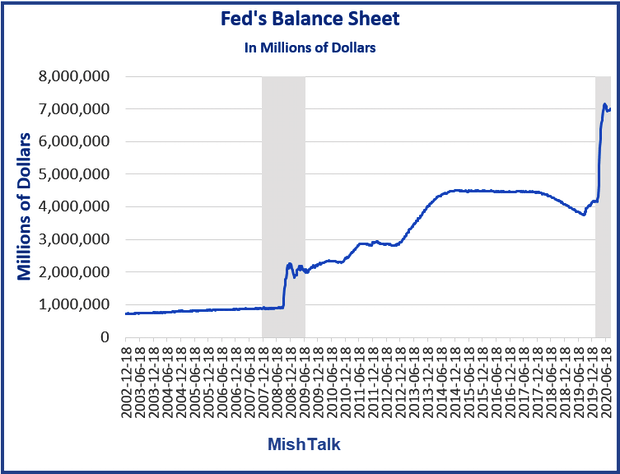
Nearly $7 Trillion in Securities, $2 Trillion Mortgages

As of August 26, 2020 the Fed's Balance Sheet is nearly $7 trillion total of which $3.7 trillion are notes or bonds, and nearly $2 trillion in mortgages (Fannie Mae, Freddie Mac, or Ginnie Mae).

No End in Sight to Fed's Mortgage Buying Spree

Bloomberg reports No End in Sight to Fed's Mortgage Buying Spree.

Key Points

  • The Fed has snapped up $1 trillion of mortgage bonds since March. It bought around $300 billion of the bonds in each of March and April, and since then has been buying about $100 billion a month. 
  • The Fed now owns almost a third of bonds backed by home loans in the U.S. 
  • Buying the securities has pushed mortgage rates lower, with the average 30-year rate falling to 2.91% as of last week from 3.3% in early February.
  • Morgan Stanley analysts pointed out in late March that the buying was running at eight times the pace seen in prior episodes of Fed purchasing under programs known as quantitative easing.
  • Just before this latest round, principal payments from its mortgage bond holdings had whittled that down to 21%, but it has now increased back to 30%. 
  • If the Fed maintains its current buying pace, it will again own 34% of the mortgage universe by year’s end.

Fed's Balance Sheet Expansion Over Time
Questions of the Day

  • Does the Fed have everything under control?
  • Is the Fed totally out of control?

Author

Mike “Mish” Shedlock's

Mike “Mish” Shedlock's

Sitka Pacific Capital Management,Llc

Mike “Mish” Shedlock is a registered investment advisor for SitkaPacific Capital Management.

More from Mike “Mish” Shedlock's

Share:

Editor's Picks

AUD/USD softens as Middle East tensions, stronger jobs report boost US Dollar

The AUD/USD pair remains under selling pressure near 0.7035 during the early Asian session on Monday. The Australian Dollar (AUD) extends the decline against the US Dollar (USD) amid escalating tensions in the Middle East and stronger-than-expected US economic data. 

160.00: USD/JPY back near intervention territory after upbeat US jobs report

US Nonfarm Payrolls beat expectations by a wide margin in May, with 172K jobs added. The US Dollar rebounds after the release, helping USD/JPY recover from its intraday lows. Warnings from Japanese authorities continue to limit upside potential near the 160.00 threshold.

Gold targets $4,300 amid stronger Dollar

Gold faces increasing selling interest and navigates the area of three-month lows near the $4,300 mark per troy ounce on Friday. The precious metal’s decline comes as traders assess the stronger-than-expected NFP, while the bid bias in the Greenback and higher US Treasury yields also collaborate with the retracement.

Cardano hits five-year low even as Hoskinson clarifies "break" isn't an exit

Cardano (ADA) price is down 10% at press time on Friday, extending losses over 30% so far this week amid Charles Hoskinson's clarification that "break" isn't an exit.

Week ahead – Fed countdown begins amid US inflation data and geopolitical risks

Fed Chair Warsh’s first meeting approaches as key US inflation data could reshape expectations. Oil prices remain elevated as US-Iran talks continue; tariffs also return to the spotlight. ECB is expected to hike; will it be a one-off move or is July live?

The US economy defies the rules: 100 days into the Oil shock and the recession signal is still missing

More than three months after the start of the Iran war and the resulting disruption to global energy markets, the US economy continues to display remarkable resilience. The conflict has triggered a sharp rise in Oil prices, reignited inflationary pressures and fueled widespread concerns about a potential economic slowdown.