The FED and the CPI in the US

A couple of months back, the FED shocked the entire financial market when it decided to adjust it’s inflation mandate. Now to understand why this thing is important, it’s important to know just how the Federal Reserve actually operates.
The FED works based on a dual mandate system of stable prices (which is measured through inflation) and low unemployment, pretty basic, I know. However, the complexity comes when trying to adjust the interest rate to keep prices stable while allowing unemployment to remain low. It’s a delicate balance to keep everything in check.
For the longest time, the FED’s mandate was to keep inflation stable at 2%, meaning that the economy would be considered overheating when inflation was rising above 2%. That forced the FED to increase interest rates to curtail the rise in inflation and hence keep things relatively stable. However, now with the new mandate allowing inflation to run, the FED has given the prices a “carte blanche” to rise higher. This could have disastrous implications on the socio-economic structure of the U.S.
The new mandate of the FED calls for an inflation of an “average” of 2%. This means that the FED is no longer interested if inflation will actually rise above 2%. As long as the average is around that 2% marker, the FED doesn’t exactly care about this indicator. So the question is, if the FED itself doesn’t care about inflation, why should investors, and does this make the CPI (Consumer Price Index) indicator an obsolete indicator in today’s economic theory?
Inflation in the US
To better answer the proposed question, first we must take a look at what inflation in the U.S. really is like. Taking information from tradeeconomics.com for the past 25 years we can have an idea of how the structure is shaped.
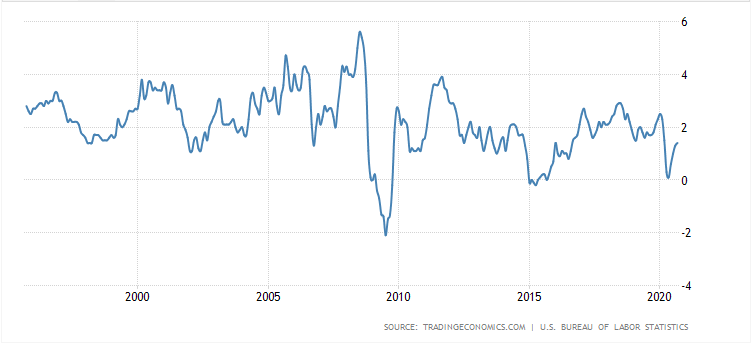
Annual inflation rate in the U.S. edged up to 1.4% in September of 2020. In August, it was still at 1.3% which appeared to be in line with expectations and reaching the highest since March. Inflation has been rising consistently since hitting 0.1% in May, the lowest since September of 2015, due to the Coronavirus crisis. Still, it rested well below 2.3% in February before the pandemic.
The figures do give kind of an indication that inflation has been lower than 2% since the financial crisis back in 2008. It has barely risen above 2% in the years after that huge crisis.
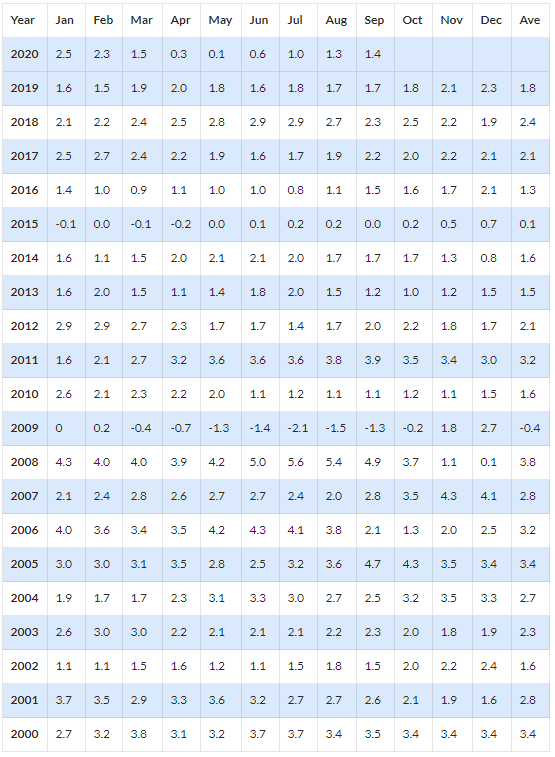
Just by a quick look at the numbers above, we can estimate that the average inflation is actually below 2.0%, and as we mentioned, the FED is now looking for inflation at around 2.0%.
So what does this tell us? It says two things, actually. The first is that FED will more than likely keep interest rates at the lowest level between 0.00% and 0.25% and keep trying to stimulate the economy to move higher.
The other thing, which frankly is the scarier of the two, is that inflation would need to run higher for longer. Now that is a scary thought as it means prices will continue to rise with no one to stop them making lives that much harder for the citizens of the U.S. In fact, this means that those who were living in the middle class, might find themselves having to cut down on their spendings to survive.
Back to the original question, has the CPI become an obsolete indicator with the new mandate from the FED?
The FED’s Inflation Metric
Back when Janet Yellen was still the FED Chair, she had announced that the FED doesn’t rely on the CPI as a measure of inflation. In fact, they use an indicator known as the PCE indicator, which is short for Personal Consumer Expenditure. As Janet Yellen once put it, the CPI doesn’t give an accurate measure of whether or not consumers are actually spending their earned money, instead, CPI only measures the increase in prices which are usually attributed to a magnitude of different factors.
The FED uses the PCE indicator to see whether or not people are actually spending money and hence they’d be participating in the price increase or not. So the FED had been relying on the PCE more than the CPI, that doesn’t mean that they have removed that indicator from the equation, but have reduced its weighting in favor of the PCE. This resulted in what we now see as investors are using the PCE indicator more than the CPI thus reducing the CPI’s impact on the market.
The Verdict
The answer to the mentioned question “Has CPI become an obsolete indicator?” is now rather obvious. Ever since the FED reduced the importance of the CPI by using the PCE indicator, the market has also reduced the importance of the CPI and its impact on the market.
Has it become obsolete? I don’t believe so. I actually believe that CPI will remain an indicator that investors will be using for some time to come.
However, I believe that CPI’s importance will be reduced much further this time around. I also believe that there will be another indicator that would come into existence which is an Average Inflation Indicator based on the metrics that the FED uses. This would become the go to inflation indicator in order for the market to understand what the FED sees and what might happen to interest rates.
So no, CPI will not go silently into the night and will remain an important indicator, but it’s importance will be reduced.
Author
Alexander Douedari
Independent Analyst
Alexander Douedari is an Award Winning Hedge Fund Manager and Selfmade 7-Figure Trader. Now Mentor for Students all around the world.

















