The era of cheap money is over
Geopolitical conflicts have triggered global inflationary shocks that continue to drive up sovereign bond yields.
The Russia-Ukraine war spiked European energy costs, while US-Iran tensions caused severe crude oil disruptions, hitting import-dependent Japan especially hard.
Escalating inflation forced upward pressure on Japanese yields, which subsequently transmitted spillover pressure onto global fixed-income markets, including French and US long-term bonds.
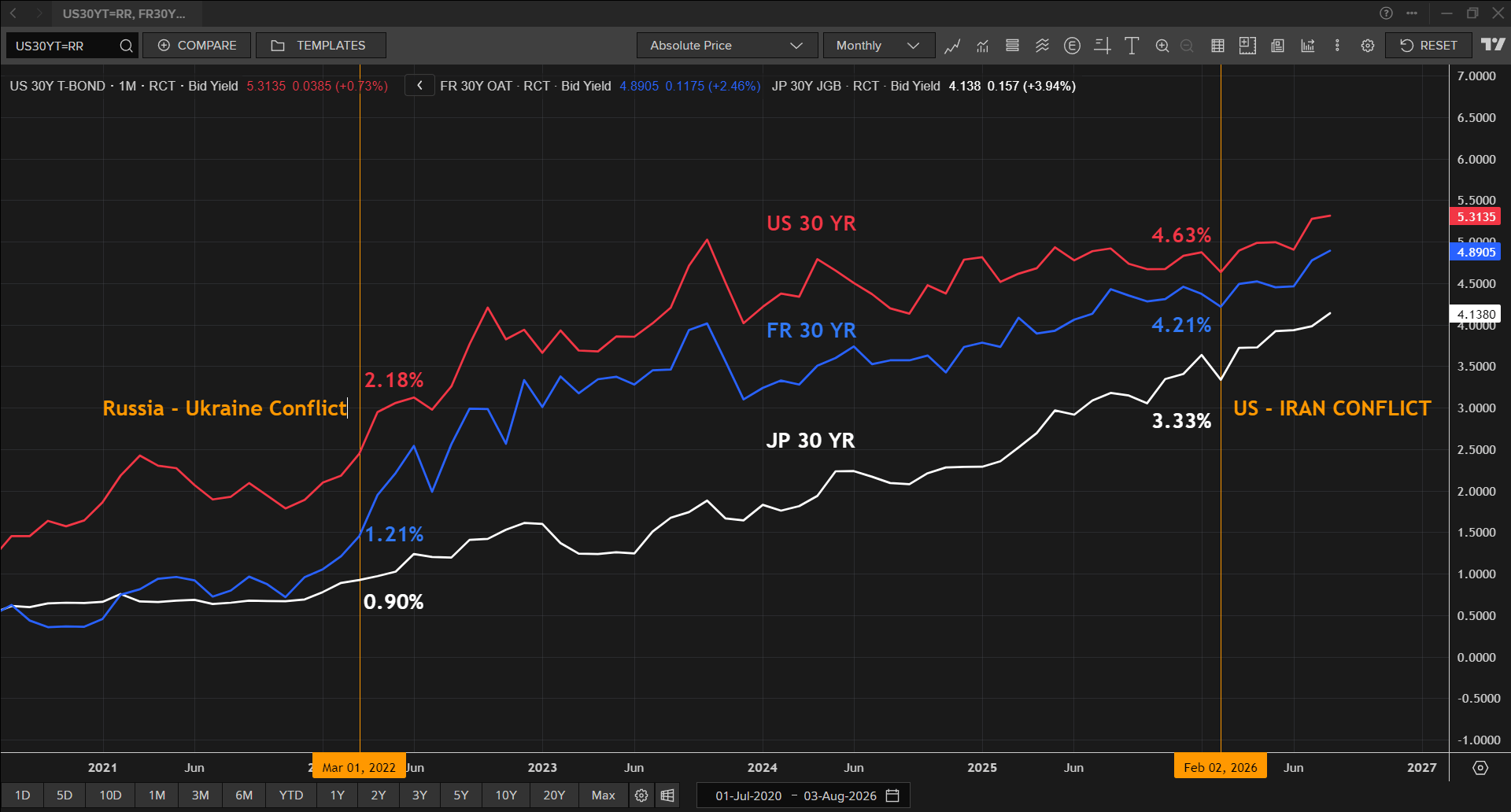
From early 2022 to early 2026, 30-year yields surged dramatically across all three regions:
Japanese 30-Year: Scaled up from 0.90% in March 2022 to 3.33% in February 2026.
French 30-Year: Rose from 1.21% in March 2022 to 4.21% by February 2026.
US 30-Year: Increased from 2.18% in March 2022 to 4.63% by February 2026.
As shown in the chart's, this upward trajectory has intensified further, with the US 30Y reaching 5.32%, the French 30Y rising to 4.89%, and the Japanese 30Y surging to 4.14%.
As Japanese yields move higher, reduced demand from domestic Japanese investors for foreign debt—coupled with potential repatriation of capital—is expected to exert sustained upward pressure on long-term yields across advanced G7 economies.
The Era of Cheap money is over!
Author

Hany Saleeb
Independent Analyst
Hany Saleeb is a highly experienced Senior Treasurer. With over a decade of experience in treasury, served as Head of Treasury at BM in France and head of research in Sinai Securities.