XAU/USD analysis: 7th-order institutional demand slab holds at $4,070

Market context and the 7th-order institutional demand defense
On the 4-hour execution continuum, XAU/USD (Gold vs US Dollar) has transitioned into a tight structural compression, with spot price stabilizing near the 4,135.84 mark. Following a prolonged liquidation phase from the 4,700+macro highs, sellers have encountered a formidable institutional liquidity threshold. Downside probes have repeatedly failed to generate continuation, stalling against the monolithic bid foundation established across the 4,040–$4,090 pricing corridor.
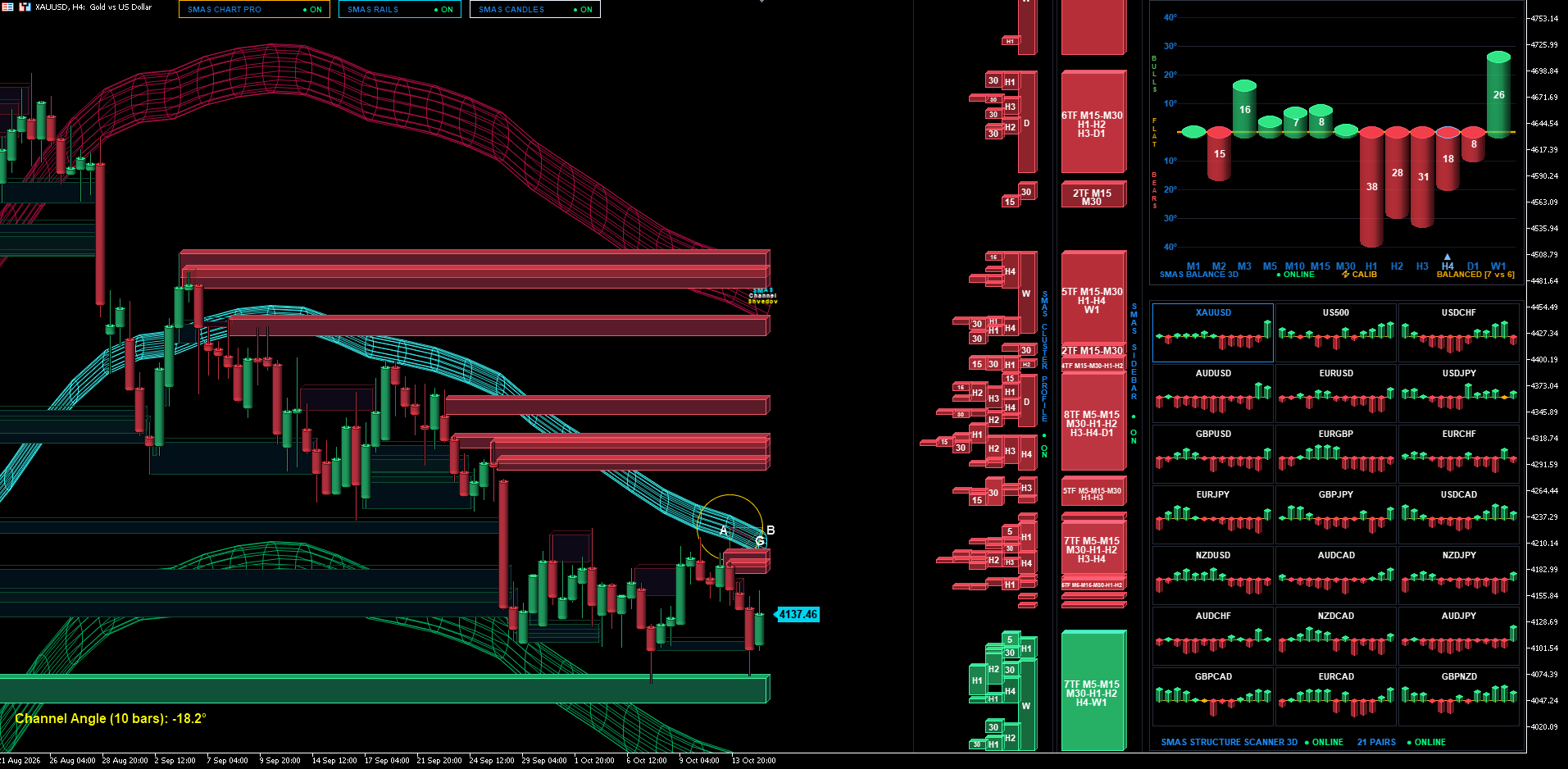
This inability of sellers to force follow-through represents textbook Sell Volume Absorption. Rather than accelerating downward, price action has locked into a horizontal base. The market is physically coiling against an immovable wall of limit buy orders, signaling that the directional momentum of the preceding decline has reached terminal exhaustion.
Cluster density analysis (Sidebar architecture)
Data aggregation via the SMAS Sidebar 3D exposes the dense structural friction defending the current consolidation:
- The underlying titanium foundation: Directly anchoring current price action lies a 7th-Order Institutional Demand Super-Cluster (7TF: M5-M15-M30-H1-H2-H4-W1) spanning $4,040 – $4,090. Seven independent temporal horizons—from the 5-minute microstructure pulse to the macro Weekly baseline—have synchronized their confirmed demand footprints at this exact coordinate, creating a powerful multi-timeframe floor.
- Overhead resistance echelons: Any relief rotation will face layered supply barriers:
- An immediate 7th-Order Tactical Supply Cluster (7TF: M5-M15-M30-H1-H2-H3-H4) concentrated across $4,195 – $4,245.
- An intermediate ceiling at the 8th-Order Institutional Massif (8TF: M5-M15-M30-H1-H2-H3-H4-D1) spanning $4,340 – $4,430.
- Macro supply slabs positioned higher up across the $4,500 – $4,680 zone.
Multi-timeframe phase telemetry (Structure balance 3D)
The SMAS Structure Balance 3D module captures an inflection state of structural equilibrium, flashing an official BALANCED [7 vs 6] status:
- Residual Intraday Drag: Intermediate frames still carry historical downside bias: M30 (-38°), H1 (-28°), H2 (-31°), H3 (-18°), and H4 (-8°). However, the visible deceleration from -38° down to just -8° on H4 confirms that selling velocity is rapidly drying up.
- Micro-Impulse Turnaround: Rapid tactical horizons have already initiated positive phase inversion: M3 (+16°), M5 (+3°), M10 (+7°), and M15 (+8°) have flipped green, confirming active limit accumulation.
- Macro Baseline Anchor: The senior macro horizon W1 remains firmly bullish at +26°, acting as a steady structural anchor.
- Telemetry Synthesis: This divergence between fading intraday selling and micro-buying against the weekly foundation confirms a classic Spring Compression Pattern, setting the stage for a mean-reversion rebound.
Vector geometry and channel trajectory (Structure engine 3D)
The SMAS Structure Engine confirms clear trend exhaustion on the active dynamic channel:
- The channel's invariant slope angle currently reads at -18.2°, reflecting significant downward deceleration compared to earlier impulse phases.
- Price action is pressing directly into the channel's lower dynamic boundary. Having absorbed the downward move at these outer structural rails, directional sellers lack the momentum for an expansion breakdown, indicating a high-probability rotation back toward the channel's central equilibrium axis.
Execution protocol and quantitative trade parameters
With sellers failing to breach the 7th-order demand foundation and phase balance stabilizing at the weekly anchor, an asymmetric Long Mean-Reversion Scenario is activated:
- Order type: Long Accumulation / Buy Limit.
- Execution coordinate range: $4,110 – $4,138 (Current price: 4,135.84).
- Structural invalidation (Stop Loss): $4,025 (Placed safely below the 7TF titanium demand floor and the W1 base; calculated risk: ~85–110 points).
- Target objective 1 (Take Profit 1): $4,235 (+100 to +125 points; Retest of the 7TF supply cluster perimeter. Protocol: Liquidate 50% volume and systematically move Stop Loss to Breakeven +0.1H).
- Target objective 2 (Take Profit 2, Final): $4,360 (+225 to +250 points; Lower boundary of the 8th-Order Institutional Supply Massif 8TF).
- Risk / Reward Ratio: 1 : 2.45.
Author

Andrey Shvedov
SMAS Quantum Research
Andrey Shvedov is an active quantitative trader, software architect, and financial market researcher with over 24 years of live market microstructure experience.
















