The end of the Trump bounce, as markets awaken to tariff risks once more

President Trump has ramped up tariff threats this week. There will be another 10% levy imposed on Chinese imports to the US, and 25% tariffs will be imposed on Mexico and Canada on 4th March. He did not stop there, reciprocal tariffs will come into effect on 2nd April and the EU is also likely to be hit by 25% tariffs, after the President used inflammatory language when talking about the bloc earlier this week. For now, the only country that seems to be out of Trump’s tariff scope is the UK.
The market had been lulled into a false sense of security regarding tariffs, but their risks to economic growth and inflation are coming back to haunt investors. The immediate knock to sentiment has seen equity indices fall around the world. The Nikkei and the Hang Seng were lower by 2.8% and 3.2% respectively. The S&P 500 closed down 1.5% on Thursday and the Nasdaq is down 2.7%. Thursday’s sell off has pushed both US indices into the red YTD. The declines this week have been sharp: the S&P 500 is down 4% in the past 5 sessions, the Nasdaq is down by 7%, led by a sharp selloff in Nvidia, although the chip maker is stabilizing in the pre-market on Friday. The US underperformance is set to continue for another week, with the Eurostoxx index down 1.1% on a currency adjusted basis, the Nikkei is down 4% and the Cac is down 1.5%. European stocks have held up well considering tariff risks are a threat to the EU.
ECB comes to the rescue
European equities could be more resilient due to a couple of factors: inflation is retreating in the currency bloc, French price growth fell to a mere 0.9% in February, which is the lowest level since 2021, and justifies more ECB rate cuts. Inflation expectations in the currency bloc also fell. 1-year ahead inflation expectations fell to 2.6% in January, from 2.8% in December. Although this level is higher than the ECB’s target rate, it remains at a stable enough level to allow further ECB rate cuts. The market is currently expecting more than three rate cuts from the ECB for the rest of this year, which could help the Eurozone economy as it navigates Trump’s tariff threats.
The optimist’s view: Trump could still change his mind on tariffs
It is worth noting that there is still time for things to change in Trump world. While he seems resolute that tariffs will be employed by the US administration, could a rush of diplomatic efforts and calls to the White House see Trump’s stance change over the weekend? This cannot be ruled out, due to Trump’s style of politics. Added to this, he could give certain sectors and companies a reprieve, like he did in his first term. If there are positive developments over the weekend, then this could set the stage for a rebound in risk assets next week.
Dollar acting as a safe haven as tariff threats increase
Tariffs are not only having an impact stocks, but they are also integral for the FX market. The dollar is one of the top performers in the G10 FX space in the last 24 hours, as the dollar catches a bid. The dollar is also the top performer so far this week. GBP/USD has been the most resilient pair and is lower by 0.26%, the yen has also been resilient, while the Aussie and Kiwi dollars are the weakest performers, they are both lower vs. the USD by more than 2%. These currencies are acting as a proxy for China. As the trade war between the US and China ramps up, these currencies are taking a hit.
Bitcoin gets decimated as Trump forgets about crypto
The other casualty from Trump’s latest round of tariffs is bitcoin. It had been one of the biggest winners from the Trump trade, but Bitcoin is now deep in correction territory and is lower by $16,000 in the last five days, Bitcoin is lower by more than $4000 on Friday. The correlation between Bitcoin and US stocks is around 30%. This isn’t a particularly strong relationship. It also suggests that even though Bitcoin and stocks are both moving lower, Bitcoin’s sharp decline cannot be fully explained by the fall in US stocks, especially the Nasdaq. Something else is going on with Bitcoin. If we were to hazard a guess, we think that a lot of money went into crypto on the hope that Donald Trump would institutionalize crypto when he got to office, however, comments about crypto since Trump took over the presidency, have been conspicuous by their absence. This could be why investors are flooding to the exits. Bitcoin is at an interesting juncture, it is testing the 50% retracement of the Trump trade run up, from the September 2024 low to the peak in January. If it breaks below this level, then further declines could be on the cards.
UK bonds catch a bid as the UK remains Trump’s favourite child
There are few places to hide in financial markets at the end of this week. The oil price is sharply lower. Both Brent crude and WTI are down by more than 1%, even gold is lower by $15 on Friday, as the US dollar catches a bid. Government debt is the best haven so far on Friday, and bond yields are lower. UK bonds are outperforming peers, which could be a sign that the UK is on Trump’s good side, for now.
What next for US yields?
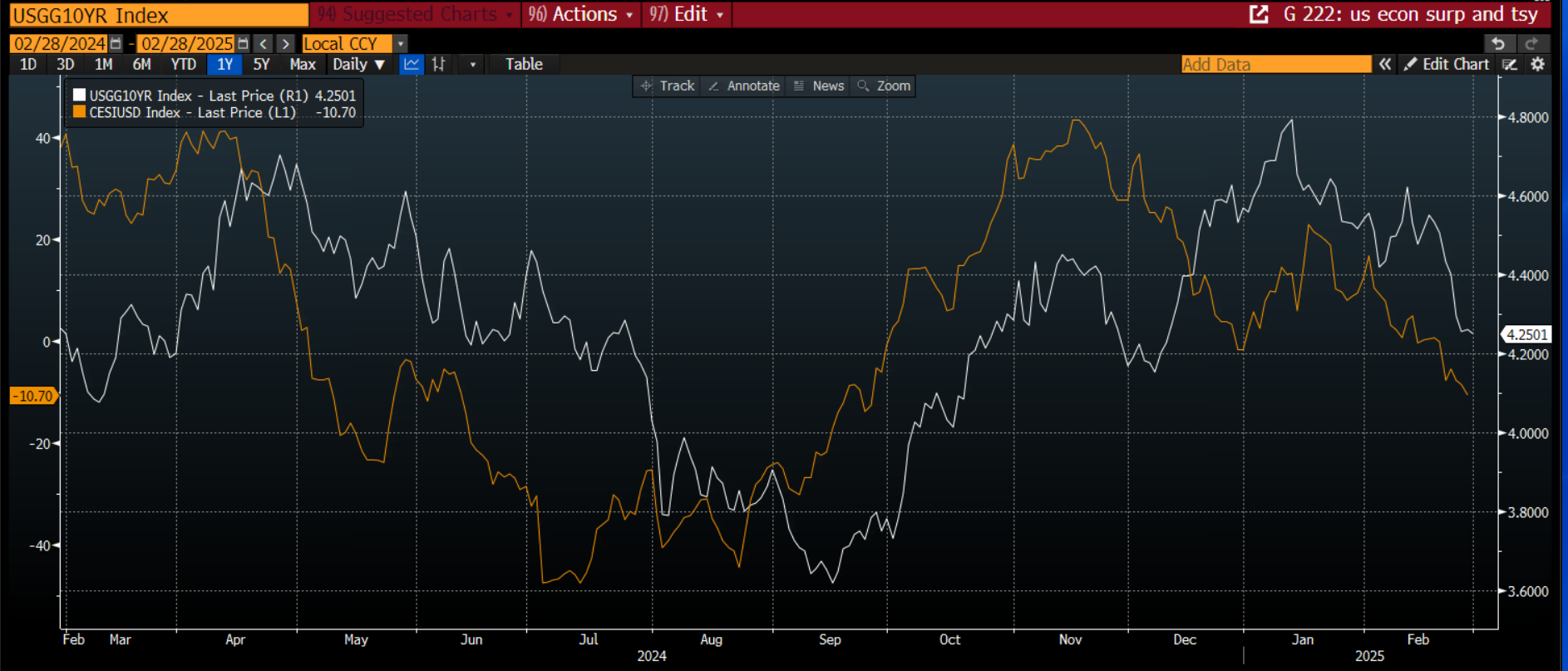
Ahead today, US PCE will be closely watched as it’s the Fed’s preferred inflation measure. It is also a key driver of team Trump’s preferred asset class: the 10-year US Treasury yield. The 10-year Treasury yield has been a key beneficiary from the uncertainty in markets that has been created by President Trump. The 10-year Treasury yield is lower by 29bps in the past month, compared with a decline of 14bps for the UK 10-year yield, and a decline of 18bps for the German Dax index. The US Treasury yield is falling at the same time as US economic data is surprising on the downside, as you can see in the chart below. A larger than expected fall in the core PCE rate for January could see another lurch lower for Treasury yields as we reach month end.
Chart: US Citi economic surprise index and the US 10-year Treasury yield
Source: XTB and Bloomberg
Author
Kathleen Brooks
XTB UK
Kathleen has nearly 15 years’ experience working with some of the leading retail trading and investment companies in the City of London.