The dragon digs in — Markets brace for the next trade war act

The trade war is once again grinding its gears, and Beijing is showing no signs of slamming the brakes. This isn’t an April rerun—it’s more like a sequel written by a director who’s had enough of being lectured by Hollywood. China has moved from veiled warnings to active retaliation, limiting U.S. entities tied to South Korea’s Hanwha Ocean. The move wasn’t about economics alone—it was about theater, sovereignty, and showing that Beijing will not be typecast as a supporting actor in Washington’s trade drama.
The Ministry of Commerce’s vow to “fight to the end” might sound like rhetorical boilerplate, but in FX space, those words reverberate like the clanging of a temple bell. Traders know that when Beijing speaks in absolutes, it’s usually signaling strategic patience cloaked as defiance. That tone, combined with another twist in U.S. rhetoric accusing China of “pulling everyone else down,” sent traders sprinting for the nearest safe haven. The yen, franc, and euro became the market’s bomb shelters while the Aussie and Kiwi—perennial proxies for Chinese sentiment—were shoved into the storm cellar.
This is what happens when geopolitics collides with seasonality and positioning. The dollar, which had been trying to enjoy a quiet recovery after the weekend’s tariff lull, suddenly finds itself torn between its two personalities: the swaggering bully of the global system and the scared kid hiding behind the Fed’s balance sheet. For now, it’s leaning on its safe-haven status, but that comfort blanket can only hold as long as yields stay sticky and Treasury buyers keep believing that U.S. dysfunction is somehow “safer” than everyone else’s chaos.
What’s more, China’s latest trade figures have emboldened this stance. Strong diversification means Beijing no longer needs to blink first. It can afford to flex on exports while still absorbing the blows of higher tariffs. In other words, Washington’s tariff gun may still be loaded—but Beijing’s wearing armor forged in alternative supply chains. Every ton of copper rerouted to Brazil, every container reflagged through Malaysia, every semiconductor line shifted from Shenzhen to Penang adds another layer to China’s resilience playbook.
Meanwhile, traders are dissecting every pixel of Powell’s speech today, though there’s unlikely to be any fresh choreography. With the data blackout from the government shutdown muting macro rhythm, even a whisper from the NFIB’s hiring sub-index could swing the tempo. If Powell sticks to his cautious beat, we’ll likely see a dollar that wobbles but doesn’t yet wilt.
Elsewhere, Europe’s theater remains messy. The French political saga threatens to keep EUR/USD stuck in a holding pattern, like a pilot circling a stormy Paris runway. If Prime Minister Lecornu’s budget gamble collapses into another confidence crisis, the euro’s safe-haven status will look more like a cardboard set than steel shelter.
Across the Channel, the U.K. quietly drifts toward its own reality check. Cooling wage data and a rising jobless rate give the Bank of England some breathing room—but not enough to whistle past December. A February cut remains the likely release valve, assuming fiscal policy stops throwing kerosene on the inflation embers.
But the real stage drama remains in Tokyo. Japan’s political script has morphed from triumphant to tangled. Sanae Takaichi’s victory should’ve been the start of a new policy arc—looser fiscal strings, a friendlier BoJ—but losing coalition support has turned the LDP’s majority into quicksand. Now, with Komeito walking out and opposition parties scenting blood, even the question of who will be Prime Minister by month’s end feels up for grabs. Traders, ever allergic to uncertainty, have started repatriating. USD/JPY has slid from the 153 handle as the yen reclaims its ancestral safe-haven mantle. The Nikkei, once drunk on political optimism, is now sobering up fast.
What we’re seeing isn’t panic—it’s fatigue. A market that’s learned to react, retreat, and reload faster than policy can pivot. Tariffs, shutdowns, coalition collapses—each episode feeds volatility, but traders have adapted to the noise. The more Washington and Beijing lock horns, the more the market internalizes that this is the new equilibrium: a world where “truce” is just another trade setup and “retaliation” a fresh entry signal.
In that sense, China’s message is simple and brutally clear: it isn’t playing for applause anymore. It’s playing for endurance. And the longer this dance drags on, the more likely it is that fatigue—not fire—will decide who steps off the floor first.
The port wars — When tariffs go nautical
The trade war has sailed into its next act, and this time the battlefield isn’t cyberspace or chip fabs—it’s container ports. The U.S. and China have turned the world’s docks into toll booths, charging ocean shipping firms that ferry everything from Christmas toys to crude oil. In this new theater of economic warfare, cargo ships have become the conscripts, each container a reluctant foot soldier in a global tug-of-war for leverage.
The move smacks of economic brinkmanship disguised as logistics policy. The U.S. wants to remind Beijing that tariffs can metastasize into every artery of global commerce; China, in turn, wants to show Washington that maritime arteries can clog just as easily as supply chains can snap. It’s a duel fought not with cannons but cranes—where a port charge can sting as much as a sanction.
Markets, meanwhile, have the emotional stamina of a seasick tourist. S&P 500 futures erased their morning gains the moment Beijing’s Commerce Ministry fired off its rebuttal—accusing Washington of talking peace while loading its tariff cannons. Traders who had been hoping for calm waters after Trump’s latest tariff salvo instead found themselves bracing for another squall.
Friday’s White House announcement of new duties on Chinese goods effective November 1 was the equivalent of tossing another anchor overboard while claiming to steer for open seas. The irony? Both sides insist they want dialogue, yet every headline feels like a sonar ping in a Cold War movie—no one sure who’s bluffing, everyone terrified of what comes next.
What everyone else is chasing ( charts via Goldman)
The market has once again slipped into that familiar delirium—half fear, half FOMO—where everyone’s compass spins wildly and nobody remembers which way true north lies. After Trump’s tweet-borne thunderclap on Friday, a once-euphoric market got stripped down to its underwear. The overbought excess that had wrapped itself around every index, every ETF, and every retail chatroom position was rinsed clean in 48 hours. It wasn’t a correction—it was a controlled detonation of crowd psychology.
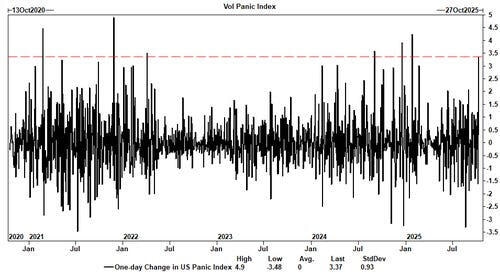
For all the noise about “fundamentals,” the modern market runs less on cash flow and more on confession. Positioning and technicals have become the sacred scriptures; everything else—economic data, earnings guidance, even geopolitics—is treated like propaganda from a tired regime. The shutdown merely turned off the illusion machine. Traders were left staring at their screens, unable to agree whether to buy, sell, or call it all a simulation. Cue the Panic Index spiking like a cardiac monitor in a trauma ward.
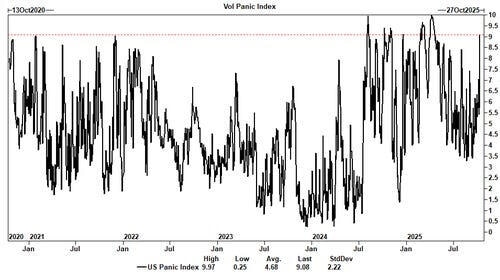
... in one of the biggest 1-day increases on record.
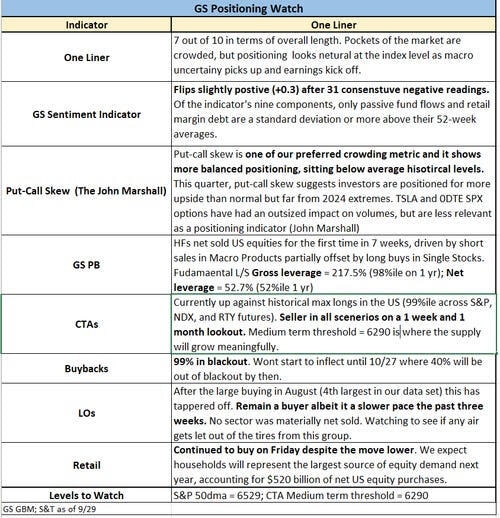
The new religion of trading is knowing what everyone else thinks everyone else is doing. The herd isn’t chasing valuation anymore—it’s chasing perception, liquidity, and the faint echo of someone else’s confidence. What we’ve witnessed is a great un-crowding: hedge funds trimming their egos, systematic traders flipping their switches, retail traders being handed a reality check written in red ink. The market now sits “neutral,” but in trader speak, neutral is just the space between one panic and the next.
The takeaway: sentiment still leans bullish, but nowhere near the champagne-and-confetti zone. Think of it as a 7-out-of-10 optimism score — confident, but glancing nervously over its shoulder. There are hot, overcrowded corners where traders are elbow-to-elbow, yet at the broader index level, positioning feels balanced, almost hesitant, as macro fog thickens and earnings season flickers to life.
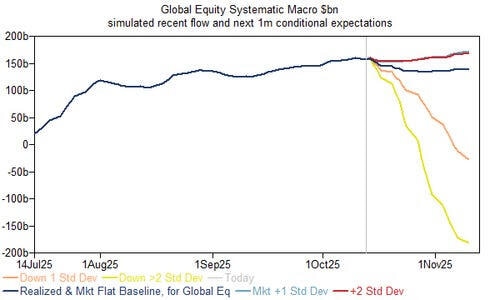
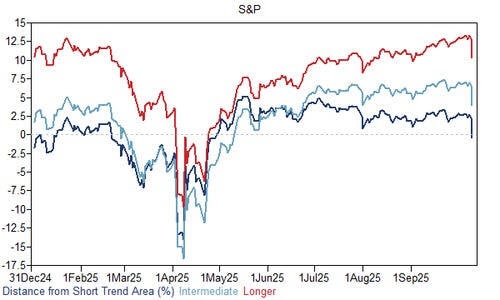
Short-term trend signals are wobbling like a drunk tightrope walker. Roughly one-fifth of global markets have turned negative, the rest still clinging to positive trends like a barfly clutching his last drink ticket. The S&P’s short-trend flickered negative, then positive, as if the algos themselves can’t make up their minds. There’s about $18 billion of programmed selling queued up in global equities—modest by today’s hypertrophic standards—but it’s concentrated in the U.S., where every tick lower threatens to trip a cascade. If volatility settles, that selling evaporates. If vol doesn’t, the machines will simply feed until the order book is bone-dry.
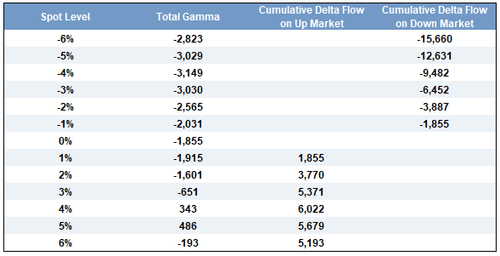
Friday’s crash yanked away the market’s invisible safety net. Dealer gamma collapsed by $5 billion in a single session—the largest drop in over three years. Dealers used to act like shock absorbers, buying dips and selling rips to keep prices contained. Now they’re just less long, which means they’ll no longer cushion the blows. Think of it as a car with the airbags deflated: you can still drive fast, but you’d better pray not to hit a wall.
Trend followers, those emotionless monks of momentum, finally turned positive for the first time since February—only to have Friday’s chaos test their faith.
CFTC data is dark thanks to the shutdown, leaving traders blind to who’s leaning which way. But the desk chatter tells a familiar story—hedge funds sold the U.S. indices hard, especially Nasdaq, which remains Wall Street’s favorite whipping boy whenever liquidity gets thin. Europe was muted, Asia mixed, while China bled. Everyone’s trying to game everyone else’s exhaustion level.
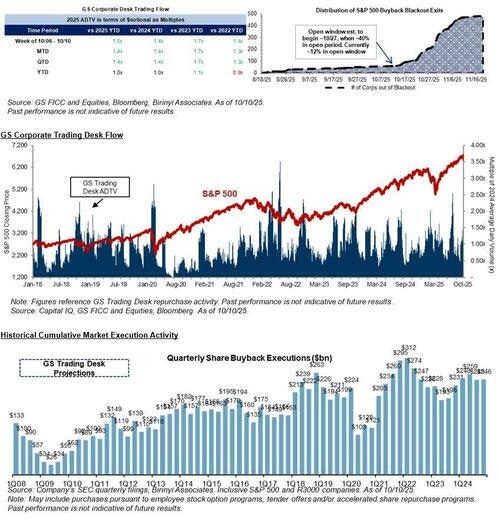
Corporate buybacks—the great liquidity anesthetic—are currently blacked out until late October. Forty percent of the corporate bid will re-enter the market after the 24th, but until then, equities must walk without their crutch. Traders know this; it’s why liquidity readings just cratered to near-decade lows. Without buybacks, every tick feels heavier, every dip lasts longer, every rebound less believable.
So what is everyone chasing? Not fundamentals. Not even the Fed’s ghost whisperings. They’re chasing each other’s shadows in the alleyways of positioning, gamma, and trend. The market is no longer a debate about value—it’s a race to guess who’s about to flinch. We are, all of us, running through a darkened casino, listening for the sound of chips being moved. Somewhere, someone still believes they can beat the dealer. But the dealer’s hedges are thinner, the tables are slicker, and the crowd’s nerves are shot. The chase continues—not for truth, nor for yield, but for the fleeting illusion that you’re still one step ahead of everyone else.
Author
Stephen Innes
SPI Asset Management
With more than 25 years of experience, Stephen has a deep-seated knowledge of G10 and Asian currency markets as well as precious metal and oil markets.