The Dot-com “dejà vu”: Are US stocks in a new bubble?


The S&P 500 has surged to record highs in 2025, but beneath the surface, warning signs are flashing. By some measures, U.S. equities are more expensive than they were at the height of the dot-com bubble, with investors paying record premiums for each dollar of revenue. What’s more, the index has never been so heavily reliant on such a narrow group of mega-cap tech stocks, raising questions about how sustainable this rally can be. While the giants continue to deliver robust profits, expectations are sky-high — and history shows that when too much rides on too few, the risks multiply. Let’s take a closer look:
The S&P 500 reached a new record high in August
August turned out to be another milestone month for Wall Street, with the S&P 500 notching fresh records despite bouts of profit-taking. The index briefly surpassed the 6,500 level for the first time ever, a symbolic breakthrough that underscored investor confidence in the resilience of the U.S. economy. Although stocks slipped on the final trading day of the month — the S&P 500 lost 0.64% on Friday as investors locked in gains ahead of the long Labor Day weekend — the benchmark still finished August nearly 2% higher, marking its fourth consecutive month of gains.
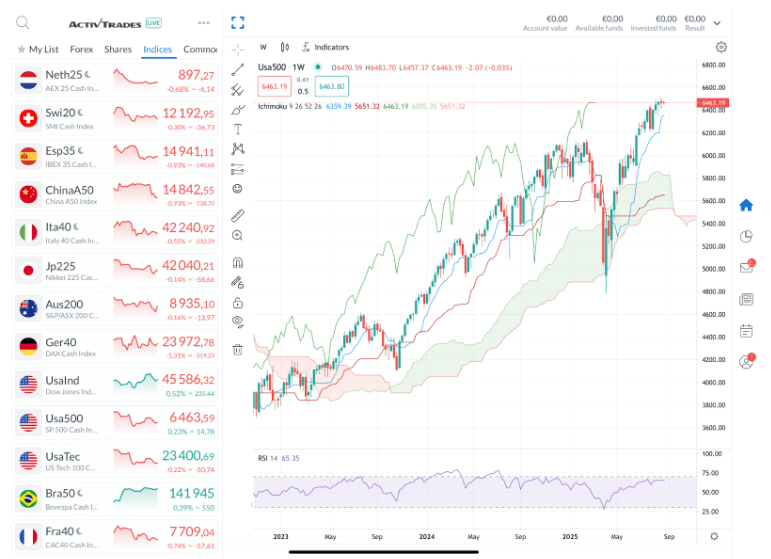
Weekly S&P 500 Chart - Source: ActivTrades
What drove the rally?
The upward momentum was fueled by a combination of stronger-than-expected economic data and sector-specific strength:
- GDP revision: Q2 GDP growth was revised higher, indicating that the U.S. economy expanded more robustly than initially thought.
- Labor market resilience: Weekly jobless claims came in lower than forecast, suggesting no imminent cracks in employment despite persistent inflation concerns.
- Corporate earnings: A rebound in corporate profits during Q2 reassured investors that companies remain profitable in a higher-rate environment.
- Tech leadership: Software stocks and chipmakers once again powered the rally, highlighting the dominant role of the technology sector in driving index-level gains.
Together, these factors allowed the S&P 500 to climb 500 points in just 196 trading days, a remarkably swift ascent considering that back in April the index briefly dipped below the 5,000 mark.
How unusual was August’s performance?
Seasonally, August and September are often difficult months for equities. Historically, September has been the weakest month of the year for all three major U.S. benchmarks — the S&P 500, Dow Jones, and Nasdaq — according to the Stock Trader’s Almanac. Against that backdrop, the market’s ability to post gains in August looks all the more notable.
Policy expectations in focus
Another powerful driver behind Wall Street’s rally was monetary policy expectations. Traders are now assigning more than an 87% probability that the Federal Reserve will cut interest rates as early as September, according to CME’s FedWatch tool. The prospect of looser financial conditions has kept sentiment buoyant, even as inflation data reminded investors that rising prices remain a lingering risk.
A Small Number of Stocks Are Propping Up the Market: A Concentration Risk Investors Can’t Ignore
The S&P 500’s climb to fresh record highs in 2025 has been impressive — but also increasingly narrow. A small group of mega-cap technology companies now accounts for an outsized share of the index’s performance, raising questions about how sustainable these gains really are.
Valuations at the high end of history
By traditional valuation metrics, U.S. equities are looking stretched. The S&P 500 traded at 3.23 times sales last Thursday, the highest multiple ever recorded, while its forward price-to-earnings ratio sits at 22.5, well above the historical average of 16.8 since 2000. Profit margins from large-cap leaders have prevented P/E ratios from reaching absolute extremes, but investors are paying a premium for growth.
The weight of a few giants
The concentration issue is unprecedented. At the end of July, the 10 largest companies in the S&P 500 controlled 39.5% of the index’s total market value — the highest share on record, according to Morningstar. Nine of those companies are worth over $1 trillion each, and most belong to the technology sector. Names like Nvidia, Microsoft, Apple, Amazon, Alphabet, and Meta have powered the index higher, masking weaker performance in the broader market.
This raises a key question for traders and investors: What happens if these dominant companies falter? With such a heavy weighting, even a modest correction in tech could drag down the entire benchmark, regardless of how the other 490 companies perform.
A glimpse of the downside
Markets received a reminder of this risk earlier this year. In April, news of fresh Trump tariff plans triggered a brief selloff. The so-called “Magnificent Seven” tech stocks dropped more sharply than the broader index, causing the market-cap weighted S&P 500 to underperform its equal-weighted counterpart. This dynamic underscores how fragile the rally can be when leadership rests on such a narrow base.
The broader market tells a different story
Interestingly, not all of the S&P 500 looks expensive. If the index were calculated on an equal-weight basis, valuations appear far more modest: companies trade at 1.76 times sales, only slightly above the long-term average of 1.43. This suggests that while a handful of mega-cap tech stocks are driving valuations to extremes, much of corporate America is trading at relatively reasonable levels.
Bottom line
The S&P 500’s push above 6,500 has highlighted both the strength of the U.S. economy and the market’s reliance on a narrow group of mega-cap leaders. Robust labor data, resilient growth, and expectations of Fed rate cuts have provided the backdrop for record highs. Yet, beneath the surface, concentration risk looms large. The dominance of a handful of tech giants means the index’s trajectory is increasingly tied to their fortunes, leaving it more exposed to regulatory shifts, geopolitical tensions, or sudden reversals in sentiment.
As September begins — historically the most challenging month for equities — investors are wondering if the rally will broaden out beyond a few tech champions, or if the market’s narrow leadership will prove to be its Achilles’ heel. What do you think?
Stay up to date with what's moving and shaking on the world's markets and never miss another important headline again! Check ActivTrades daily news and analyses here.
Stay up to date with what's moving and shaking on the world's markets and never miss another important headline again! Check ActivTrades daily news and analyses here.
Author
Carolane de Palmas
ActivTrades
Carolane graduated with a Masters in Corporate Finance & Financial Markets and got the AMF Certification (Financial Markets Regulator in France). Afterward, she became an independent trader, investing mostly in European and American stocks/indices.