The 2020 presidential election: September update


Executive Summary
The race for control of the White House has tightened somewhat, as Joe Biden's lead in most polling averages has declined moderately from its summer highs. But, with roughly a six point lead according to the Real Clear Politics (RCP) national polling average, Biden still appears to be in the driver's seat. As of this writing, PredictIt betting markets imply Joe Biden has roughly a 59% chance of winning, while FiveThirtyEight's model is more bullish on Biden, giving him a 76% chance of winning. It is perhaps worth remembering that even if Biden has a 76% chance of winning, Trump's 24% probability of winning the election is about the same odds as flipping a coin twice and getting heads both times. While unlikely, that is far from a one-in-a-million event.
Of course, President Trump could chip away at Joe Biden's lead in the remaining weeks of the campaign. And furthermore, we do not believe President Trump needs to pull even in the national vote to win the election. Indeed, he won the 2016 race while losing the national vote by about three percentage points. In 2016, key swing states like Pennsylvania, Michigan, Wisconsin and Florida voted roughly 3-4 points to the right of the nation, helping to swing the Electoral College to Trump despite his popular vote loss.
As things stand today, a 2016-sized polling error in these key swing states would still yield a Biden victory, holding the rest of the electoral map from 2016 constant and using the current RCP polling average for each state. But the election is not being held today, and circumstances could change significantly in the weeks ahead. As always, we will continue to keep our readers informed of the latest developments, and in our next piece we will compare some of the key economic policy proposals of the two major party candidates.
Biden Maintains the Lead, but Will It Hold Come Election Day?
In mid-July, we published a summer update on the state of the 2020 U.S. national election. At that point in time, Democratic nominee Joe Biden had about a nine point lead in the RCP polling average. In the key swing states of Wisconsin, Michigan, Pennsylvania and Florida, Biden's lead ranged from +5.2 in Florida to +7.5 in Michigan.
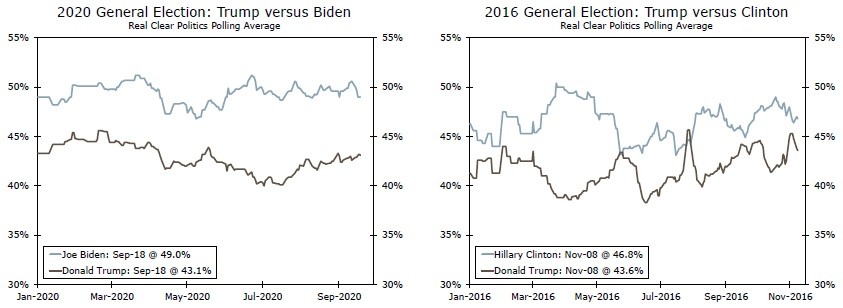
Fast forward to today and the race has narrowed somewhat. At present, Joe Biden's lead in the RCP national polling average is +5.9, a tightening of a few points relative to his summer highs (Figure 1). At this point in 2016, the race was actually polling quite closely, with Hillary Clinton up just +1.5 on September 18 (Figure 2). We continue to be struck by the relative stability of 2020 polling. As can be seen in the two charts below, the 2016 race was marked by considerable swings over the course of the year, oscillating between periods where Hillary Clinton polled well ahead of Donald Trump and periods where the race appeared tied or Trump even had a small lead. Contrast that with 2020, where Joe Biden has led pretty much the whole year by a decent margin.
Source: Real Clear Politics and Wells Fargo Securities
Of course, President Trump could chip away at Joe Biden's lead in the remaining weeks of the campaign. As we noted in our previous report, Donald Trump closed well in 2016, cutting Hillary Clinton's national polling lead in half in the final weeks of the campaign. Exit polls also provided additional evidence that Trump won a majority of voters who decided in the final month of the race. And furthermore, we do not believe Donald Trump needs to pull even in the national vote to win the election. Indeed, he won the 2016 race while losing the national vote by about three percentage points, in line with the RCP polling average on Election Day. In 2016, swing states like Pennsylvania, Michigan, Wisconsin and Florida voted roughly 3-4 points to the right of the nation as a whole. Thus, if 2016 is any guide, Donald Trump could be within striking distance of a win even if Biden is polling 3-4 points ahead at the national level.
Furthermore, although the polling at the national level proved to be fairly accurate in 2016, there were some polling issues at the state level, particularly in Wisconsin and Michigan. These were two states that were generally considered fringe swing states at best: prior to 2016 no Republican presidential candidate had won Michigan since 1988, and a Republican candidate had not won Wisconsin since 1984. This led us to ask a question: what if the key swing states see a polling error about the size of the ones that occurred in 2016? What would that do the electoral map, holding everything else equal?
Source: Real Clear Politics and Wells Fargo Securities
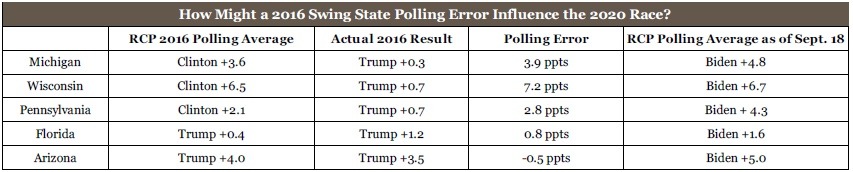
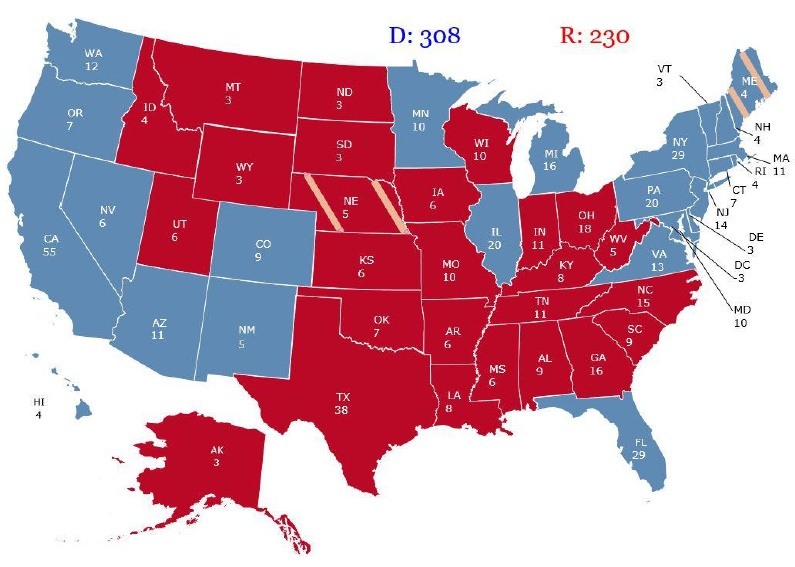
Figure 3 looks at the five states in the 2016 election that had the closest margins and were won by Donald Trump. As can be seen in the third column, the polling errors seen in these five states varied significantly. In Wisconsin and Michigan, the errors were fairly large at roughly seven and four points, respectively. In contrast, the Florida polling was fairly accurate, and in Arizona Trump actually slightly underperformed the polls. The far right column in Figure 3 shows the current RCP polling average as of September 18. As things stand today, a 2016-sized polling error in each of these five states would lead to Biden winning all but Wisconsin. Holding the rest of the electoral map from 2016 constant, that would yield the hypothetical scenario seen below in Figure 4.
Source: Wells Fargo Securities
While this should probably be considered encouraging news for Joe Biden, the race remains far from a slam dunk for the challenger. Although we do not consider it especially likely, it is certainly possible that state-level polling errors could be even bigger in 2020. Alternatively, and perhaps more likely, the race could tighten a few more percentage points in the weeks ahead. A few more points of tightening and a fairly normal sized polling error in some key states could very well put Donald Trump on the road to another narrow victory. As of this writing, PredictIt betting markets imply Joe Biden has a 59% chance of winning, while FiveThirtyEight's model is more bullish on Biden, giving him a 76% chance of winning. It is perhaps worth remembering that even if Biden has a 76% chance of winning, Trump's 24% probability of winning the election is about the same odds as flipping a coin twice and getting heads both times. While unlikely, that is far from a one in a million event.
One final point we believe it is important to keep in mind is that polling errors can swing both ways. In 2012, for instance, the race appeared quiet close on election day, with the Real Clear Politics national polling average showing President Obama up just +0.7 over Republican candidate Mitt Romney. Many political analysts projected a fairly close race in both the popular vote and the Electoral College. President Obama went on to win fairly comfortably, winning the popular vote by about four percentage points and winning the Electoral College 332-206. We remind our readers that there is always the possibility that the polling error could swing back the other direction and understate Joe Biden's support.
Congressional Outlook
What about the outlook for control of Congress? For a description of what each party needs to either retain or capture the House/Senate, see our mid-July report. In short, the polling has improved a bit for Republicans here too, though in an absolute sense it still remains fairly favorable for the Democrats. In generic ballot polling, the Democrats had an +11 point lead at the time of our mid July update according to the RCP polling average. At present, the spread is +5.7 points for Democrats (Figure 5). This tightening makes some intuitive sense to us; the mid-July reading of +11 signaled a more favorable environment than 2008, when Barack Obama won the presidency with sizable majorities in both chambers of Congress. A spread of +5.7 is still much stronger for Democrats than what the polls signaled in 2016, where Democrats had only a slight edge on Election Day in the generic ballot.
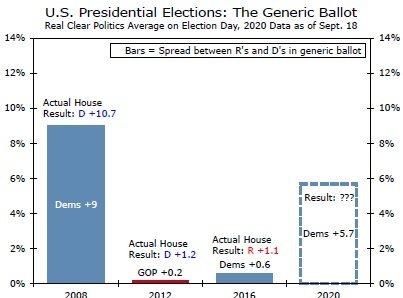
In our view, the generic ballot polling data are consistent with a race that has tightened moderately since mid-July but that remains more favorable to Democrats than the 2016 environment. PredictIt betting markets give the Democrats a 56% chance of taking the Senate and an 84% chance of keeping the House of Representatives. Political analyst Larry Sabato's widely-followed Crystal Ball projections currently rate the Senate as 49-48 for the Republicans, with three states (North Carolina, Maine and Iowa) considered toss-ups. Of course, the race for control of the House and Senate, like the race for control of the White House, could change significantly in the weeks ahead.
Download The Full Special Reports
Author
Wells Fargo Research Team
Wells Fargo