The 10-year treasury yield hits 5%: Is the era of ultra-low interest rates over?

The U.S. Treasury market has crossed a psychologically important threshold. On Monday, the benchmark 10-year Treasury yield briefly climbed above 5%, reaching around 5.01%, its highest intraday level since 2007 and its highest level since October 2023. The move comes as surging oil prices, persistent inflation and expectations of a more restrictive Federal Reserve fuel a broader selloff in government bonds.
The 5% threshold is not, by itself, evidence that a financial crisis is approaching. But it is an important signal that investors are demanding substantially more compensation to hold long-term U.S. government debt. More importantly, it raises a broader question: is the global economy moving further away from the ultra-low interest-rate environment that dominated the years following the Global Financial Crisis and the Covid-19 pandemic?
Why are US Treasury yields rising?
The immediate catalyst is the renewed surge in energy prices. Brent crude climbed above $108 a barrel on Monday, after new attacks on Saudi energy infrastructure and shipping in the Middle East intensified concerns about global supply. WTI also moved above $100.
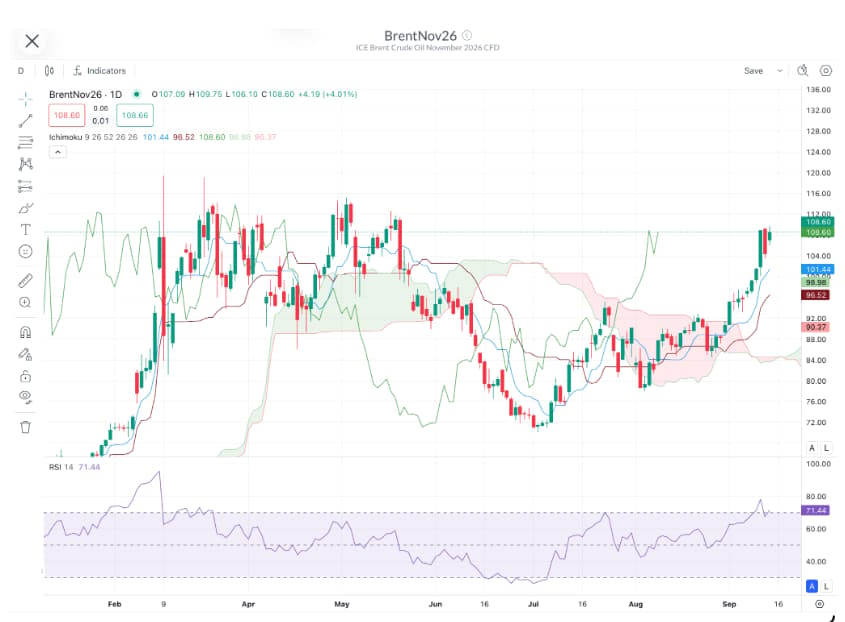
The problem for central banks is that an oil shock can simultaneously increase inflation and weaken economic growth. Higher energy costs raise transportation, production and household expenses, while potentially reducing consumers’ disposable income. Unlike demand-driven inflation, however, higher interest rates cannot directly produce more oil or reopen disrupted supply routes. Nevertheless, markets are increasingly pricing the possibility that central banks will need to respond to the second-round effects of the energy shock.
That concern has been reinforced by the latest U.S. inflation figures. The August CPI increased 0.4% month-on-month, while annual inflation remained at 3.4%, significantly above the Federal Reserve’s 2% target and above the 10-year average of 3.3%. Gasoline prices alone increased 3.9% during the month and accounted for more than one-third of the monthly rise in headline CPI.
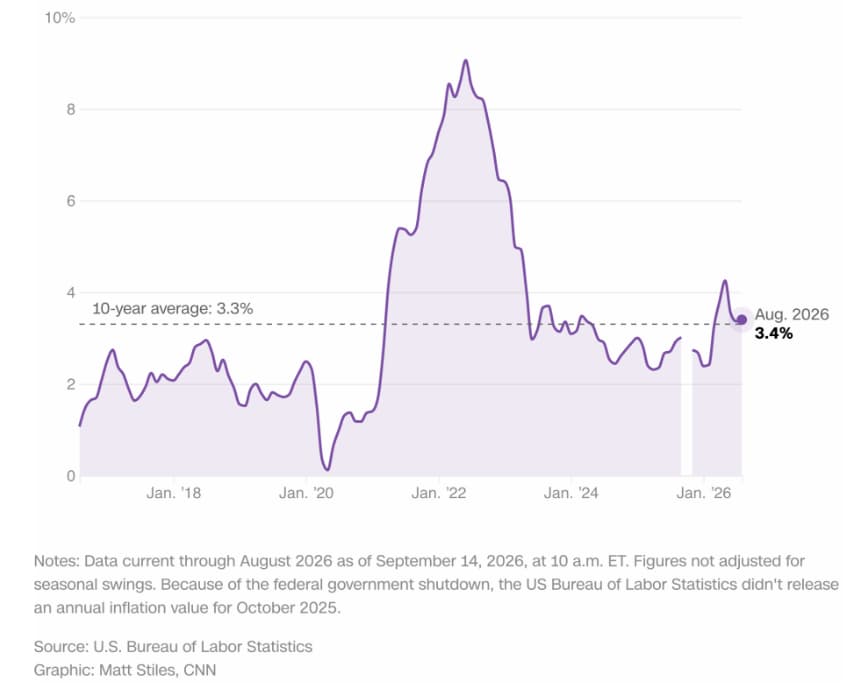
The result is a major repricing of monetary policy. A Reuters economist poll on Monday showed that a majority now expect the Fed to raise rates at its September meeting, reversing the consensus that had prevailed only days earlier. Some economists also expect at least one additional increase by March.
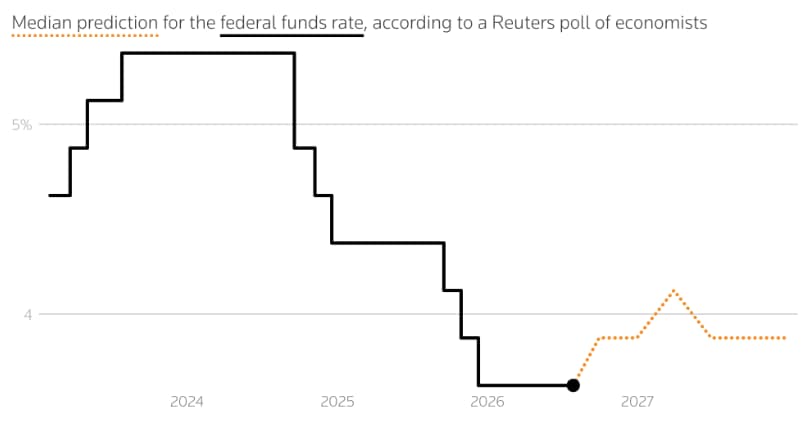
Where experts think the U.S. rate is moving towards to - Source: Reuters
But the 10-year yield is not simply a reflection of where the Fed sets overnight rates.
Long-term Treasury yields incorporate expectations for future short-term rates plus a term premium—the additional compensation investors demand for holding longer-duration bonds amid uncertainty over inflation, fiscal policy and future interest rates. The San Francisco Fed’s Treasury decomposition explicitly separates expected future short rates from this term premium.
That distinction matters because the current rise in yields reflects more than expectations for one or two Fed hikes.
The bond market is questioning the return to cheap money
The 10-year Treasury yield has also been under pressure from the enormous amount of debt that the U.S. government needs to finance.
The U.S. national debt has surpassed $40 trillion, while heavy government and corporate issuance has increased the supply of bonds that investors must absorb. At the same time, concerns about persistent budget deficits can make investors demand a higher yield to hold long-duration government debt.
This creates an important distinction between the current environment and the ultra-low-rate era.
During the 2010s, investors became accustomed to exceptionally low yields, supported by subdued inflation, quantitative easing and highly accommodative central-bank policy. The Covid-19 shock then pushed this model even further, with policy rates near zero and central banks expanding their balance sheets dramatically.
That environment has now largely reversed. The Federal Reserve’s balance sheet remains enormous—around $6.47 trillion of securities held outright as of September 9—but the post-pandemic direction of monetary policy has been toward normalization rather than another wave of emergency asset purchases.
The implication is not necessarily that 5% Treasury yields will become permanent. It is that investors can no longer assume that central banks will automatically suppress long-term borrowing costs whenever financial markets weaken.
Why does a 5% 10-year yield matter for investors?
The significance of the 10-year Treasury extends far beyond the bond market. Treasury yields form one of the most important reference points for global asset pricing. When the risk-free rate rises, the required return on other investments tends to rise as well.
For equity investors, higher Treasury yields can make bonds relatively more attractive. An investor can now obtain around 5% from a U.S. government security before taking on the additional risks associated with equities. That changes the risk-reward calculation and can compress the equity risk premium.
Higher yields are particularly relevant for growth and technology stocks, whose valuations depend heavily on earnings expected many years into the future. When the discount rate rises, the present value of those future cash flows falls. This is one reason rising Treasury yields can put pressure on high-duration equities.
The impact is already visible. U.S. stocks fell on Monday as the Treasury yield crossed 5%, with the S&P 500 and Nasdaq under pressure amid simultaneous concerns over oil and technology valuations.
For bond investors, the picture is more complicated. Rising yields mean falling prices for existing bonds, creating mark-to-market losses for holders of longer-duration securities. But higher yields also improve the prospective returns available to investors who buy bonds at today’s prices.
For households, higher long-term yields can translate into more expensive mortgages and other forms of borrowing. U.S. 30-year mortgage rates were already around 6.85% in mid-September, with some market measures above 7%.
For companies, higher borrowing costs can discourage investment, increase refinancing expenses and reduce the attractiveness of debt-funded expansion. This could become particularly important for highly leveraged businesses or capital-intensive sectors.
Does 5% mean a recession or financial crisis is coming?
Not necessarily. A 5% 10-year yield is a market signal, not a crisis indicator. There is no specific yield level at which the economy automatically enters recession or stocks must collapse.
In fact, some of the current increase reflects an economy that remains relatively resilient. Strong corporate earnings and substantial investment in areas such as artificial intelligence have helped the equity market absorb higher borrowing costs so far.
The greater risk would come from a persistent and disorderly rise in yields.
If yields continue climbing because investors expect structurally higher inflation, a higher Fed policy rate and increasing fiscal risk, financial conditions could tighten significantly. Mortgage rates would rise, corporate refinancing would become more expensive and equity valuations could face additional pressure.
There is also a potentially uncomfortable feedback loop. Higher Treasury yields increase the government’s interest expense. Larger interest costs can worsen fiscal deficits, potentially requiring more borrowing, which can increase the supply of Treasury securities investors need to absorb.
That does not automatically produce a debt crisis, but it can reinforce the demand for a higher term premium.
Bottom line: Is the world entering a new rate regime?
The most important implication of the 5% threshold may therefore be structural rather than immediate. The era of ultra-low interest rates was supported by powerful forces: low inflation, demographic trends, abundant global savings, quantitative easing and exceptionally accommodative monetary policy. Some of those conditions have changed.
Today’s environment is characterised by more volatile inflation, geopolitical fragmentation, higher energy-security risks, substantial government borrowing and less willingness from central banks to maintain emergency-level stimulus.
That does not mean rates must remain at 5% indefinitely. A resolution to the Middle East conflict, a decline in oil prices or a significant slowdown in economic activity could send inflation lower and allow the Fed to ease policy again.
But if inflation remains above target while fiscal borrowing stays elevated, the market may increasingly view 4–5% long-term Treasury yields as a normal part of the post-ultra-low-rate environment rather than an extreme anomaly.
For investors, the question is no longer simply whether rates will eventually fall. It is how far they can fall without a return to the economic conditions that justified near-zero rates in the first place.
Stay up to date with what's moving and shaking on the world's markets and never miss another important headline again! Check ActivTrades daily news and analyses here.
Author

Carolane de Palmas
ActivTrades
Carolane graduated with a Masters in Corporate Finance & Financial Markets and got the AMF Certification (Financial Markets Regulator in France). Afterward, she became an independent trader, investing mostly in European and American stocks/indices.