|

Technical analysis – GBP/USD sellers take a breather but bearish bias rules

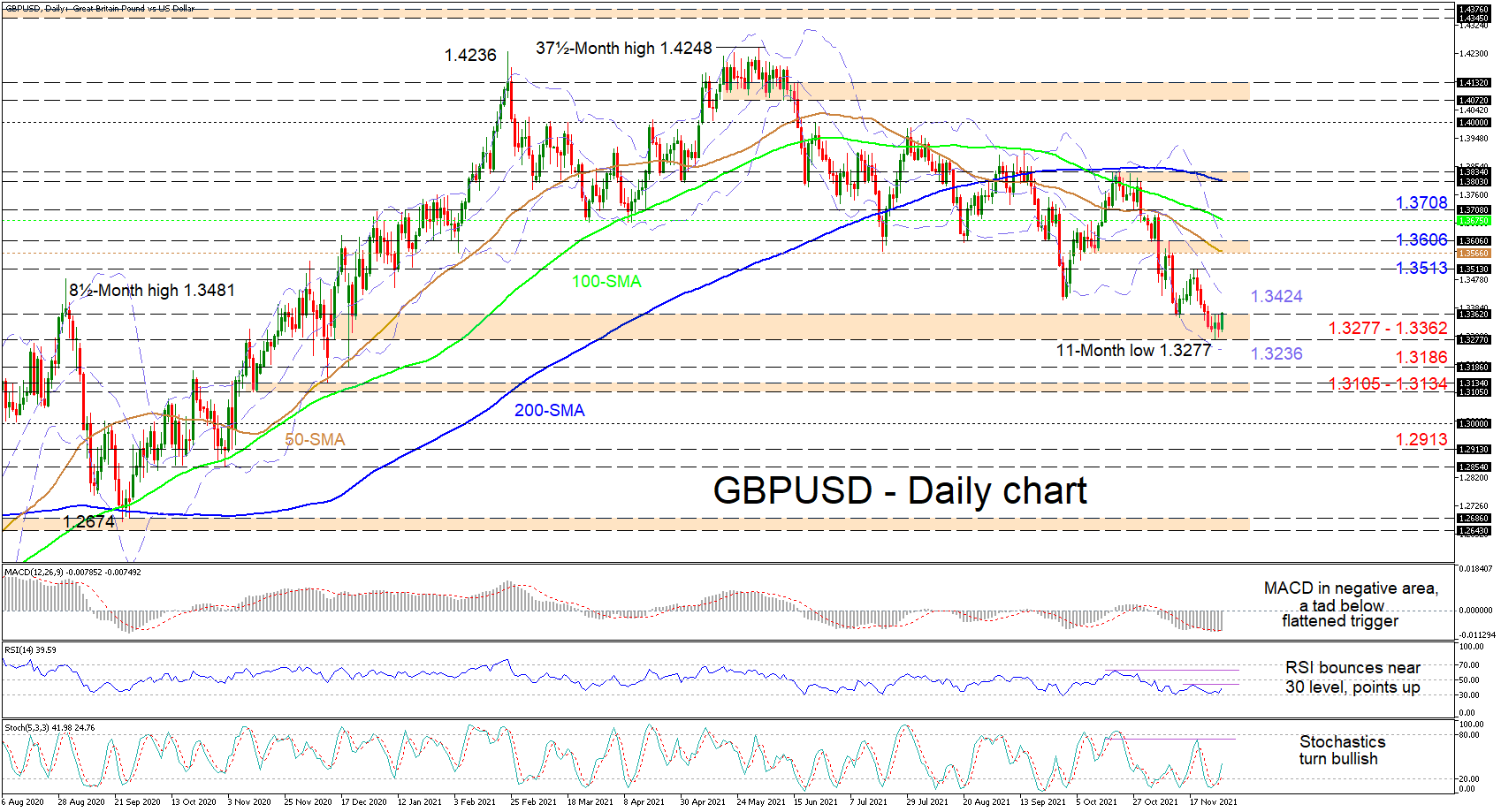
GBPUSD is consolidating around the 1.3300 mark, within the 1.3277-1.3362 support zone that has managed to mute negative forces for now. The falling simple moving averages (SMAs) are presently backing the bearish picture in the pair.

The short-term oscillators are suggesting a moderate waning in negative momentum. The MACD, some distance in the negative zone, is holding beneath its red trigger line. The RSI, in bearish territory, is improving from the 30 level, while the stochastic oscillator is promoting advances in the pair.

In the positive scenario, immediate constraints could originate from the 1.3362 mark and the approaching mid-Bollinger band at 1.3424 ahead of the 1.3513 barrier. Overstepping the latter obstacle, buyers may encounter a fortified section of resistance from the 50-day SMA at 1.3566 until the upper Bollinger band, residing at the 1.3606 high. Conquering this crucial border, the bulls could then eye a region of resistance existing between the 100-day SMA at 1.3675 and the 1.3708 level.

Otherwise, if sellers resurface, initial downside friction could transpire from the 1.3277 boundary of the current buffer zone, which happens to also be the 11-month low. Sliding past this, the neighboring lower Bollinger band at 1.3236 and the 1.3186 low could delay the test of the 1.3105-1.3134 support band. Piercing below this key barricade, the price may then plunge towards the 1.3000 handle before targeting the 1.2913 obstacles.

Summarizing, GBPUSD’s medium-term outlook is growing increasingly negative, as the pair logs lower highs and lows. That said, buyers are fighting back but they would need to drive the price above the 1.3513 high to start to gain some upside momentum.
GBPUSD

Author

Anthony Charalambous, CFTe

Anthony Charalambous joined XM in 2019 and specializes in preparing daily technical analysis, using his years of trading experience to provide detailed forecasting for all major asset classes such as forex, indices, commodities and equities.


More from Anthony Charalambous, CFTe
Share:

Editor's Picks

GBP/USD off highs, back to 1.3620

GBP/USD remains slightly on the defensive at the end of the week, receding to the low 1.3600s after hitting fresh tops past 1.3670 earlier in the day. Cable’s correction comes after two daily gains in a row and amid a tepid advance in the Greenback, while poor UK data also accompany the downside.

EUR/USD treads water below 1.1700

EUR/USD now trades with modest losses around 1.1670 following another unsuccessful atempt to advance past 1.1700 the figure in a convincing fashion. The pair’s decline follows a maginal rebound in the US Dollar as market participants continue to assess recent US data as well as developments from the US bond market.

Gold keeps rallying toward $4,700, fresh three-month highs

Gold extends its last week's stellar performance into Asian trading on Monday, refreshing three-month highs beyond $4,600. The precious metal capitalizes on persistent US Dollar weakness, following the US Treasury's buyback plan amid fresh US-Canada trade tensions.

Bitcoin, Ethereum and Ripple pause as momentum indicators signal overbought conditions, massive rallies
Bitcoin (BTC), Ethereum (ETH) and Ripple (XRP) hover around key levels on Monday, with a bullish bias but appearing stretched after surging over 23%, 31% and 53% in the previous week. Such a massive rally suggests the top three cryptocurrencies could consolidate or pull back in the short term as traders take profits.
US Dollar Weekly Forecast: Enter Jackson, mind the (budget) Hole
It was not geopolitics, the US-Japan joint FX intervention to support the beleaguered Japanese currency or the omnipresent bets on what the Federal Reserve (Fed) might do in the second half of the year that kept the US Dollar (USD) well on the back foot over the past five days.
$20 billion offered, $2 billion taken: Why Treasury doubled its buyback cap

The US Treasury moved off its own calendar on Wednesday, and that is the part worth sitting with. At 12:32 GMT, the department said it would at least double the size of liquidity support buyback operations in the 10-year to 20-year and 20-year to 30-year sectors, lifting the maximum from $2 billion per operation to at least $4 billion, effective September 9 and running to November 4.