|

Technical analysis – EUR/USD’s positive traction disappoints, negative bias holds

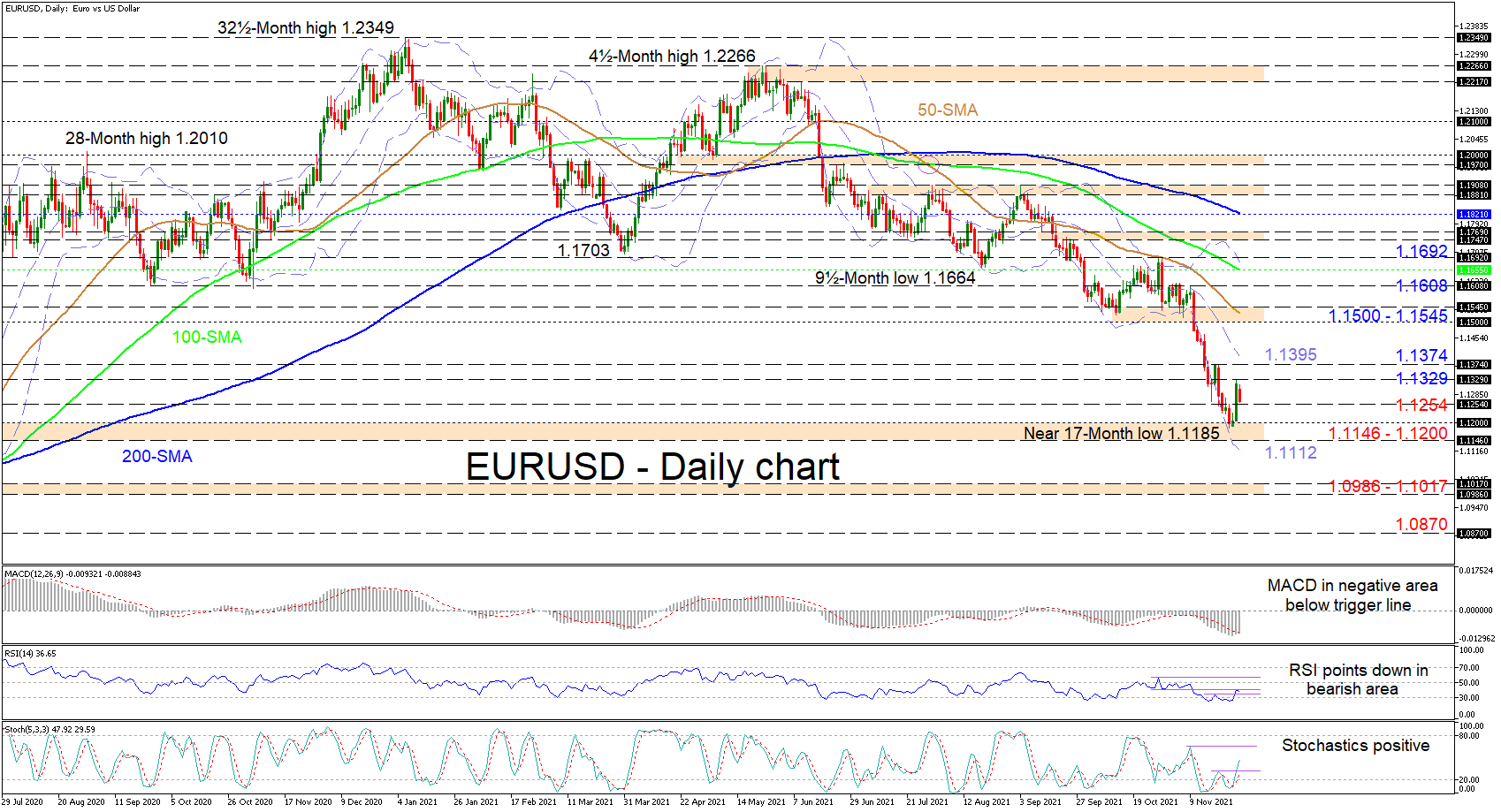
EURUSD’s negative bearing prevails despite the bounce off the near 17-month low of 1.1185. The falling simple moving averages (SMAs) are endorsing the bearish outlook in the pair.

The short-term oscillators are transmitting mixed signals in directional momentum. The MACD is far beneath the zero mark and is holding below its red trigger line. The RSI is dipping in bearish territory signalling that positive impetus is feeble, whereas the rising stochastic lines continue to sponsor gains in the pair.

If sellers manage to stay in control, initial support could emanate from the 1.1254 level ahead of the 1.1146-1.1200 support boundary. Resuscitating the descent, sellers may snag at the 1.0986-1.1017 border, linked to the inside swing highs over the mid-April until mid-May period of 2020. Sinking beneath the 1.1000 vicinity, traders’ attention could then turn to the 1.0870 trough, achieved in the later part of May 2020.

If buyers re-emerge, preliminary resistance could transpire from the 1.1329 and 1.1374 nearby highs, where the mid-Bollinger band is converging. Climbing higher, the critical 1.1500-1.1545 resistance border coupled with the 50-day SMA, may impede additional gains from materialising. However, should buyers conquer this barrier, they could jump towards the 1.1608 neighbouring high before challenging a fortified region of resistance, existing between the 100-day SMA and the 1.1692 mark.

Summarizing, EURUSD is struggling to recoup previously lost ground. The pair is sustaining a bearish bias below the SMAs and the 1.1500-1.1545 obstacle.
EURUSD

Author

Anthony Charalambous, CFTe

Anthony Charalambous joined XM in 2019 and specializes in preparing daily technical analysis, using his years of trading experience to provide detailed forecasting for all major asset classes such as forex, indices, commodities and equities.


More from Anthony Charalambous, CFTe
Share:

Editor's Picks

EUR/USD weakens to near 1.1900 as traders eye US data

The EUR/USD pair loses ground to around 1.1905, snapping the two-day winning streak during the early European trading hours on Tuesday. Markets might turn cautious ahead of the release of key US economic data, including US employment and inflation reports that were pushed back slightly due to the recently ended four-day government shutdown.

GBP/USD edges lower below 1.3700 on UK political risks, BoE rate cut bets

The GBP/USD pair trades on a weaker note around 1.3685 during the European session on Tuesday. The Pound Sterling edges lower against the US Dollar amid political risk in the United Kingdom and rising expectations of near-term Bank of England rate cuts. 

Gold drifts lower as positive risk tone tempers safe-haven demand; downside seems limited

Gold drifts lower during the Asian session on Tuesday and snaps a two-day winning streak, though it lacks strong follow-through selling and shows some resilience below the $5,000 psychological mark amid mixed cues. The outcome of Japan's snap election on Sunday removes political uncertainty, which, along with signs of easing tensions in the Middle East, remains supportive of the upbeat market mood.

Bitcoin Cash trades lower, risks dead-cat bounce amid bearish signals

Bitcoin Cash trades in the red below $522 at the time of writing on Tuesday, after multiple rejections at key resistance. BCH’s derivatives and on-chain indicators point to growing bearish sentiment and raise the risk of a dead-cat bounce toward lower support levels.

Follow the money, what USD/JPY in Tokyo is really telling you

Over the past two Tokyo sessions, this has not been a rate story. Not even close. Interest rate differentials have been spectators, not drivers. What has moved USD/JPY in local hours has been flow and flow alone.

Bitcoin Cash trades lower, risks dead-cat bounce amid bearish signals

Bitcoin Cash (BCH) trades in the red below $522 at the time of writing on Tuesday, after multiple rejections at key resistance. BCH’s derivatives and on-chain indicators point to growing bearish sentiment and raise the risk of a dead-cat bounce toward lower support levels.