Tame tariff impact gives the US Fed room to cut

So far, US tariffs have not been as impactful as feared, giving more time for disinflationary pressures from weaker wage growth and housing rents to flatten CPI projections. This has given the Federal Reserve room to cut rates as cooling job creation becomes the more pressing issue.
Decent momentum looks set to gradually fade on weaker sentiment
Second-quarter GDP growth came in stronger than expected in the US at an annualised 3.8%, and there was decent momentum at the start of the third quarter, prompting us to revise up our third-quarter GDP growth forecast from 1.5% to 2.4%. Trade and inventory data have been better than anticipated, while higher-income households in the US show little sign of slowing their spending.
Nonetheless, weakness in consumer confidence and a rapidly cooling jobs market suggest spending growth will slow. Business surveys have also come in on the softer side of expectations, with subdued investment outside of tech/AI likely to persist. There are now more unemployed Americans than there are job vacancies, and this is depressing wage growth, while five consecutive monthly drops in home prices present challenges for the residential construction sector.
US GDP growth (YoY%) and ISM business surveys advanced by four months
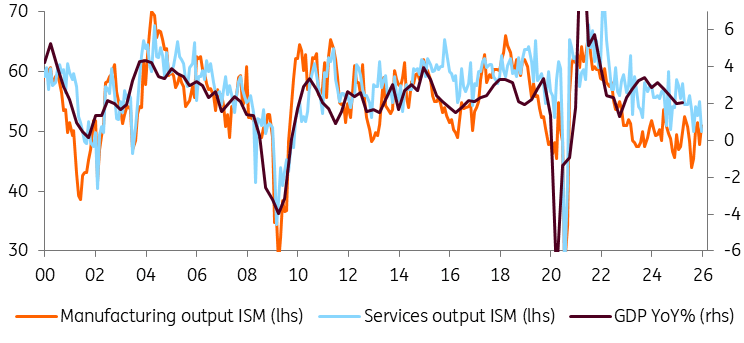
Source: Macrobond, ING
Muted tariff inflation impact allows jobs slowdown to be the focus
Another concern for US consumer spending was that tariffs would drive up prices and erode spending power. However, so far, there is little sign of this happening. The announced tariffs on individual countries and sectors suggest an applied average tariff rate of 18%, but the realised tariff rate is only around 10% based on trade and customs tax revenues for July and August. Companies appear to be willing to absorb these cost increases for now. While not good news for the fiscal deficit, this means that inflation has been better behaved.
While we assume tariff revenue will eventually rise, it means the disinflationary impulses from lower energy prices, moderating housing rent increases and weakening wage growth have more time to gain traction and help offset the eventual tariff impact on goods prices. We consequently expect a flatter, lower inflation profile than predicted just a few months ago.
As such, the Fed has acknowledged that the balance of risks to its dual mandate of price stability and maximum employment has shifted, justifying renewed interest rate cuts. Monetary policy is still viewed as being restrictive, and we expect the Fed to cut rates by a further 50bp this year and 50bp next year to bring them towards neutral.
Fed to continue cutting rates towards 3%
We are currently in the middle of a government shutdown, which ordinarily would have limited long-term implications. Around three million federal government workers are not being paid, with around a quarter having been furloughed, but all workers have historically received back-pay owed to them when the shutdown ends. Government contractors don’t get compensated, though, and government work can be heavily delayed, and economic data is not released.
This time, there is a concern that there could be more negative implications, with White House officials having warned that furloughed workers involved in programmes not aligned with President Trump’s priorities could be permanently fired. Federal funding for some infrastructure projects is already being paused. As such, rather than knocking perhaps 0.1pp off annual GDP, a protracted shutdown could increase that to perhaps 0.2pp or even 0.3pp.
Looking towards 2026, lower policy rates, recent declines in Treasury yields and a weaker dollar represent a loosening of financial conditions, which is supportive of growth. Additionally, more clarity on the global trading environment may stabilise sentiment and tempt companies that have been reluctant to put money to work and hire to start spending again. But this needs to happen quite quickly, otherwise the “low hire, low fire economy” risks converting into a "no hire, let's fire" story. In such a scenario, the Fed could be forced to move policy into stimulative territory (sub-3%).
Read the original analysis: Tame tariff impact gives the US Fed room to cut
Author
James Knightley
ING Economic and Financial Analysis
James Knightley is the Chief International Economist in London. He joined the firm in 1998 and has been covering G7 and Western European economies. He studied economics at Durham University, UK.