Swedish GDP Growth Surges to Fastest Pace Since Q4-2010


Second quarter GDP in Sweden blew past expectations, growing 1.7 percent sequentially over the quarter. Labor market progress remains a key concern that is keeping the Riksbank on hold.
Swedish GDP Growth Tops Expectations in Q2
Swedish GDP data, released this morning for the second quarter, topped expectations, rising 1.7 percent sequentially (7.1 percent annualized) and 3.9 percent year-over-year. This was the fastest sequential growth rate registered by the Swedish economy since Q4-2010 when the global economy was climbing back from the throes of the Great Recession.
Encouragingly, economic growth was generally broad-based in Q2. Domestic demand growth was strong, led by 16.0 percent annualized growth in gross investment, the second consecutive quarter of annualized double digit gains. In this regard at least, negative interest rates have been associated with the desired outcome, as investment spending has accelerated on a year-ago basis to its fastest pace in six years. Household consumption growth was also strong, rising at a 4.4 percent annualized rate. Consumption has held up reasonably well despite elevated debt-toincome ratios that present a challenge for Riksbank policymakers. Net exports provided a modest boost to headline growth amid an improved global trade environment, while government spending was flat.
Conditions for a Rate Hike in Sweden Slowly Gathering Steam
Earlier this year, the Swedish Riksbank signaled that, despite healthy economic activity and rising inflation, it did not expect to increase its currently negative policy rate until the middle of 2018. Since then, economic growth has continued to firm, and inflation has moved closer to two percent (middle chart). Given this progress, it begs the question: why does a rate hike remain so far off?
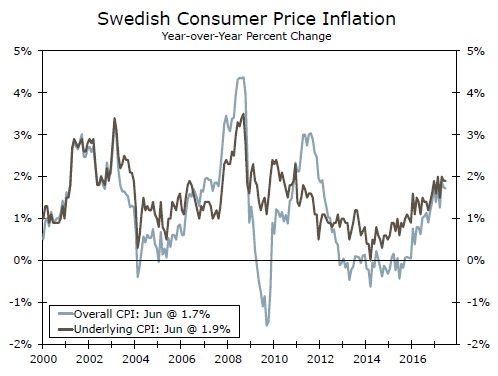
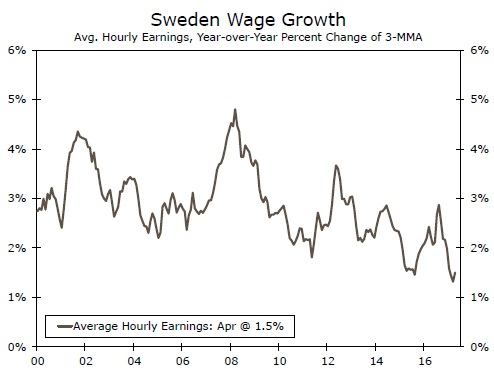
After several years of relatively benign inflation, the Riksbank is cognizant of how quickly inflation and inflation expectations can revert back to below target levels. In addition, labor market progress remains slow going: Sweden's unemployment was a semi-elevated 6.7 percent in May, and, despite faster inflation and improved economic growth, wage growth remains subpar (bottom chart). This slow progress on the labor market front is coupled with high household debt levels. Higher interest rates could drive the household debt-service ratio higher, choking off the nascent recovery in growth and inflation.
The Riksbank's next monetary policy meeting will take place on September 7. Although we do not expect a rate increase, it will be interesting to see if policymakers revise their outlook and guidance in light of the continued acceleration in prices and the broad-based economic growth in the second quarter. Riksbank policymakers will also likely be closely monitoring developments at the European Central Bank in light of the modestly more hawkish rhetoric of late coming from the continent's monetary policymakers. Our currency strategy team sees a firmer Swedish krona against both the euro and U.S. dollar in the quarters ahead.
Author
Wells Fargo Research Team
Wells Fargo