Spain drives Eurozone jobs growth as employment rises once again

Spanish employment continues to rise, even as unemployment grows to 10.6%. Spain remains a key driver of eurozone employment growth, with gains concentrated in full-time private-sector jobs and supported by strong participation from foreign workers.
Spanish employment keeps rising, even as unemployment edges up
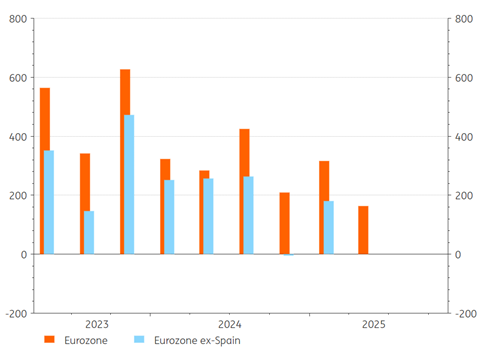
The number of employed people aged 16-64 in Spain increased by 119,500 in the third quarter, a 0.55% quarter-on-quarter gain. However, the labour force expanded slightly faster, pushing the unemployment rate up by 0.17 percentage points to 10.55%. While job creation has moderated and unemployment remains high by eurozone standards, Spain will continue to stand out as one of the region’s key employment engines with these numbers, contributing significantly to overall job growth.
Spains leads Eurozone employment gains (QoQ change, thousands)
Source: LSEG datastream, ING Economic research
Continuation of employment trends
Digging deeper, non-nationals remain an important driver of employment dynamics in Spain. The percentage growth of active people remains stronger for non-nationals than for nationals, with the active population of non-nationals aged 16-64 having surged 36.1% since the fourth quarter of 2019, lifting their share of the labour force from 17.7% to 24.5%. Their unemployment rate has also fallen sharply over that time period, from 18.8% to 13.9%.
Furthermore, job creation continues to be driven mainly by the private sector and is spread across industry, services, and construction, and concentrated in full-time roles at the expense of temporary contracts. The decline in temporary employment is particularly striking; Spain’s temporary employment rate had already dropped to 15.5% in the second quarter of 2025, down from 18.2% in the fourth quarter of 2022, following legislative changes that restricted short-term hiring. Despite this progress, the country's share of temporary workers still lies above the eurozone average of 13.6%.
Outlook remains positive with an easing pace
The outlook for the labour market remains positive, but the pace appears to be easing in line with the overall economic outlook. Employment sentiment indicators remain well above their long-term average and significantly stronger than eurozone sentiment. Purchase managers indicate that service-sector employment confidence has been rising for three years. Still, September’s gain was the weakest since November 2023, while manufacturing posted its first decline in staffing levels in seven months.
With GDP growth still projected to exceed potential, albeit at a softer pace, we expect employment to keep expanding, though more gradually. Labour shortages should remain a minor constraint on production, and wage pressures should remain contained, giving Spain room to continue on its convergence path with northern European countries.
Read the original analysis: Spain drives eurozone jobs growth as employment rises once again
Author

ING Global Economics Team
ING Economic and Financial Analysis
From Trump to trade, FX to Brexit, ING’s global economists have it covered. Go to ING.com/THINK to stay a step ahead.