|

Spain: A dynamic housing market

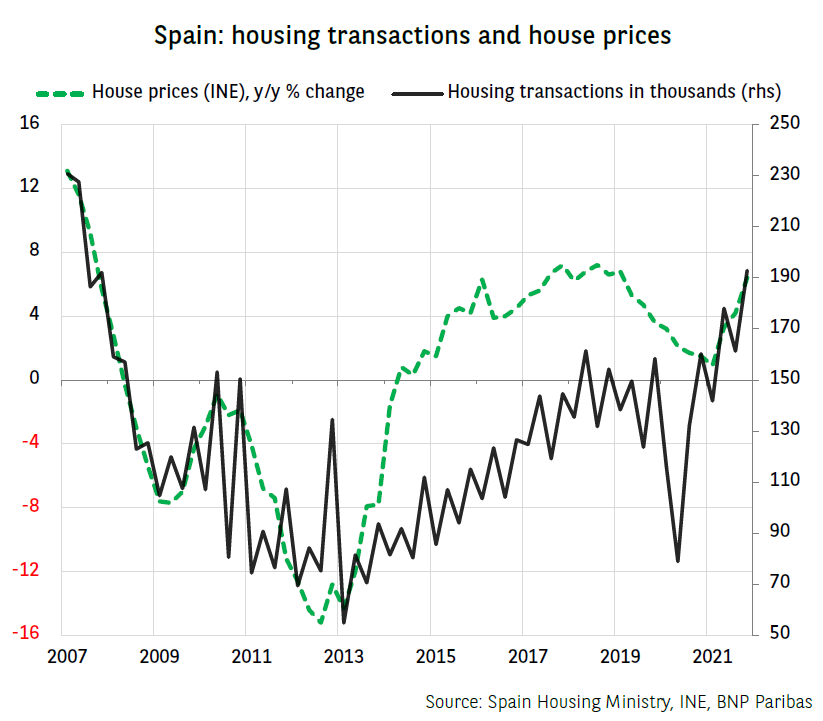
In Spain, the change in house prices and the transaction volume are highly correlated. In an upswing, the latter will be supported by attractive borrowing conditions and confidence in the economic outlook, thereby causing a rise in house prices, which in turn can fuel expectations of further increases and hence raise the transaction volume.

Real estate activity in Spain rebounded sharply in 2021 following a drop in 2020 due to the health crisis. The number of housing transactions exceeded 674,000 last year, the highest level since 2007. Even so, this was nearly 30% below the 2006 peak.

Demand is still buoyed by historically low borrowing costs and a rising number of Spanish households. As a result, house prices rose significantly in 2021 (at annual rate of 3.7%), maintaining the rapid pace of the past six years (average annual growth of 4.6% between 2015 and 2021). House prices are still nearly 10% below the peak of summer 2007 according to the Spanish statistics bureau (INE), but they have been rising at a rapid pace, and much faster than household revenue growth.

The new housing law that took effect last February aims primarily at strengthening the framework for rent and tenant rights, which is a good thing. Yet the law does not directly address the core problem of house price inflation, which is making it difficult for part of the country’s population from getting on the property ladder, notably young people.
Chart

Download The Full Eco Flash

Author

BNP Paribas Team

BNP Paribas Team

BNP Paribas

BNP Paribas Economic Research Department is a worldwide function, part of Corporate and Investment Banking, at the service of both the Bank and its customers.


More from BNP Paribas Team
Share:

Markets move fast. We move first.

Orange Juice Newsletter brings you expert driven insights - not headlines. Every day on your inbox.

By subscribing you agree to our Terms and conditions.

Editor's Picks

EUR/USD gathers recovery momentum, trades near 1.1750

Following the correction seen in the second half of the previous week, EUR/USD gathers bullish momentum and trades in positive territory near 1.1750. The US Dollar (USD) struggles to attract buyers and supports the pair as investors await Tuesday's GDP data ahead of the Christmas holiday. 

GBP/USD knocks ten-week highs ahead of holiday slowdown

GBP/USD found room on the high side on Monday, kicking off a holiday-shortened trading week with a fresh spat of Greenback weakness, bolstering the Pound Sterling into its highest bids in ten weeks. Pound traders are largely brushing off the latest interest rate cut from the Bank of England as the UK’s central bank policy strategy leaves the water murky for rate-cut watchers.

Gold buying remains unabated; fresh all-time peak and counting

Gold builds on the previous day's blowout rally through the $4,400 mark and continues scaling new record highs through the Asian session on Tuesday. Bets for more interest rate cuts by the US Fed, renewed US Dollar selling bias, and rising geopolitical uncertainties turn out to be key factors driving flows towards the bullion. Traders now look to the delayed release of the revised US Q3 GDP print and US Durable Goods Orders for a fresh impetus.

ETHZilla sells over 24,000 ETH, community reacts to shift away from DAT strategy

Peter Thiel-backed ETHZilla announced it sold 24,291 ETH for ~$74.5 million to redeem outstanding senior secured convertible notes. "We plan to use all, or a significant portion, of the proceeds to fund the redemption," ETHZilla noted in a Monday X post.

Ten questions that matter going into 2026

2026 may be less about a neat “base case” and more about a regime shift—the market can reprice what matters most (growth, inflation, fiscal, geopolitics, concentration). The biggest trap is false comfort: the same trades can look defensive… right up until they become crowded.

XRP steadies above $1.90 support as fund inflows and retail demand rise

Ripple (XRP) is stable above support at $1.90 at the time of writing on Monday, after several attempts to break above the $2.00 hurdle failed to materialize last week. Meanwhile, institutional interest in the cross-border remittance token has remained steady.














