S&P 500 poised to print worst month this year – Further downside possibly ahead


Original content: S&P 500 poised to print worst month this year – Further downside possibly ahead
Major US equity indices have well and truly been on the ropes in September, with the S&P 500 set to end the month down more than -5.0%.
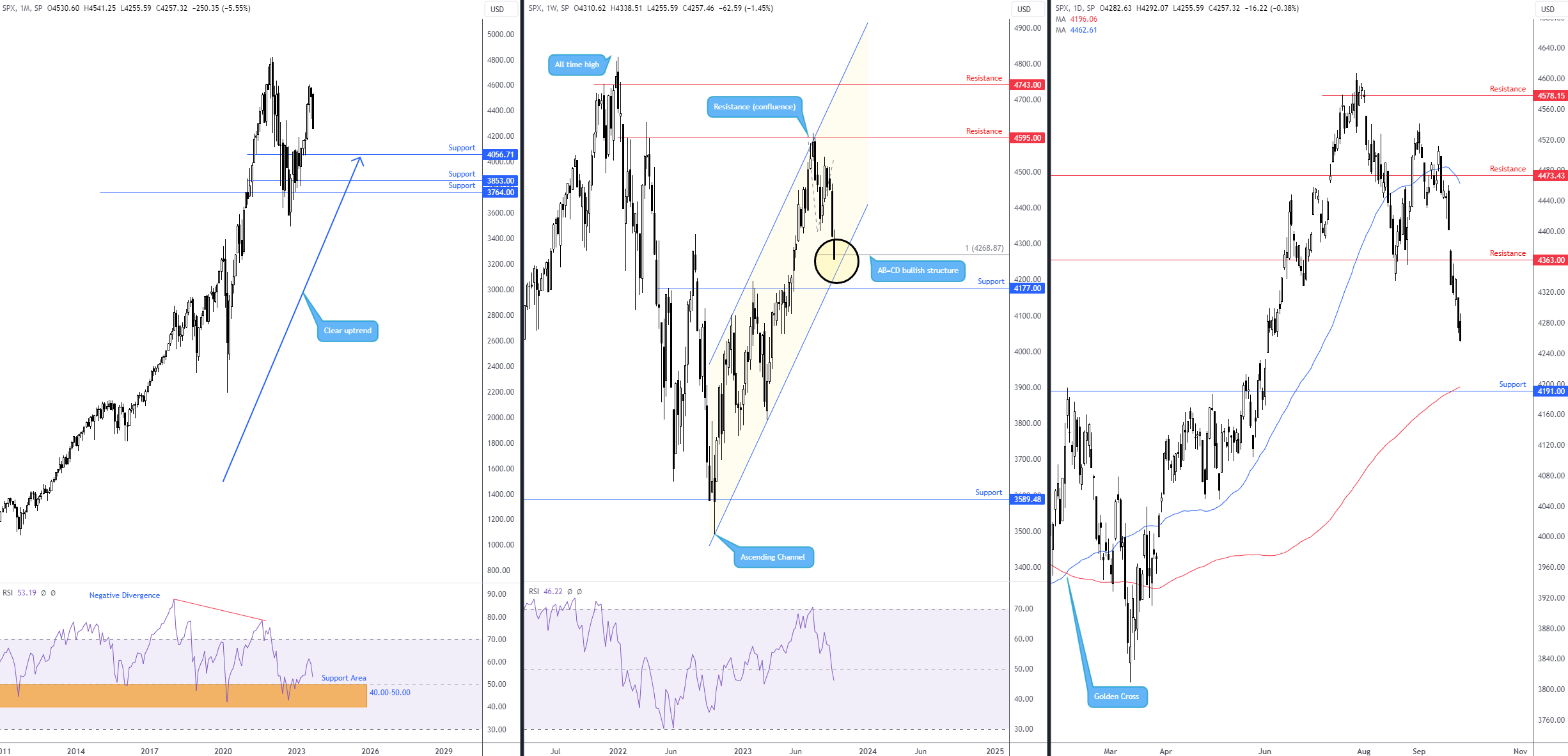
Let’s start by saying, however, that the trend remains north on the bigger picture: the monthly timeframe. This is clear to everyone, and we were on track to challenge all-time highs of 4,818. That was, of course, until this month’s downside move, which largely gathered steam on the back of the Fed’s longer-for-higher theme. Should further selling unfold, support is not expected to materialise on the monthly chart until 4,056.
While the monthly timeframe displays a bearish bias and scope to continue pressing southbound, the weekly chart recently touched gloves with an equivalent AB=CD harmonic support level at 4,268, depicted by a 100% projection ratio. You will note that although the Relative Strength Index (RSI) on the weekly timeframe has dipped a toe in waters south of its 50.00 centreline (negative momentum), the harmonic support level is complemented by neighbouring channel support extended from the low of 3,491.
From the daily timeframe, however, we can see that price recently dropped through support at 4,363, which is now marked as resistance. This has essentially helped pave the way for additional underperformance towards daily support at 4,191, which shares space with the 200-day simple moving average at 4,196.
Ultimately, we have the monthly and daily timeframes telling us that this market lacks support, though, on the weekly timeframe, we could see buyers respond to the AB=CD harmonic formation and associated channel support. Given this, chart studies are leaning towards more downside for the US equity space, at least until we reach daily support at 4,191, followed by weekly support at 4,177.
Author
Aaron Hill
FP Markets
After completing his Bachelor’s degree in English and Creative Writing in the UK, and subsequently spending a handful of years teaching English as a foreign language teacher around Asia, Aaron was introduced to financial trading,