|

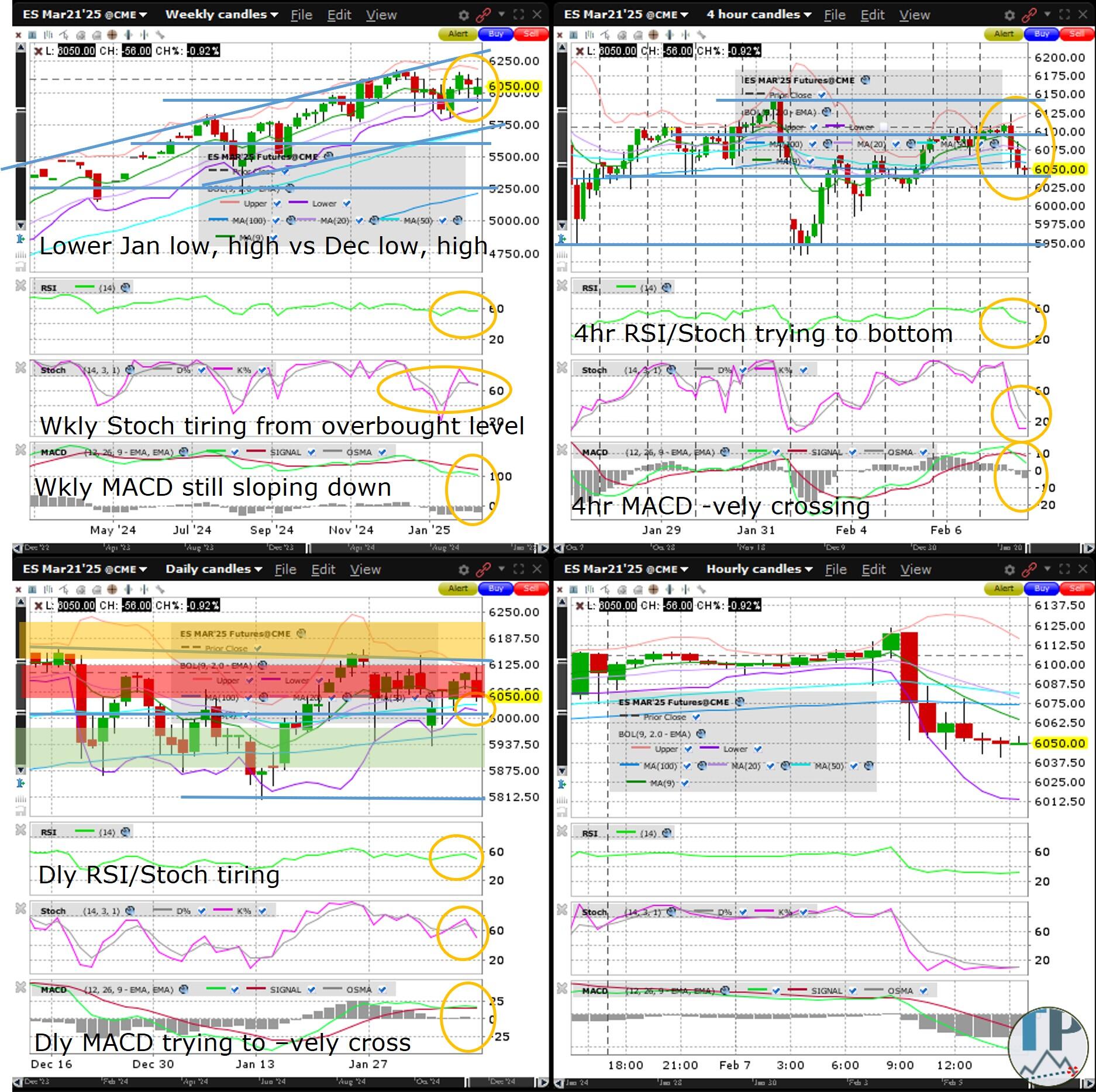
S&P 500 daily MACD tries negatively crossing
The S&P500 (ES) reversed more than a third of last week’s gains off its Monday low on Friday, and is vulnerable this week to a retest of last week’s low.  Before bears get excited, ES will need to break below the weekly chart upchannel support.  Nevertheless, the lower January low and high versus the December low and high are increasing chances that the powerful Bull Market extension from October 2022 may be exhausting.  The monthly MACD histogram on the continuous contract (as can be seen on tradingview.com) is steadily sloping down and weighing on the still slightly rising MACD blue line.  Volatility is likely to increase as early as Tuesday with the US Fed Chair Powell comments, and certainly by Wednesday with the US CPI and further Powell remarks.  Thursday, watch for the US PPI and unemployment claims, and on Friday for the US retail sales. The weekly and daily RSI, Stochastics and MACD are tiring or steadily sloping down.  I am looking to enter short in the red zone (of the daily chart), targeting the green zone for Friday.  The amber/yellow zone is where I might place a stop if I was a swing trader (although in my personal account with which I seldom hold overnight I sometimes set my stops tighter).

Weekly/Daily/4hr
Chart

Author

Darren Chu, CFA

Darren Chu, CFA

Tradable Patterns

Darren Chu, CFA, ex-Intercontinental Exchange | NYSE Liffe, TMX Group, CMC Markets, is the founder of Tradable Patterns – a publisher of futures/FX technical analysis on Bloomberg, LSEG (Refinitiv) and Factset.


More from Darren Chu, CFA
Share:

Editor's Picks

AUD/USD hangs near three-week low, above 0.7100 ahead of Fed decision

AUD/USD retains its negative bias for the third straight day, trading around 0.7120 and close to a three-week low during the Asian session on Wednesday. The US Dollar stands firm near a two-week high as the anticipated Fed rate hike and oil-driven inflation fears continue to push US bond yields to a multi-year high. Furthermore, escalating Middle East tensions benefit the safe-haven buck and weigh on the risk-sensitive Aussie.

USD/JPY remains below 155.50 as bulls await the key Fed decision

USD/JPY climbs to a fresh one-week high during the Asian session on Wednesday amid a bullish US Dollar. Oil-driven inflation fears, along with the anticipated Fed rate hike, continue to support surging US bond yields. Moreover, rising US-Iran tensions underpin the USD's reserve currency status. Spot prices, however, remain below the mid-155.00s as bulls seem hesitant ahead of the Fed decision later today and the BoJ meeting, starting on Thursday.

Gold struggles below $4,300, near one-month low as Fed decision looms

Gold remains depressed below $4,300 during the Asian session on Wednesday as traders look to the crucial Fed decision for a fresh impetus. Meanwhile, a surge in US bond yields, bolstered by oil-driven inflation fears, continues to weigh on the non-yielding bullion. Furthermore, escalating Middle East tensions underpin the safe-haven US Dollar and contribute to a weaker tone around the XAU/USD.

Ethereum continues to attract capital despite impending rate hike and Clarity Act failure

Ethereum declined to $2,400 on Tuesday after the Clarity Act failed to progress in the Senate. Despite that and the market's near certainty of an interest rate hike at the next Federal Reserve (Fed) meeting, the top altcoin has continued to attract fresh capital. Ethereum buyers have been dominating sellers over the past few days.

How Japan became the World's Banker and why that era may be ending

Japan's ultra-low interest rates helped finance trillions of dollars in global investments for more than a decade, making the Japanese Yen one of the world’s cheapest sources of funding. With the Bank of Japan expected to tighten policy again this week, that advantage may be entering a new phase. While most major economies raised interest rates, Japan remained the world's outlier.

Venezuela’s 65-billion-barrel Oil deal could reshape America’s inflation fight
The United States (US) has secured unprecedented access to part of Venezuela’s vast Oil reserves. The timing is particularly significant as the war with Iran is disrupting Middle Eastern supplies, keeping energy prices elevated and reviving concerns about inflation.