Software extinction downgraded to integration as the tape reprices AI panic

Software extinction downgraded
For weeks, the tape tried to price in the end of the software world. Today, it quietly walked some of that angst back.
What we just witnessed was not a structural repricing of technology. It was a recoil from yesterday’s dystopian AI blog narrative, a selloff dressed up as existential code eats code dread. For weeks, the AI scare trade has landed like a daily meteor, scorching the high multiple SaaS complex. Now that some of the smoke has cleared and the debris settled, investors are realizing the crater was never as deep as first feared.
The rebound in beaten-down software was less about fresh conviction than about a mechanical reflex. Traders who sold the disruption rumour into the Anthropic enterprise agents event, then bought to cover on the news when the narrative pivoted from displacement to orchestration.
The takeaway from the event was clear. Claude is not here to devour every enterprise system. It is positioning itself to sit atop them. That distinction is everything. One path leads to extinction. The other is integration. Integration preserves cash flows. Extinction vaporizes them.
With no fresh dystopian tech blog fiction hanging over the tape, traders finally exhaled.
The Nasdaq 100's 1.1 percent gain tells you the panic premium is being shaved, not erased. Advanced Micro Devices ripping nearly 9 percent on Meta’s spending plans reinforces the real axis of this cycle. AI is not a morality play about job destruction. It is a capex story. The picks and shovels still matter. Texas Instruments’ sliding on capital spending concerns reminds us that when everyone builds the future at once, balance sheets carry the strain.
Macro quietly did its part. Home prices stabilized. Consumer confidence ticked higher. In a market starving for confirmation that the real economy has not cracked, that was oxygen.
Yet here is the part most investors are ignoring. Relief rallies that stall at the 50-day moving average are not signs of renewed leadership. They are signs of hesitation. The S&P 500 bounced 0.8 percent and then stalled right where it has stalled before.
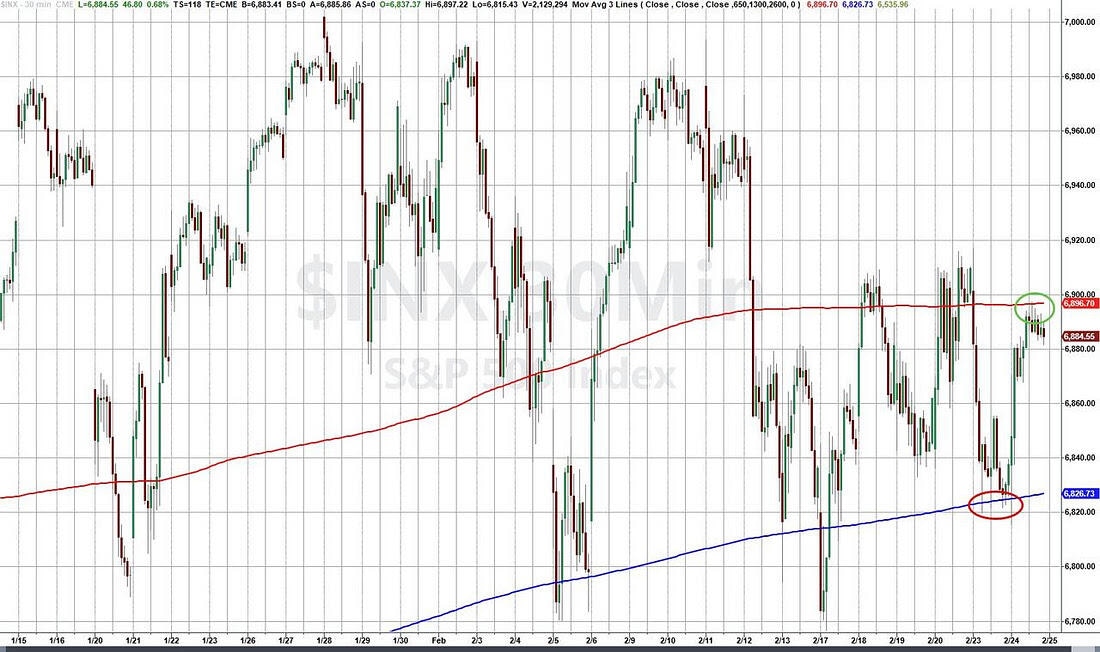
The index has gone nowhere since October. That is an eternity in modern market time. We are not in a bull sprint. We are in a valuation holding pattern complemented by very foggy crystal balls.
-1771983763102-1771983763103.jpg&w=1536&q=95)
Now the real catalyst looms. NVIDIA reports this week. In this tape, Nvidia is not just a company. It is a referendum. If it trounces expectations and guides with authority, AI morphs back into a productivity miracle rather than a profit destroyer. If it disappoints, the fear trade finds fresh oxygen and induces a case of wobbly vertigo. Investors are not looking for perfection. They are looking for clarity. In a market this concentrated, clarity is currency.
Overlay that with the State of the Union address, and you have a policy backdrop that can nudge sentiment in either direction. Markets do not trade on speeches. They trade on the fiscal arithmetic implied by those speeches.
The yen continues to soften as reports suggest Prime Minister Takaichi is pressing the Bank of Japan to slow further tightening. If April hikes get repriced from the 15 basis points currently embedded, yen selling accelerates. Monetary divergence remains the cleanest trade on the board. When policy resolves wobbles, currencies do not hesitate.
Oil, meanwhile, is trading diplomacy rather than deterrence. Prices slid as Washington and Tehran edged back toward negotiations in Geneva. An early spike in tough rhetoric gave way to cooler heads. Crude is not pricing war. It is pricing the probability of talks that prevent one. In energy markets, the absence of escalation is bearish.
Step back and connect the threads.
Technology rallied because extinction was downgraded to evolution. Macro held because the consumer has not folded. Bonds drifted because inflation and growth remain in tension. The yen weakened because policy pressure trumped tightening ambitions. Oil softened because diplomacy re-entered the chat.
This is not a market choosing euphoria. It is a market repricing tail risks. The AI apocalypse was a headline. The real story remains capital spending, earnings durability, and the cost of money.
And until the S&P decisively breaks out of the range it has inhabited since October, every rally will feel like a rehearsal rather than an opening night.
In this tape, panic travels faster than fundamentals. But fundamentals, in the end, usually get the last word.
Opinion
Goldman’s top tech trader, Pete Callahan, summed it up perfectly when he said this “doesn’t feel like an especially fun plus 1 percent NDX move” coming off a sell-everything session. That tells you everything about the tone. The bounce is happening, but nobody is high-fiving.
The support under today’s grind higher is less about improving fundamentals and more about the sheer weight of protection embedded in the system. Downside hedging is so pervasive that the S&P 500 almost needs a constant drip of fresh bad news to justify the premium investors are paying for it. When the headlines merely stabilize rather than deteriorate, the market floats. Not because the outlook brightens, but because the insurance bill starts to look expensive.
The index put skew is elevated. Single-name implied volatility across the AI complex remains rich. That means participants are heavily positioned for left-tail outcomes. Layer in systematic vol selling and heavy call overwriting, and you get the classic “Doomers (Hedgers & Skeptics) and Boomers(The Chasers)” structure Nomura’s Charlie McElligott describes. Institutions are loading up on crash protection while income strategies keep dealers saturated with overhead call side gamma. The result is a market with a built-in ceiling. Upside is sold. Downside is feared.
Dispersion remains high, and correlations are low enough that the index can look stable even while individual stocks feel broken. That dynamic prevents the kind of retail capitulation that usually marks durable lows. Prime broker data and institutional surveys show the pros have already lightened up. Retail has not fully thrown in the towel. That keeps the index pinned rather than purged.
The setup leaves the market in a curious position. It is structurally short on good news. If the flow of negative headlines slows even marginally, hedges decay( charm effect) , vanna flows turn supportive, and the squeeze risk rises. In that environment, the path of least resistance can flip higher simply because the protection expires worthless.
Still, the macro risk list remains long. Tariff uncertainty, private credit spillover fears, AI disruption anxiety, geopolitical tension. That cocktail justifies the skew. But if even two of those storms lose intensity, the relief rally can feed on itself.
Technically, the 6800 to 6900 zone continues to anchor the S&P. Below that lies the trap door of negative gamma where moves can accelerate. Above it sits a wall of positive gamma that encourages mean reversion and caps breakouts.
-1771983784935-1771983784936.jpg&w=1536&q=95)
For now, the index is oscillating inside that corridor, coiled between fear and frustration, waiting for either headlines or positioning to force the next decisive move
Conclusion
Based on my data analysis and the charts, the market is currently driven less by fresh fundamentals and more by self-reinforcing feedback loops, where positioning, hedging flows, and mechanical adjustments amplify the underlying price move rather than simply reacting to it.
A feedback loop in markets is a self-reinforcing cycle in which an initial move triggers behaviour that amplifies it.
In a positive feedback loop, rising prices create conditions that push prices even higher. For example, when stocks rally, short sellers cover, options dealers adjust hedges by buying futures, volatility falls, and risk models allow more exposure. That additional buying pressure fuels further gains, which in turn forces more buying. The move feeds on itself.
In a negative feedback loop, the opposite occurs. Falling prices trigger margin calls, stop losses, volatility spikes, and dealers hedge by selling more futures. That selling accelerates the decline, which then forces more defensive positioning. Again, the move reinforces itself.
In short, a feedback loop is when positioning and mechanics stop reacting to price and start driving it.
Author
Stephen Innes
SPI Asset Management
With more than 25 years of experience, Stephen has a deep-seated knowledge of G10 and Asian currency markets as well as precious metal and oil markets.