So much has happened in the last week, What's next?

It's been twelve long years since the last black swan event, most had forgotten they were possible.
We were as bearish the stock market as they come in early 2020 but were caught completely off guard by the events that have unfolded in the last two and a half weeks. The pace, the depth, and the emotional turmoil have been like nothing we have ever experienced. Nor do we ever wish to again. Nevertheless, the carnage in traditional investments (stocks and bonds), as well as commodities, have likely created extraordinary opportunities. Those who survive the month of March could face attractive bullish opportunities in commodities, stocks, and perhaps even currencies (other than the dollar) throughout the remainder of the year.
I'll never forget 2008, but I will also never forget the effects quantitative easing had on asset prices. Just as we have witnessed all assets trade as one (nearly everything was down today with the exception of the dollar)as the markets melted lower. In the aftermath of the Financial Crisis, all assets melted higher together. There were few exceptions. Markets such as corn and soybeans traded at prices farmers could only dream of. Oil moved from the mid-$30s back into the $100s. And stocks tripled in value.
I suspect once the dust settles, that will happen again. The US government is injecting an unfathomable amount of money into the economy and with interest rates at zero, that money will have to go somewhere. Assuming the COVID-19 crisis is curbed by the current quarantine, things could normalize surprisingly quickly.
Treasury Futures Markets
30-year Treasury Bond Futures
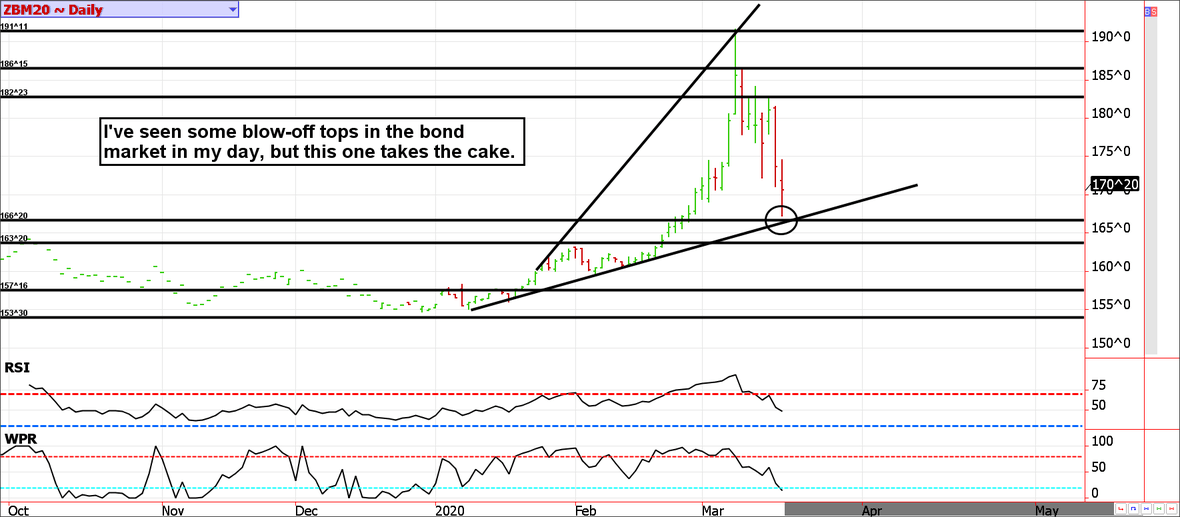
Suddenly a 1% yield in the 10-year note seems high.
Perspective is everything. A few weeks ago, a 1% yield on the 10-year Treasury note seemed laughably low. But in a world of collapsing asset prices and negative yields, it actually looks attractive. We aren't sure how we got here, nor how we will get back to some sort of normalcy, but once the latest round of "liquidating everything that has value" runs its course, Treasuries will probably grind higher.
We are looking for this decline to continue into the mid-to-low-160s in the ZB and the 133'0 area in Treasuries.
Treasury futures market consensus:
The good news about last week's stunning volatility is option spread traders will have attractive opportunities.
Technical Support: ZB: 166'20, 163'20, 157'16, and 153'30 ZN: 132'23, 130'29, and 128'0
Technical Resistance: ZB: 182'23, 186'15, 191'11 ZN: 136'23, 139'27, and 140'23.
Stock Index Futures
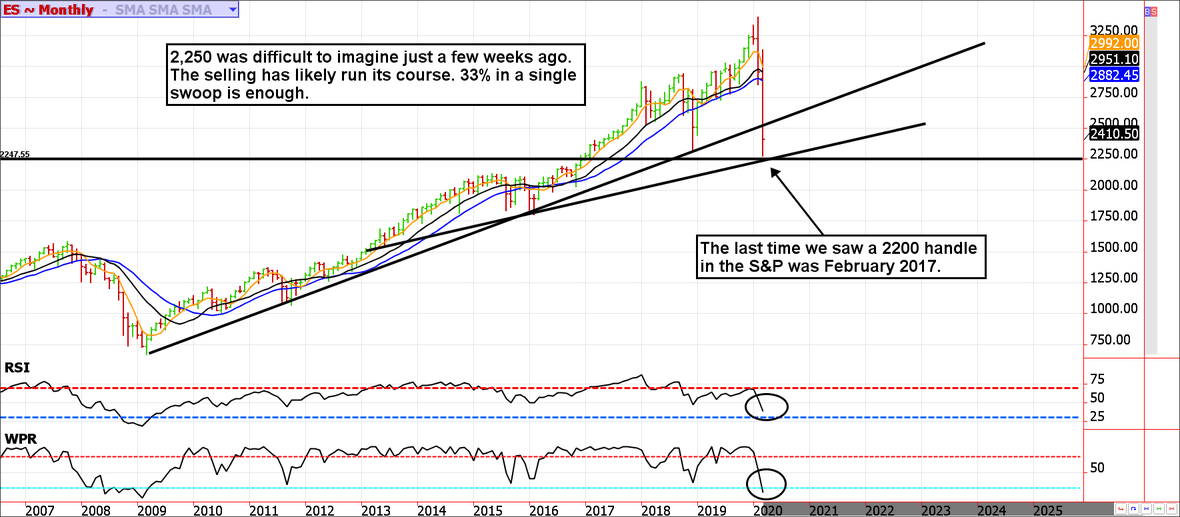
The SP500 shaved 33% off the top in about two weeks.
Today's low near 2260 in the June S&P 500 essentially erased all progress made from February 2017. That is an incredibly scary feat in the time frame. A quick look at the weekly chart above puts things into perspective. Each of the price bars represents a month of trading. The March, and February for that matter, not only engulf all other visible price bars but it engulfs years of price bars.
These are scary times making the financial crisis and flash crash experiences seem like child's play. I suspect the best trades are from the long side from here, but the environment calls for nibbles with hedges or simply outright call options. Anything beyond that is dangerous. If the 2200 area fails, the market could see 1800 in short order.
The world probably isn't ending, but it feels like it is. It felt similarly hopeless in March of 2009.
Stock index futures market consensus:
The market has melted through support levels thus far but it feels like the margin call selling is probably behind us. A few days of bounce? Yet, f the 2200 area fails, the market could see 1800 in short order.
Technical Support: 2250 and 1800
Technical Resistance:2764, 2897, and 3130
E-mini S&P Futures Day Trading Ideas
*These are counter-trend entry ideas, the more distant the level the more reliable but the less likely to get filled
ES Day Trade Sell Levels: 2450, 2550, 2697
ES Day Trade Buy Levels: 2250, 2190, and 2000
In other commodity futures and options markets...
January 3 - Go long mini natural gas futures near $2.10.
January 16 - Go long May corn, hedge the position by purchasing a May 3.70 puy and paying for it with the sale of a May 4.10 call.
February 25 - Sell June ZN 134 call and buy the April 136 call as insurance.
February 27 - Offset short corn 4.00 call and long 3.70 put to lock in moderate gain on those legs. Buy the April 3.60 put to keep a floor under risk.
March 2 - Roll BCI into June.
March 4 - Go short the September eurodollar near 99.37 and buy the 99.50 call option. Total risk is roughly $600 depending on fills (prior to transaction costs).
Due to time constraints and our fiduciary duty to put clients first, the charts provided in this newsletter may not reflect the current session data.
Seasonality is already factored into current prices, any references to such does not indicate future market action.
There is substantial risk of loss in trading futures and options.
** These recommendations are a solicitation for entering into derivatives transactions. All known news and events have already been factored into the price of the underlying derivatives discussed. From time to time persons affiliated with Zaner, or its associated companies, may have positions in recommended and other derivatives. Past performance is not indicative of future results. The information and data in this report were obtained from sources considered reliable. Their accuracy or completeness is not guaranteed. Any decision to purchase or sell as a result of the opinions expressed in this report will be the full responsibility of the person authorizing such transaction. Seasonal tendencies are a composite of some of the more consistent commodity futures seasonals that have occurred over the past 15 or more years. There are usually underlying, fundamental circumstances that occur annually that tend to cause the futures markets to react in similar directional manner during a certain calendar year. While seasonal trends may potentially impact supply and demand in certain commodities, seasonal aspects of supply and demand have been factored into futures & options market pricing. Even if a seasonal tendency occurs in the future, it may not result in a profitable transaction as fees and the timing of the entry and liquidation may impact on the results. No representation is being made that any account has in the past, or will in the future, achieve profits using these recommendations. No representation is being made that price patterns will recur in the future.
Author
Carley Garner
DeCarley Trading
Carley Garner is an experienced commodity broker with DeCarley Trading, a division of Zaner, in Las Vegas, Nevada. She is also the author of multiple books including, “Higher Probability Commodity Trading” and “A Trader's First Book on Commodities”.