Slowing UK wage growth points to spring rate cut


Bank of England officials – or some of them at least – remain concerned about inflation. The latest UK jobs report suggests those concerns are overblown.
Here's what the latest UK jobs report tells us: Unemployment stayed at 5.1%, though we had thought it might temporarily dip back. That’s up from 4.4% early last year. Private-sector payrolls fell another 55,000, a fairly chunky number, albeit one that might get revised up. Employment outside of government was down more than a percentage point in 2025. In (slightly) better news, the redundancy rate dipped in November; fears towards the end of last year that layoff notifications to the government had picked up also appear to have been short-lived.
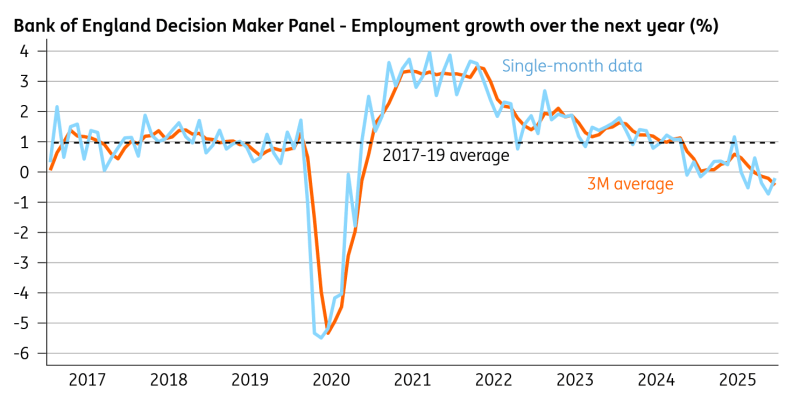
In short, the jobs market is still cooling – gradually. Weak hiring surveys suggest that’ll continue at least through the first few months of the year. And crucially for the Bank of England, this is finally showing through in wage growth.
BoE surveys suggest employment will keep falling
Source: Macrobond, ING
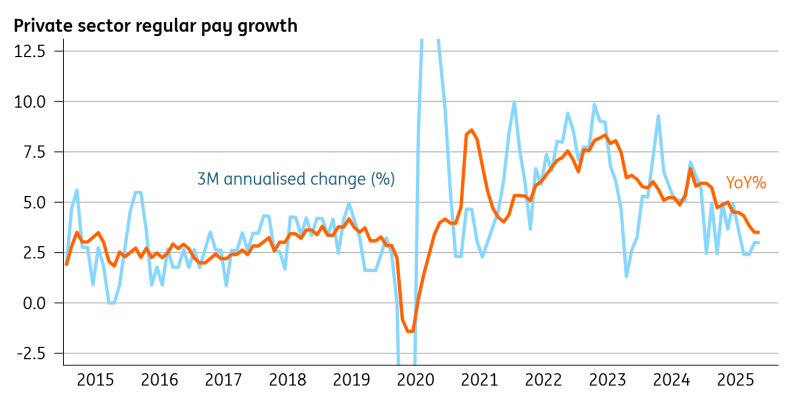
Private-sector pay is now growing at 3.6% on a year-on-year basis, a remarkable pull-back from 6% at the start of 2025. True, this is in line with the Bank’s recent projections. And for now, both BoE doves and hawks alike point to survey data, suggesting wage growth expectations for the next year have bottomed out around 3.5-4%. They worry this is as good as it gets for those official numbers.
Yet if we look at the three-month annualised growth rate in private pay – a better gauge of recent momentum – this has been running at 2.5-3% for a few months now. That’s below the average we saw through 2018/19 when UK interest rates were lower than 1%. It suggests the year-on-year wage growth numbers should fall closer to 3% over the coming months.
UK wage growth has slowed markedly
Source: Macrobond, ING
That said, we doubt this latest data will change the minds of many officials at the Bank of England ahead of its February meeting. Not least because tomorrow’s inflation data carries the risk of an upside surprise, depending on how air fares are measured in December. We expect rates to remain on hold next month.
By March, however, the Bank will have had a further two jobs reports and, assuming the current benign wage growth trends continue, we think it will have enough evidence to cut rates again. By June, we should have had inflation data showing headline CPI back at 2% or even below, which should spur one final cut that month, leaving Bank Rate at 3.25%.
Read the original analysis: Slowing UK wage growth points to spring rate cut
Author
ING Global Economics Team
ING Economic and Financial Analysis
From Trump to trade, FX to Brexit, ING’s global economists have it covered. Go to ING.com/THINK to stay a step ahead.

















