Silver’s strategic turn: Why the market can no longer treat it as a simple precious metal

Silver is no longer just a monetary hedge. It is becoming one of the most strategically important materials in the global economy.
The recent move above 54,00 $, followed by a controlled pullback toward 52,60 $, is not simply a technical fluctuation. It reflects the intersection of three powerful forces that are reshaping the role of silver: industrial demand, geopolitical competition and the transition to cleaner energy systems.
For years, the metal was overshadowed by gold. Today it is emerging as a structural cornerstone of technology, energy and supply chain resilience. That change is visible in the data, in the policy decisions of major economies and in the price action itself, which continues to show deeper underlying strength than short term volatility suggests.
Industrial demand is rewriting Silver’s identity
Silver’s industrial footprint has expanded dramatically. More than half of global consumption now comes from sectors that have nothing to do with safe haven flows or jewelry.
These include solar panel manufacturing, high efficiency conductors, precision electronics, electric vehicle components, medical equipment and emerging battery chemistries that rely on silver based coatings.
The solar industry alone creates a constant and resilient baseline of demand. Even during macro slowdowns, photovoltaic deployment has shown little sensitivity to short term economic cycles. China, Europe and the United States continue to install new capacity at a pace that has systematically exceeded forecasts.
The result is that industrial buyers form a stable demand floor that did not exist ten years ago.
At the same time, mining supply has not kept pace. Grade depletion, regulatory hurdles and higher extraction costs have produced a multiyear environment in which global silver production grows slowly while industrial needs expand. This structural imbalance is subtle but persistent, and it helps explain why the metal behaves differently from classical precious metals during periods of economic uncertainty.
Geopolitical competition supports a new premium
The global environment has shifted toward strategic stockpiling and supply chain defense.
Silver is part of that logic. Governments and large corporations increasingly view it as a material that cannot be easily substituted or replaced by alternative inputs. The United States and Europe have recently expanded their lists of “strategic minerals” and although silver is not officially categorized alongside rare earths or lithium, procurement policies increasingly treat it with similar caution.
Tensions between major economies accelerate this trend.
China dominates the refining of numerous industrial metals, and although it does not control silver in the same way, its leadership in solar manufacturing and electronics indirectly shapes global flows. The United States and its allies respond with incentives for domestic production, cleaner manufacturing lines and diversification toward other suppliers.
This geopolitical chessboard creates a scarcity premium that has nothing to do with short term market sentiment. It is not speculative enthusiasm but strategic positioning, and it tends to persist even when risk appetite fluctuates.
The clean energy transition creates structural demand elasticity
The shift toward decarbonisation is intensifying silver’s relevance.
Next generation solar cells require higher silver loadings to improve conductivity and efficiency. The expansion of data centers and artificial intelligence infrastructure adds further pressure, since server farms require high efficiency components to reduce electrical losses.
Electric vehicles also rely on silver for power control modules, charging systems and safety electronics.
These applications do not respond quickly to price movements. Whether silver costs 40 000 $, 50 000 $ or 60 000 $, manufacturing demand does not collapse, because the metal’s contribution to the final product cost is small relative to its functional necessity.
This is what makes silver different from other commodities that are highly cyclical. Its demand is becoming more technology linked, less economically sensitive and more structural.
Investor flows shift from Gold only to Gold plus Silver
For two decades, institutional investors treated gold as the sole monetary hedge. Silver was perceived as too volatile and too industrial to serve the same purpose.
That perception is changing.
When the monetary environment becomes uncertain, diversification within the precious metals space becomes more attractive. Central banks still buy gold, but private funds diversify into silver because its return profile increasingly blends inflation protection with exposure to technological growth.
This dual identity gives silver unique appeal.
It acts like gold during episodes of global stress, but it behaves like a growth material when industrial activity strengthens. Few assets combine these traits.
Macro stress reinforces Silver’s strategic value
The global macro landscape remains uneven.
Growth forecasts have softened in several regions and policymakers continue to send mixed signals on the direction of monetary policy. Real yields have eased, but they remain high enough to test traditional correlations between bonds and precious metals.
Silver, however, continues to show resilience because its value is not solely tied to monetary expectations.
When investors worry about supply chain fragility or geopolitical fragmentation, silver becomes relevant for reasons that gold alone cannot capture.
That is why the metal held firm even when yields drifted higher earlier this autumn, and why dips continue to draw interest from long term buyers.
Technical structure confirms deeper accumulation
The Renko chart of XAGUSD highlights the process underway.
Silver reached a high of 54,38 $ on 13 November and has since retraced toward 52,60 $, a level that aligns with the lower boundary of the recent consolidation area.
The reaction around 52,35 $ shows the presence of responsive demand, with several bricks printing near that zone before buyers attempted to rebuild structure.
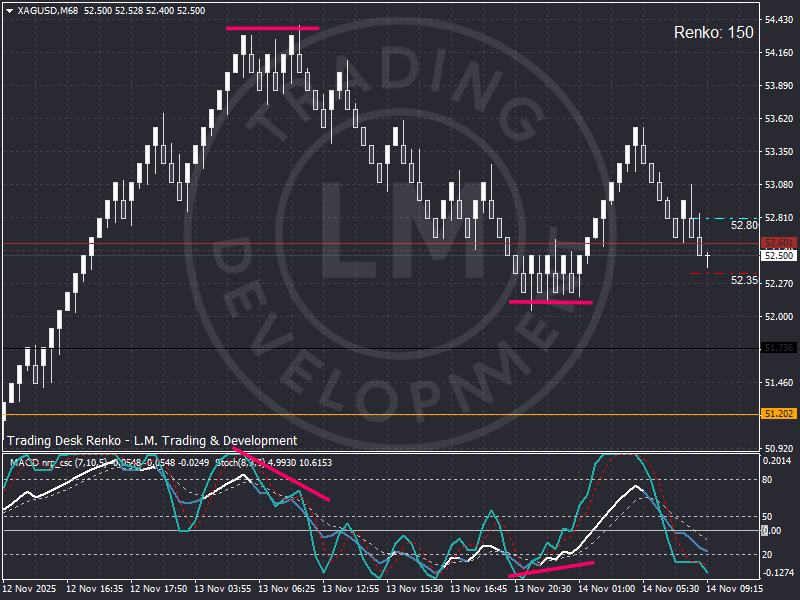
The divergence on the momentum oscillator at the highs warned of a short term correction, but the price action remains orderly and lacks the characteristics of distribution.
As long as silver holds above 51,70 $ and continues to form higher floors on the Renko sequence, the broader trend remains constructive.
The key resistance remains the 53,00 to 53,20 $ zone. A close above that area would re open the path toward the 54,00 to 55,00 $ region, where the next liquidity pockets reside.
In other words, the price action does not contradict the macro narrative. It reinforces it.
Why Silver is now a strategic metal
The transformation of silver’s role can be summarised in three structural pillars.
First: industrial users treat it as essential for technology and energy systems.
Second: geopolitical fragmentation elevates its importance in supply chain planning.
Third: investors increasingly recognise that silver combines monetary characteristics with industrial momentum.
The result is a material that no longer fits neatly into traditional categories.
It is not merely a precious metal, not merely an industrial input and not merely a defensive asset. It is a strategic commodity that sits at the intersection of energy policy, technological innovation and global macro dynamics.
This is why price reactions appear more disciplined than in past cycles. And it is why the current consolidation should be interpreted as part of a broader structural phase rather than a sign of exhaustion.
Conclusion
Silver’s evolution from secondary precious metal to strategic asset is underway and accelerating.
The combination of industrial demand, geopolitical realignment and technological transformation creates a foundation that is far stronger than traditional safe haven logic.
Short term fluctuations will continue, especially around major macro events, but the underlying forces point to an asset that is moving into a new era.
In this landscape, pullbacks like the one seen after the 54,38 $ high represent opportunities for accumulation rather than signals of instability.
For markets searching for tangible anchors in an uncertain world, silver is emerging as one of the most compelling candidates.
Author

Luca Mattei
LM Trading & Development
Luca Mattei is a market analyst focusing on FX, metals, and macroeconomic trends. He develops trading tools for retail and professional traders, coding indicators and EAs for MT4/MT5 and strategies in Pine Script for TradingView.














