Silver supply ordered today arrives in 2032

This month Pan American began digging a tunnel down from one of its silver mines toward rock that holds only about one eighth as much silver per tonne.
That sounds like a bad trade until you see the tonnage. The deposit underneath carries roughly twenty-eight times the rock, and getting at it is what the next six years of work and $1.9 billion of initial capital are for. The company completed the first cut of a tunnel in early August. The first meaningful metal arrives in 2032. If you want a single, dated answer to the question of how quickly high silver prices can pull new supply out of the ground, this is it: six years to first metal, eight to full rate.
Silver closed Monday at $68.80 against gold at $4,645.74, a gold-silver ratio of 67.5. The metal has run about 9% higher since last Wednesday, after the Treasury said it would at least double its buybacks of long-dated government debt and long-end yields fell back. That still leaves silver about 43% below the intraday high it set on January 29. Prices at this level are supposed to be the signal that brings new mines into production. What follows is what that signal actually buys. Golden Meadow® publishes the longer-form work this article draws on, and how silver has traded through this cycle sets the backdrop.
The mine that breaks ground in 2026 and delivers in 2032
Pan American Silver reported second-quarter results on August 12 and confirmed that it had completed the first cut of the 588 Decline at La Colorada in Zacatecas, Mexico in early August, with development of the decline commencing that month. A decline is a tunnel driven downward from an existing level of a mine to reach ore beneath it, in this case from the 588 metre level of a mine that has been running for years. The company spent $20 million of project capital in the first half, mostly on drilling, engineering and preparing for that tunnel.
The revised preliminary economic assessment puts dates against that work. One qualification travels with every date in it: an assessment of this type is an early-stage study rather than a construction decision, and Pan American states that it includes inferred mineral resources considered too speculative geologically to be categorised as reserves, and that there is no certainty it will be realised. These are modelled dates, and modelled dates slip.
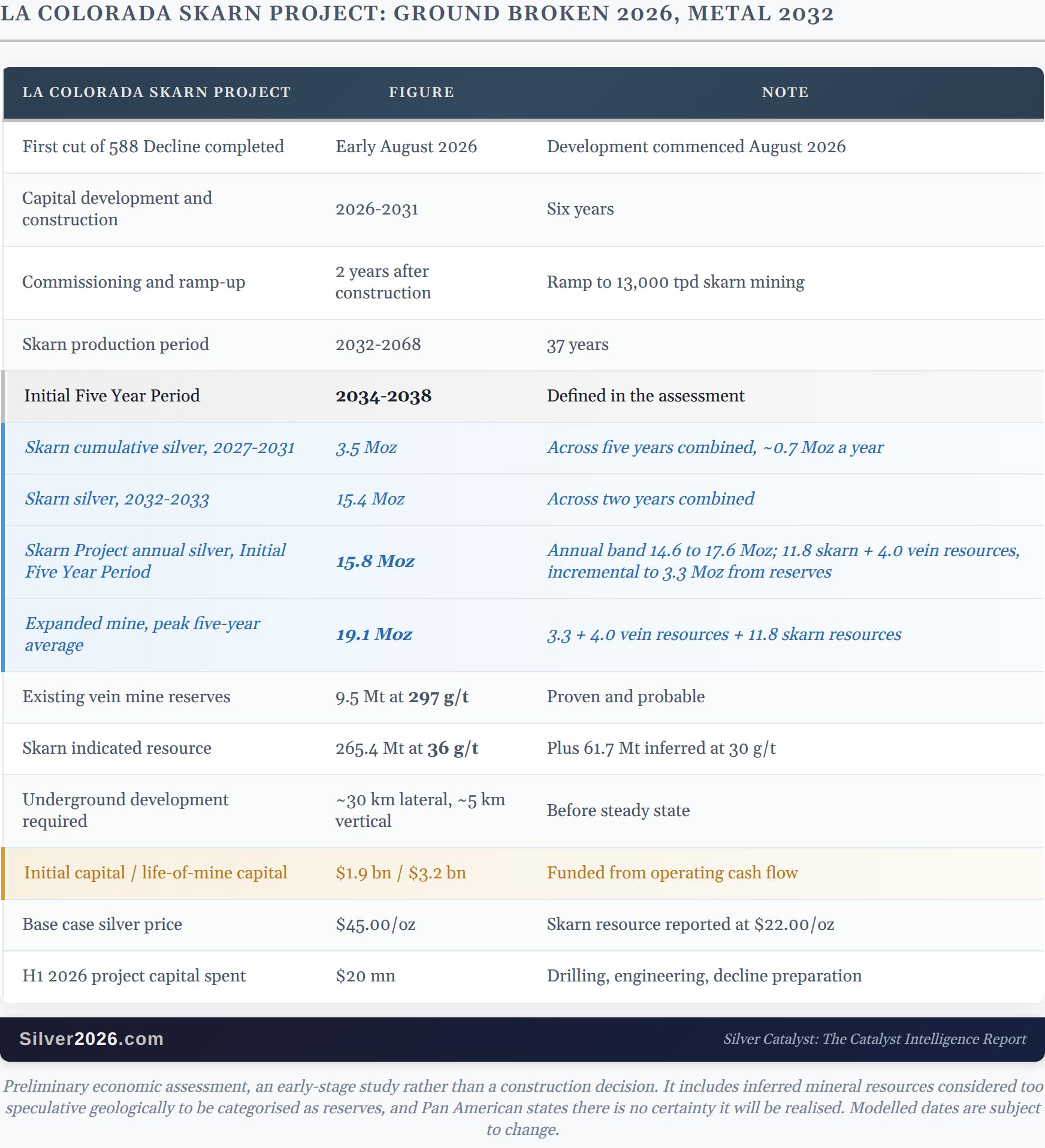
With that said, here is the schedule. Capital development and construction run from 2026 to 2031, six years, followed by a two-year commissioning and ramp-up. Skarn production runs from 2032 to 2068. The Initial Five Year Period, the window in which the project delivers its headline rate, is defined in the assessment as 2034 to 2038. The production schedule shows the skarn contributing 3.5 million ounces cumulatively across the whole of 2027 to 2031, roughly 0.7 million ounces a year, then 15.4 million ounces across 2032 and 2033 together, before reaching a 14.6 to 17.6 million ounce annual band from 2034. Those five years average 15.8 million ounces, which is where the project's headline rate comes from.
Why it takes that long is in the rock. The existing vein mine holds proven and probable reserves of 9.5 million tonnes at 297 grams of silver per tonne. The skarn beneath it holds an indicated resource of 265.4 million tonnes at 36 grams per tonne, plus 61.7 million tonnes inferred. On the indicated resource alone, the new deposit carries roughly an eighth of the grade and roughly twenty-eight times the tonnage, and that trade is what the schedule is paying for: approximately 30 kilometres of lateral and 5 kilometres of vertical development, a new 15,000 tonne per day plant, two shafts sunk to about 1,480 and 1,400 metres, $1.9 billion of initial capital and $3.2 billion over the life of the mine.
Three features make this a clean test of how fast the industry can move rather than an unlucky case. The project sits on an operating mine with existing infrastructure and workforce. No additional permitting is required for the 588 level ramp decline, though permits for the shafts, plant and tailings expansion have still to be submitted. And Pan American expects to fund it entirely from the cash flow of its operating mines, having generated $344 million of attributable free cash flow in the quarter. No financing gap, no permitting gap for the first step, no discovery risk. On starting conditions this favourable, ground broken in August 2026 yields its first meaningful metal in 2032 and its steady-state rate in 2034.
One number in the release needs care, because two different figures circulate and both are correct. The highlights section states annual average silver production of 15.8 million ounces from the La Colorada Skarn Project over the Initial Five Year Period, incremental to 3.3 million ounces from the existing mine's reserves. The production metrics table underneath splits the same total differently, showing 11.8 million ounces from skarn mineral resources and 4.0 million ounces from vein mineral resources, because the project as an economic entity includes newly identified vein material alongside the skarn itself. Both add to the same place: 3.3 plus 4.0 plus 11.8 gives the 19.1 million ounces the company quotes for the expanded mine at its peak.
There is a pricing detail worth carrying too. The base case economics assume $45.00 an ounce for silver, while the skarn mineral resource itself was reported at $22.00 an ounce and the vein mine at $24.00. Silver closed Monday at $68.80. A company sizing a $3.2 billion programme built its base case on a price about 35% below where silver trades now, which says more about how the industry plans than any forecast does.
Sources: Pan American: Revised PEA for the La Colorada Skarn Project | Pan American: Q2 2026 Financial Results | SEC: Pan American Q2 2026 Form 6-K
What this means to silver investors
The verdict is bad for anyone waiting on new supply, and that is the whole point. This is a resource of real scale, owned by a company with the balance sheet to build it, and it contributes 3.5 million ounces cumulatively across the whole of 2027 to 2031, roughly 0.7 million ounces a year, before anything meaningful arrives in 2032. On a six to eight year lag under favourable conditions, the new-mine supply response to today's price does not arrive until the 2030s.
That is a claim about mines, not about total supply, and the distinction is the obvious counterargument to everything above. Scrap responds inside a year, which is why recycling carries as much weight in Silver Rising as mine supply does. Metals Focus and the Silver Institute forecast recycling rising from 197.6 million ounces in 2025 to 211.3 million ounces this year, an increase of 13.7 million ounces, and that is the channel through which high prices elicit metal on a short cycle. What it cannot do at that scale is close the 46.3 million ounce deficit the same organisations forecast for 2026, which would be the sixth consecutive year of shortfall, five of them complete and this one a forecast.
So the honest reading is split. Over the next few years, a market that cannot answer price with new mine supply is a market where the deficit persists, and that supports the longer-term case for the metal. Over the same period, nothing about this project changes the balance at all. For a long-term holder the mine timeline is the argument, and it is an argument that pays out in the 2030s rather than this cycle. Anyone expecting high prices to fix the shortage inside this decade is expecting something faster than this project delivers, and this project has fewer obstacles in front of it than most.
Want free follow-ups to the above article and details not available to 99%+ investors? Sign up to our free newsletter today!
Author

Przemyslaw Radomski, CFA
Gold Price Forecast
Przemyslaw Radomski, CFA (PR) is a precious metals investor and analyst who takes advantage of the emotionality on the markets, and invites you to do the same. His company, Sunshine Profits, publishes analytical software that any
















